Showing posts with label dessert. Show all posts

Friday, January 4, 2013

RECIPE - Homestyle Squash Compote (Doce de Abóbora Caseiro)

When you think of squashes, what comes to mind first - main course or dessert? We'd bet that for the majority of our readers, squash brings to mind something that's served with the main course - to accompany meat or chicken, for example. Many might even say that squash has nothing to do with desserts. It's only when they are reminded that traditional Thanksgiving and Christmas feasts often feature pumpkin pie for dessert, and that pumpkin is merely one of many kinds of squash, that they might concede that squash and sugar go together.

Some squashes are quite sweet in and of themselves, of course, but combining members of the squash family with sugar, honey or coconut milk is an old culinary tradition in Brazil, and for many Brazilians, abóbora (Portuguese for squash or pumpkin) is something seen more often on the dessert table or buffet than it is as a vegetable side dish.

Throughout Brazil, one of the oldest, most traditional (and easiest) ways to turn squash or pumpkin into a dessert is to cook it down to a thick puree, spice it with cinnamon and clove, then sweeten it with sugar and a splash of coconut milk. This recipe is so basic that Brazilians simple call it Doce de Abóbora, which means Squash Dessert or Squash Sweet. It's served at weekday family meals, and it's served on fancy dessert tables. It's popular with all economic classes in Brazil, as squashes are generally very cheap in Brazil, and it doesn't require expensive ingredients.

This recipe can be made with any type of winter squash - Hubbard, Butternut, Acorn, etc. It can also be made with pumpkin. Summer squashes (e.g. zucchini, pattypan) are not suitable as they contain too much water. It can be served warm or cold (though cold is more typically Brazilian). If you wish to make it a bit richer, pour a couple of tablespoons of coconut milk over the squash once you've put it into individual serving dishes.
_________________________________________________________
RECIPE - Homestyle Squash Compote (Doce de Abóbora Caseiro)
Serves 6

2 lbs (1 kg) winter squash, any type, peeled and cored, cut into 1 inch cubes
1/4 cup coconut milk
3 cups granulated white sugar (more or less, to taste)
2 small sticks cinnamon
4 cloves
-----------------------------------------------------------------------------
Put the squash into a large heavy saucepan,. Add a very small quantity of water (less than half a cup). Add the sugar and stir to mix. Heat the mixture over low heat, stirring constantly, until the sugar dissolves. When the sugar has dissolved, add the cinnamon and cloves, and continue to cook, mixing and stirring constantly with a wooden spoon. Continue to cook until the cubes of squash have become very tender.

When the squash is tender, using the same wooden spoon, begin to mash the cubes against the sides of the pan while continuing to cook over low heat. When all the squash is mashed and the mixture begins to pull away from the bottom and the sides of the pan, add the coconut milk and mix it in.

Cook for an additional two or three minutes only, stirring constantly. Remove from heat and let cool. Can be served slightly warm, at room temperature, or chilled. Divide the mixture between six dessert dishes, and pour additional coconut milk over the puree if desired.

Wednesday, November 14, 2012

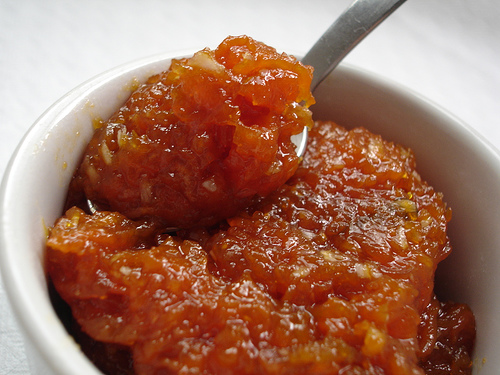
RECIPE - Jambo Compote (Compota de Jambo)

One of the very simplest, and most delicious, ways to handle fruit that you don't want to or can't eat fresh is to turn it into a compote. A compote is nothing more than pure fruit and sugar, cooked down until the fruit is softened and the sugar is dissolved. Done.

In the past, in the days before refrigeration, compotes were an important method of preserving fruit and they allowed the harvest surfeit to be enjoyed long past the season. Today, compotes are eaten mostly because they're delicious, but their preservative powers shouldn't be neglected. When a seasonal fruit is at it's peak of ripeness and flavor turning it into a compote locks in that flavor, allowing you to enjoy it when that fruit isn't in season.

Compotes, unlike jams and jellies, aren't made for canning. They can be kept for a few weeks in the refrigerator and can be frozen for up to several months. The fact that you don't have to deal with sterilizing jars, rings and lids makes them much less of a task than jams or jellies.

Compotes can be served as is as a dessert or breakfast dish. They also make wonderful toppings for ice cream, turning a good-quality vanilla ice cream into a marvelous sunday.

This traditional Brazilian recipe for jambo compote is a good guide to making compotes. It can be adapted to almost any other kind of fruit - just remember that you can not eliminate the sugar, nor even reduce it very much. It's the sugar that acts as a preservative.
________________________________________________
RECIPE - Jambo Compote (Compota de Jambo)

4 cups chopped, seeded jambo (do not peel)
3 cups granulated white sugar
-------------------------------------------------------------------------
Combine the fruit and sugar in a large saucepan and heat over low heat, stirring frequently, until the sugar dissolves. Increase the heat and cook, stirring constantly, until the mixture thickens and the fruit has completely softened.

Remove from heat and let cool completely. Store in refrigerator until ready to use, or freeze for up to several months.

Friday, October 26, 2012

RECIPE - Brigadeiro Cake (Bolo Brigadeiro)

Give the depth and intensity of the Brazilian obsession with the small fudge-like ball of chocolate called brigadeiro, it's no surprise that the essential ingredients of a brigadeiro - chocolate, sweetened condenses milk, chocolate sprinkles - show up in other dessert treatments. Think of them as tributes to the glories of the original brigadeiro. Some of these treatments are relatively straightforward reimaginings while others are high-concept flights of fancy.

One popular way to recreate the brigadeiro is to turn it into a rich, moist chocolate cake. The cake part is usually some sort of standard chocolate cake, the brigadeiro part being found in the frosting. The recipe below, which was created by Brazilian chef Raphael Despirite and is featured on the website of Brazilian food and wine magazine Prazeres da Mesa, is just such a creation - a chocolate sponge-cake with a brigadeiro topping. The resulting dessert is rich and moist, and since a small slice goes a long way is perfect for a fairly large crowd.

NB. This recipe calls for creme de leite, a thickened, unsweetened cream that is a staple in all Brazilian kitchens. You can find creme de leite, UHT-treated or canned, in Brazilian groceries in cities that have a Brazilian immigrant community. Alternatively it is sold in almost all Latin American markets under the Spanish name media crema and the English name table cream, most often manufactured by Nestlé. It is also available online from numerous sources, including Amazon.com.
__________________________________________________

RECIPE - Brigadeiro Cake (Bolo Brigadeiro)
Makes 1 8-inch cake

For the sponge cake:
6 large whole eggs, free-range preferred
3/4 cup all-purpose flour
2/3 cup granulated white sugar
6 Tbsp unsweetened dry cocoa powder
1 tsp vanilla essence
3 Tbsp unsalted butter, melted and cooled

For the topping:
1 1/3 cup sweetened condensed milk
1 Tbsp unsalted butter, softened
4 Tbsp unsweetened dry cocoa powder
2/3 cup creme de leite (see note above)
chocolate sprinkles
-------------------------------------------------------------------------------
Make the sponge cake:
 Preheat the oven to 400F (200C). Beat the eggs, vanilla and sugar together with a cake-mixer for 10 minutes, or until the mixture is light and fluffy. Fold in the flour and cocoa powder, taking care not to overmix. Pour the batter into an 8-inch springform cake pan, ungreased, and bake for 20 minutes in the preheated oven, or until a toothpick inserted into the center comes out clean. Let cool completely.

Make the topping:
Combine the sweetened condensed milk, the butter and cocoa powder in a double-boiler and heat, stirring constantly, until you have a thickened, consistent mixture. Remove from the heat, then stir in the creme de leite. Let cool.

Frost and decorate the cake:
When the cake and the frosting are cool, spread the frosting on the top of the cake, then cover the frosting with chocolate sprinkles. Remove the sides of the springform pan to expose the sponge cake. Leave the cake resting on the bottom of the pan and place it on a decorative serving platter for cutting into slices and serving.


Tuesday, September 25, 2012

RECIPE - Cartola Nordestina

We're wrapping up our trip of recipes from the Brazilian state of Paraíba with a dessert that's not only typical of the state that is the birthplace and home of Flavors of Brazil honoree,  Chico César, but of neighboring states in Brazil's northeast as well.

Back in February of 2011, we published another recipe for Cartola - a recipe one that is popular all over Brazil. What makes this version specifically northeast is the addition of powdered cocoa, which adds an additional flavor to the traditional recipe, and the specification of queijo coalho, a non-salty, feta-like cheese from the northeast.
____________________________________________________
RECIPE - Cartola Nordestina
Serves 2

3 Tbsp unsalted butter
1 Tbsp granulated white sugar
4 ripe, but not over-ripe bananas, peeled and halved lengthwise
1 Tbsp granulated sugar
1 Tbsp powdered cocoa
1/3 cup, dry white cheese, grated on box grater, largest holes
powdered cinnamon to taste
---------------------------------------------------------------------------------
Mix together 1 Tbsp granulated sugar and 1 Tbsp powdered cocoa. Reserve.

In a large frying pan, melt the butter. When hot, add the 1 Tbsp sugar, stir, then fry the bananas on both sides until they are softened and beginning to brown. Remove from heat.

Put half of the fried bananas on each of two plates.  Sprinkle half the sugar/cocoa mixture evenly over the surface of the bananas, then cover with the grated cheese and sprinkle again with the remaining half of the sugar/cocoa mixture. Dust lightly with powdered cinnamon to taste.

Serve immediately, while the bananas are still hot. You can put a ball of vanilla ice cream on top of the bananas if you wish.

Wednesday, September 12, 2012

RECIPE - Café au Lait Pots-de-creme (Potinho cremoso café com leite)

This astonishingly contemporary recipe is the last one in Flavors of Brazil's trilogy of 19th century recipes from Fazenda Capoava Ranch and Hotel in the state of São Paulo. Like our two previous recipes from the hotel's restaurant, this simple and elegant dessert was adapted from the original hand-written recipes found in the hotel's archives by Heloísa Bacellar, a reknowned chef from São Paulo (the city).

____________________________________________________
RECIPE - Café au Lait Pots-de-creme (Potinho cremoso café com leite)
makes 6

4 large whole eggs, preferably free-range
1 cup brewed coffe, strong, preferably dark roast
2 cups whole milk
2 cups granulated white sugar
1/4 cup water
1/2 tsp vanilla essence
coffee beans (optional), for decoration
-----------------------------------------------------------------------------
Preheat oven to 325F (160C).

Have ready 6 ovenproof ramekins or custard cups. Put 1 cup of the sugar in a small saucepan, add the 1/4 cup water and heat over medium heat, stirring constantly, until you have a medium brown caramel. (Click here for a demonstration how to make caramel). Using caution because of the high temperature of the caramel, immediately pour 1/6 of the caramel into the bottom of each ramekin. Reserve the ramekins, letting the caramel cool.

Prepare a bain-marie by having 4 cups (1 liter) of water at the boiling point. Carefully position the 6 ramekins in a large roasting pan or lasagne dish.

Over a medium mixing bowl, pass the eggs through a sieve into the bowl. Add the coffee, milk and the other cup of sugar. Mix well with a spoon, then beat with a whisk or eggbeater until you have a frothy, like mixture. Pour the mixture into the 6 ramekins in the roasting pan.

Carefully place the roasting pan in the preheated oven, then pour the boiling water into the pan to create the bain-marie. Cook for 35 minutes or until the tops are golden and a toothpick inserted into the middle of a custard comes out clean. Remove from the oven, and let cool completely on a wire rack. When completely cool, refrigerate for at least six hours.

Serve the ramekins cold. If desired, decorate the surface of the custards with one or two coffee beans.


Sunday, August 26, 2012

RECIPE - Apple Coffee Cake (Cuca de Maçã)

This recipe for a crumble-topped, apple-flavored cake is probably not all that different from the one that readers of Flavors of Brazil have in their cooking repertoire, but it is an authentically Brazilian one - one that highlights the German contribution to the cake known in Brazil as cuca.

Cucas are customer favorites in the many Teutonic-style coffee shops in the mountainous regions of Southern Brazil. Apples are extensively cultivated in these regions, so flavoring the cake with spiced apples makes good culinary sense. It also makes for a delicious cake.
_____________________________________________________
RECIPE - Apple Coffee Cake (Cuca de Maçã)

cake mix:
3 cups all-purpose flour
2 cups granulated sugar
4 Tbsp unsalted butter
4 whole eggs, separated
1/2 cup whole milk
1 Tbsp baking powder
3 ripe cooking apples

crumbled topping:
6 Tbsp all-purpose flour
1/2 cup granulated sugar
4 Tbsp unsalted butter, chilled and cubed
1 tsp powdered cinnamon
fresh lemon juice
-----------------------------------------------------------------------------
Prepare the topping:
Combine all the ingredients in a mixing bowl, then using a pastry blender or two knives, mix everything together, cutting up the cubes of butter and distributing them through the mixture. Reserve in the refrigerator.

Prepare the cake mix:
Core and peel the apples, then cut them into thin slices. Sprinkle with lemon juice to prevent browning. Reserve.

Beat the egg whites to the soft peak stage. Reserve.

Combine the egg yolks, sugar and butter, then beat with a hand or electric mixture until you have a homogenous, creamy mixture. Beat in the milk, then the flour in 1/2 cup batches. Mix in the baking powder, then fold in the egg whites, being careful not to overmix.

Pour the batter into a 12 inch round cake pan, greased with butter and dusted with flour. Top with the apple slices, coving the entire surface of the batter. Finally, sprinkle the pre-mixed topping mixture over the surface, covering it completely.

Bake in a preheated 350F (180C) oven for 35-40 minutes, or until the topping is golden and a toothpick inserted into the cake comes out clean. Remove from the oven, cool in the pan on a wire rack.

Friday, August 17, 2012

The Brazilianization of a German Cake - Kuchen into Cuca

The Portuguese word cuca (at least the culinary meaning of the word) is a direct derivation from the German word kuchen, meaning cake. The word is much used in the southern states of Brazil, where large numbers of German immigrants settled in the late 19th and early 20th centuries, and where German culture flourishes to this day. Among the most transportable of cultural elements, food traditions and recipes from Germany can be easily found in Paraná, Santa Catarina and Rio Grande do Sul, the three states that constitute Brazil's southern region.

Cuca in Portuguese does not refer to all cakes - there's another word, bolo, to serve that purpose. A cuca is a specific kind of cake - the cake that North Americans call a coffee cake. Often containing fresh or preserved fruits, or alternatively, spices like cinnamon, ginger and cloves, cucas are not frosted. Instead they are topped by a crumbly mixture of flour, sugar and butter.

Cucas are most often flavored with apples and bananas, two fruits that grow particularly well in the climate of southern Brazil, though recipes for cuca exist that call for many other types of fruits - particularly fruits of the temperate zone, within which the south of Brazil lies.

Brazilians eat cuca as part of a breakfast buffet, or as a mid-morning or late-afternoon pick-me up with coffee. It's less likely to show up as a dessert, though that's not unheard of. For the millions of Brazilians who don't live in the south, a cuca is an entirely Brazilian conception and few of them would be able to spot its German origins. In areas where temperate zone fruits can't survive, apples or cherries are likely to be replaced by mangoes or cajus, making the treat more Brazilian and less German. But at heart, a cuca is still the same homey cake that is was in its European homeland, back it's still called a kuchen. In Germany a warm kuchen served with coffee at the kitchen table is a symbol of gemütlichkeit, in the USA or Canada a coffee cake served the same way symbolizes coziness, and in Brazil, a slice of cuca means aconchego. Whatever you call it, it still symbolizes the human warmth of the family kitchen and it still tastes just as great.

Monday, July 2, 2012

RECIPE - Rice Pudding with Caramel and Fleur du Sel (Arroz Doce ao Caramelo com Flor de Sal)

Lucas Corazza
Yesterday's recipe for Brazilian rice pudding was the homemade original - today's is the downtown, day-after-tomorrow chef's showcase recipe. It is the creation of São Paulo chef/patissier Lucas Corazza, chef-in-command of the kitchen at the city's Bar.bar Gastronomia. In an article in May's issue of Brazilian food and wine magazine Prazeres da Mesa, Corazza advocates for the inclusion of rice as a legitimate ingredient in the sweet kitchen, and explains how he finds the grain useful in the creation of new pastries, desserts and sweets.

His recipe for rice pudding combines a fairly standard rice pudding preparation with a refined salty-sweet topping of cream-caramel and fleur du sel. Best served in a tumbler, or even better, a stemless wine glass this sophisticated dessert dresses up sometimes-dull rice pudding for a night on the town, São Paulo-style.
__________________________________________________
RECIPE - Rice Pudding with Caramel and Fleur du Sel (Arroz Doce ao Caramelo com Flor de Sal)
Serves 10

For the rice pudding:
4 cups water
2 cups long-grain white rice
2 cups whole milk
2 cans sweetened condensed milk
2 vanilla beans
powdered cinnamon to taste

For the topping:
1 cup creme de leite (see note above)
1 1/4 cup granulated white sugar
2 tsp fleur du sel

----------------------------------------------------------------------------
Rice pudding:
Combine the rice, the water, the vanilla beans, opened with seeds scraped out, and the whole milk in a pressure cooker. Seal the pressure cooker, heat over medium high heat and cook for six minutes from the time the cooker takes pressure. Remove from heat, let cool to release pressure, then pour the mixture into a mixing bowl.

Stir in the sweetened condensed milk, the cover the mixture with plastic film and refrigerate.

Caramel:
Heat the creme de leite over low heat, but do not let it boil. Put half of the sugar into a heavy saucepan and heat over medium-high heat until it caramelizes. Remove from heat and immediately stir in the creme de leite very slowly, stirring all the while, until you have a homogenous mixture. Return the pan to the heat and bring it briefly to the boil. Remove from heat, stir in the fleur du sel, let cool to room temperature and reserve.

Mounting the dish:
Using cups or glasses as above, fill them half full with the chilled rice pudding. With a spoon, carefully pour a layer of caramel on top, then serve immediately.

Friday, June 15, 2012

RECIPE - Lime Mousse (Mousse de Limão)

It really wouldn't be fair to end a series of posts about Brazil's fabulous spectrum of limes and lemons without posting a few recipes employing these versatile and universally-loved citrus fruits. So here comes the first one.

Probably Brazil's favorite lime dessert, and certainly one of the very easiest to make is called mousse de limão in Portuguese, which you can translate as lime mousse. All that you need to do is squeeze some fresh limes, zest their peel, add a couple of cans of milk products, blend it all in a blender and chill it. Done! The result is cool, creamy and zingy with lime flavor and there can't be many people that wouldn't like it. In Brazil you can buy this type of lime mousse in bakeries, sweet shops and supermarkets, but really, it's so easy to make at home that there's really no reason to do so.

The recipe calls for sweetened condensed milk and another processed milk product that is called creme de leite in Brazil. In Spanish speaking Latin America the product is known as media crema, and it can be found under that name in Latin American grocery stores throughout North America. The best-known brand, in Brazil and elsewhere is Nestle, and in cans that are sold in the USA and Canada the produce is labeled table cream as well as media crema. It's available online as well from any number of vendors of Mexican foodstuffs. You can even buy it on amazon.com though there you'll have to buy a case of 24.

This recipe can be made either with Persian limes or Key limes, though if you are using small Key limes, you should double the quantity of fruit listed below.
______________________________________________________
RECIPE - Lime Mousse (Mousse de Limão)
Serves 6-8

2 cans sweetened condensed milk
2 cans creme de leite (media crema)
juice of 6 freshly squeezed Persian limes
microplane-grated zest of one lime for garnish (optional)
----------------------------------------------------------------------------------
Combine the sweetened condensed milk, the creme de leite and the lime juice in a large blender. Blend at high speed for at least four or five minutes, or until the mousse thickens.

Pour into a decorative serving bowl, or individual dessert dishes, sprinkle the surface with grated lime zest if desired and refrigerate for at least four hours before serving.

Serve cold from the refrigerator.


Monday, May 28, 2012

RECIPE - "Rotten" Cake (Bolo Podre)

Some names for recipes just plain have it wrong. Welsh rabbit, for example - there's not a long-eared, floppy-tailed little bunny within miles. Canadian beaver tails? They're nothing but a flattened wad of dough, fried, then dusted with sugar. And Buffalo wings? Next time you see a bison flying overhead, let me know (We know this dish is named after the city, not the animal, but you get the idea). As for spotted dick, we're not even going to go there.

We'd like to add this recipe to the list of misnamed dishes, as there's absolutely nothing rotten about it - neither its state of preservation nor its flavor. Plus, it's not really a cake either. It's cool, creamy, and absolutely delicious. That's all you need to know. (You can read more about bolo podre here).

This recipe is for bolo podre as it's served in the city of Belém, in Brazil's Amazonian rain forest. In other regions of Brazil and in Portugal, the same name is used for entirely different cakes, so if you've reached here by Googling bolo podre, make sure this is what you want before you cook it.
_______________________________________________
RECIPE - "Rotten" Cake (Bolo Podre)
makes 1 large cake

1 cup granulated white sugar
2 lbs grated coconut meat - packaged unsweetened or fresh
1 2/3 cup pearl tapioca
1 can sweetened condensed milk
3 cups whole milk
3 cups coconut milk, commercial or homemade
----------------------------------------------------------------------
Mix together the white sugar, the whole milk and the coconut milk, and stir briskly until the sugar is completely dissolved. Reserve.

Sprinkle the tapioca over the mixture and let it hydrate completely. Stir in the grated coconut. Mix completely.

Fill a rectangular or tube-shaped cake pan with the mixture, packing it down to eliminate air bubbles. Cover with plastic wrap and refrigerate for at least 24 hours.

Unmold the cake onto a serving platter, sprinkle additional grated coconut over if desired, and serve cold.

Sunday, May 27, 2012

"Rotten Cake" - A Terrible Name for a Terrific Dish

When Flavors of Brazil was in Belém, Pará recently, one of the best things about our hotel's marvelous breakfast buffet was something with the very unappetizing name bolo podre. The name means "rotten cake" in Portuguese but fortunately the dish was far from rotten, and not all that close to what we'd call a cake. Serving cake for breakfast might itself seem a strange practice to some people, but there's nothing unusual about it in Brazil. Hotel or resort buffet breakfasts always have a selection of cakes from which to choose, and even at home there might be a some slices of unfrosted caked on offer for the family.

We tried bolo podre the first morning we were at the hotel, mostly out of curiousity's sake and just because the name was so weird. It turned out to be absolutely wonderful, and by the time we left the hotel a few days later the dining room staff would greet us each morning saying "bolo podre" with a knowing smile.

The bolo podre we ate in Belém was more of what we'd call a pudding than a cake. In fact, we'd call it tapioca pudding. Bolo podre, as it's eaten in Belém, consists of small pearls of manioc flour (what's sold in North America as tapioca) combined with grated fresh coconut, coconut milk, sweetened condensed milk, milk and sugar. The mixture is pressed into a tube-shaped cake pan and then refrigerated until the manioc flour has absorbed enough of the liquid that the "cake" can be unmolded and cut into slices for serving. The result is creamy, sweet and rich, much like rice pudding, with the unmistakeable flavor of coconut.

In preparing for this blog post, we did some Internet research on bolo podre, and it turns out that although the name itself is a heritage of Portuguese culinary traditions, the dish itself doesn't resemble its Portuguese namesake at all. Traditional Portuguese bolo podre is a rich spice cake, sweetened with honey and moistened with generous amounts of vegetable oil and 8 whole eggs! It is spiced and flavored with powdered cinnamon.

The connection between the Portuguese spice cake and the Amazonian tapioca cake-that's-not-a-cake is a mystery. But for us, an even greater mystery is why either one of these treats would be burdened with the utterly unappealing name "rotten cake."

Monday, April 2, 2012

RECIPE - Bacuri Mousse (Mousse de Bacuri)

Although the preponderance of Brazil's annual crop of the tropical rain-forest fruit known as bacuri is eaten fresh and very close to where it has been cultivated or harvested, there is some culinary use made of processed, canned, bacuri pulp, principally in the manufacture of ice creams and pastries.

In the northern Brazilian state of Pará, located near the mouth of the gigantic Amazon river system, the fruit is also extensively used in home cooking. One specialty of Pará, and especially of the city of Belém, the state capital is variously called mousse de bacuri, or creme de bacuri, meaning either bacuri mousse or bacuri cream.

Turning fruit pulp of almost any sort into a rich, creamy mousse has long been a Brazilian tradition. Some of the most well-known are mousse de maracujá (passion-fruit mousse), mousse de limão (lime mousse) and mousse de abacaxi (pineapple mousse). In most of Brazil, mousse de bacuri isn't nearly so well known, but in Belém it's considered one of the best of the pack.
_________________________________________________
RECIPE - Bacuri Mousse (Mousse de Bacuri)

1 cup sweetened condensed milk (leite condensado)
1 cup creme fraiche or sour cream (creme de leite)
1 cup canned bacuri pulp
--------------------------------------------------------------------------
Put all the ingredients in a blender, and blend at high speed for a minimum of five minutes. Pour into a glass or ceramic baking pan and refrigerate at least four hours before serving, accompanied with a scoop of vanilla ice cream, if desired.

Thursday, March 29, 2012

RECIPE - Pineapple Kisses (Beijos de Abacaxi)

One of the most beautiful words in the Portuguese language is beijo. Pronounced something like BAY-zhoo, it means kiss. Perhaps what give it its charm is the soft sibilant of the zh combined with the oo which requires the lips to purse as if ready to kiss that gives it its charm - or maybe it's only the act described in the word that makes it so appealing. In any case, Brazilians love the word - it's a staple in pop song lyrics, it's heard every night on the extremely popular TV soap-operas called novelas, and it has even found its way into kitchens and cookbooks. In Brazilian gastronomy beijo, not surprisingly, is used mostly in the dessert kitchen, and usually to describe a very sweet, small pastry or sweet.

In this recipe, which comes from the state of Pernambuco, the kisses are made from fresh pineapple. Consequently, although they are very sweet, the sharp acidic bite of the fruit prevents the delicacy from cloying. One is fabulous, and for most people, enough. These treats are perfect as part of a dessert buffet, or on a platter of mixed cookies. As an added bonus, they are very simple to make.
_________________________________________________________
RECIPE - Pineapple Kisses (Beijos de Abacaxi)
makes 20

2 cups (300 gr) fresh pineapple, peeled, cored and very finely chopped
1 1/2 cup (300 gr) granulated white sugar
unsalted butter for greasing a cookie sheet
additional granulated sugar
fresh mint for garnish (optional)
--------------------------------------------------------------------------------------
Grease a rimmed cookie sheet with unsalted butter. Reserve.

Combine the pineapple and sugar in a medium saucepan. Heat over medium heat, stirring constantly, until the sugar dissolves and the mixture thickens sufficiently to pull away from the bottom of the pan. Remove from heat and let cool slightly.

When partially cooled, spread the pineapple mixture in the cookie sheet, and let cool completely.

When the pineapple is completely cool, using buttered hands, form the mixture into 20 small round balls. Fill a small mixing bowl with granulated sugar, and roll each ball in the sugar to completely cover. Place the completed balls back on the greased cookie sheet and let stand for several hours.

Serve in small paper cups, decorated with a sprig of mint if desired.

Recipe translated and adapted from Cozinha Regional Brasileira by Abril Editora.

Monday, March 5, 2012

Pudim - Brazil's Favorite Dessert?

It's impossible to say with any degree of certainty what Brazil's favorite dessert is. There are too many candidates and too many Brazilians with varying tastes to make a rash pronouncement as to the favorite dessert of a nation of almost 200 million persons.

However, it's quite easy to make a short-list of candidates, and few would argue that the dessert (or dessert family) known as pudim doesn't deserve a spot on the list. Pudim (pronounced something like poo-JING in Brazil) is a word that was imported into Portuguese directly from the English word pudding. In English pudding has several meanings depending on region and culture - it can be a catch-all word meaning dessert of any type, it can refer to blood sausage or other sausage types, it can be a steamed cake, or it can be a creamy dessert make from milk, eggs and other ingredients.

In Portuguese, pudim has this last sense, and when Brazilians think of pudim they're generally thinking about the type of dessert called variously around the world custard, flan, crème caramel or crème brûlée among many variations. Brazilian pudim combines milk (often in the form of sweetened condensed milk), eggs and sugar, with many additional flavorings optionally added.

These custard-type desserts came to Brazilian cooking from Europe, specifically from the Portuguese tradition of sweet-making. Often associated with monasteries and convents, Portuguese pastries and desserts frequently are based on the milk/egg/sugar combination. Pudim arrived on Brazilian shores with Portuguese colonists, but was received with enthusiasm by all sectors of Brazilian society, and today pudim has lost its specifically Portuguese connotation.

This simple dessert is infinitely variable, and Brazilians cooks have created numerous "tropical" variations on the original theme. Use of tropical fruits and liquors to spark up the relatively bland flavor of the original recipe is common. Other flavors, such as chocolate and coffee, also enhance Brazilian pudim. In the next few posts, we'll publish a few Brazilian pudim recipes - some very traditional and some modern variations.

Friday, February 3, 2012

RECIPE - Coconut Blancmange for Yemanjá (Manjar Branco para Yemanjá)

Yemanjá painted by Carybé
In yesterday's post here on Flavors of Brazil, we promised to post a recipe today for one of the ceremonial dishes associated with the goddess Yemanjá in the Afro-Brazilian religious tradition of Candomblé. Each of the many gods and goddesses of Candomblé has specific foods with which they are associated - foods that they are said to enjoy - and these foods are offered to the deity during Candomblé ceremonies (and subsequently eaten by devotees during the post-ceremonial feast).

Because Yemanjá is the goddess of the sea, the essence of motherhood and protector of children, and because she is identified with the Virgin Mary, her colors are blue and white. The foods that are offered to her are consequently white or light in color.
Manjar branco

This recipe, which comes from a Brazilian webpage called Comida do Orixá Iemanja (Food of the Goddess Yemanjá) is for one of the dishes most commonly associated with Yemanjá. Simple, light, sweet and most importantly, white, the milk pudding known as blancmange in English and manjar branco in Portuguese is perfectly suited to this loving, motherly, beautiful and vain goddess.

It's also perfectly suited to non-ceremonial roles, such as a simple dessert to end a rich meal. It can be topped with almost any fruit compote or coulis if you wish a more complex dish, but when it's served to Yemanjá it's presented in its simplest and purest form.
____________________________________________________
RECIPE - Coconut Blancmange for Yemanjá (Manjar Branco para Yemanjá)

4 cups (1 liter) hot whole milk - just at the boiling point
1 cup grated unsweetened coconut
4 Tbsp cornstarch
a small amount cold whole milk
1 cup (250 ml) granulated white sugar
-------------------------------------------------------------------------------
In a medium saucepan, pour the hot milk over the grated coconut. Let soak for 5 minutes. Meanwhile, dissolve the cornstarch in a small quantity of cold milk. Stir the cornstarch mixture into the liquid in the saucepan, then add the white sugar.


Heat the saucepan over medium-high heat, stirring constantly until the sugar is complete dissolved. Continue to cook, stirring constantly, until the mixture is very hot and has thickened, usually about 3 to 5 minutes. Do not let come to a full boil.


When the mixture has thickened, remove from the heat, pour into a ceramic bowl or a decorative mold and let cool completely. When cool, refrigerate for at least 4 hours before serving.

Sunday, January 22, 2012

RECIPE - Jackfruit Conserve (Doce de Jaca)

Here at Flavors of Brazil, we're well aware that our loyal readers in Europe, North America, and other corners of the globe don't have access to fresh jackfruit. For obvious reasons - the fruit is gigantic and heavy, so transport costs would be astronomical, once ripe the fruit is only good for a few days and then begins to rot, there's no local cultural tradition of eating jackfruit. However, there are readers of this blog, many of them, who live in Brazil and probably in other tropical regions of the world. So this recipe, for a conserve of fresh jackfruit, is for them.

For the rest of you, come to Brazil and we'll serve you a dish. It's utterly delicious.
___________________________________________________
RECIPE - Jackfruit Conserve (Doce de Jaca)
serves 4

1 cup cold water
1 cup granulated white sugar
2 cups fresh jackfruit segments, separated and with pits removed
1/4 tsp ground cloves
------------------------------------------------------------------------------
Put the water and sugar in a heavy saucepan. Heat over medium-high heat, stirring constantly until the sugar is dissolved. Bring to a boil, and then add the jackfruit segments and the ground cloves. Reduce heat to a low simmer and cook the fruit for 45 minutes. Remove the fruit with a slotted spoon and reserve in a mixing bowl. Bring the remaining water back to a boil and reduce by one-third. The syrup should be slightly thickened, but don't let it become overly thick. Pour the syrup over the fruit and let cool completely.

Once cool, place the bowl in the refrigerator and chill for at least four hours. Serve chilled.

The cooked fruit can be stored for up to one week in the refrigerator.

Tuesday, January 17, 2012

RECIPE - Chocolate Bread Pudding (Pudim de pão ao chocolate)

Bread pudding - love it or hate it? Most people seem to fall into one or the other of those two extremes. As with the related rice pudding, people are either attracted to the dish's sweet, eggy, creamy taste and texture or repelled by it.

Part of the problem, in our opinion, is that for many people both desserts are in memory forever linked with school cafeteria, summer camp, or, God knows, even prison. Maybe it's the institutionality of bread pudding and rice pudding that puts people off.

Certainly, a badly-made example of either one can be quite nasty stuff. Pasty and glutinous, ghastly white, jiggly, a plastic dish of either to top off an already dreadful meal can be the straw that broke the camel's back.

But if these dishes are prepared with quality ingredients and with attention paid to detail and to presentation, they can be heavenly. Still eggy and creamy, but with just the right amount of sugar and a minimum of starchiness, they can be worthy of a place alongside flan, egg custard and crème brûlée in the pantheon of milk-and-egg desserts.

Most bread puddings contain rough-torn pieces of stale bread, still recognizable as such in the final products. And spicing is restricted to cinnamon, with perhaps a touch of ginger or nutmeg. The bread pudding in this recipe, which comes from São Paulo restaurant Casa da Li, uses a blender to homogenize all the ingredients prior to baking, and adds chocolate to give the dish a whole new flavor profile. It's practically unrecognizable as bread pudding, and it's delicious.

If you are serving dinner to bread pudding haters and are feeling sneaky, don't tell them what the dish is (just tell them it's Pudim de pão from Brazil). After they've eaten it and lavished you with praise, it's then up to you whether to spill the beans about it being bread pudding or not.
________________________________________________
RECIPE - Chocolate Bread Pudding (Pudim de pão ao chocolate)

3 day-old French rolls, torn into small pieces
2 cups (500 ml) whole milk
1 tsp powdered cinnamon
2 cups granulated white sugar
1/2 cup seedless raisins, soaked for 15 minutes in hot water
1 whole egg
1 tsp vanilla extract
pinch of clove
pinch of nutmeg
1/3 cup creme de cacao chocolate liqueur
--------------------------------------------------------------------------
In a heavy saucepan, combine the milk, sugar, cinnamon, clove and nutmeg. Bring slowly to a boil over medium-low heat. When the liquid reaches a boil, stir in the pieces of bread. Remove the pan from the heat and let the bread soak in the liquid for 20 minutes.

Pour the ingredients from the saucepan into a blender and blend until completely homogenized. Let cool.

When the custard liquid is cool, separate the egg and beat the white until it forms soft peaks. Lightly beat the yolk. Stir the beaten yolk into the custard, then gently fold in the egg white. Do not overmix. Finally stir in the raisins and the chocolate liqueur.

Pour the custard into a non-stick tube or bundt pan, place the pan in a baking dish and pour boiling water into the dish to the level of the custard. Place in a pre-heated 350F (180C) oven and cook for 40-45 minutes, or until a toothpick inserted into the center comes out clean. Remove to a wire cake rack and let cool completely.

Chill the pudding in the refrigerator for at least three hours. Unmould onto a decorative serving platter and serve immediately.


Recipe translated and adapted from Estado de S. Paulo newspaper.

Sunday, January 15, 2012

RECIPE - Pumpkin Pudding (Curau de Abóbora)

Pumpkin pie is unknown in Brazil, or it seems to be from what we've discovered researching Brazilian cookbooks, websites and blogs. Nonetheless, Brazilians cook frequently with pumpkins - in fact, with all the hard winter squashes - and they are familiar with pumpkin's ability to shine in sweet dishes as well as savory ones.

In this easy dessert dish, which comes from the northeastern state of Ceará, pureed pumpkin is combined with coconut milk and whole milk, then cooked down to create a thickened pudding. The use of coconut milk adds a distinctly Brazilian touch and the addition of powdered cinnamon at the end of the cooking process recalls the way pumpkin is spiced in North American sweet dishes.

__________________________________________________
RECIPE - Pumpkin Pudding (Curau de Abóbora) 
Serves 4

1 lb peeled and cubed pumpkin or winter squash
1 cup (250 ml) coconut milk
2 cups whole milk
1/2 cup granulated white sugar
1/2 tsp salt
2 Tbsp cornstarch
3 Tbsp unsalted butter
powdered cinnamon
__________________________________________________
Cook the cubed pumpkin in boiling water until it is very soft. Drain thoroughly. When slightly cool, place the pumpkin in a blender or food processor with the coconut milk, the milk, the sugar, salt, cornstarch and butter. Blend until completely homogenous.

Put the blended mixture in a double boiler and cook over boiling water, stirring constantly, for thirty minutes, or until the mixture has thickened. Remove from heat.

Pour the mixture into four ramekins or custard cups. Sprinkle the surface with powdered cinnamon. Place the cups in the refrigerator for at least three hours and serve cold.

Friday, November 18, 2011

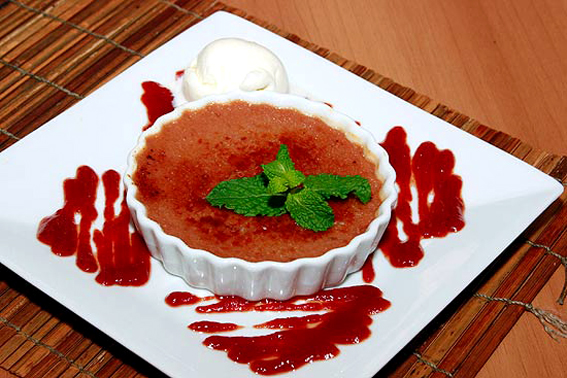
RECIPE - Guava Crème Brûlée (Crème Brûlée de Goiabada)

A recent purchase here at Flavors of Brazil World Headquarters, a centrifugal juice machine, has resulted in an abundance of tropical fruit juices at the breakfast table. In the past week there has been pineapple juice, mango juice, watermelon juice and probably-the-best-of-the-bunch guava juice.

Guava juice is something unique in the food world. It's color, a shocking pink, is unduplicated by any other fruit juice. The aroma is immediately identifiable - nothing smells like guava. And the texture, just slightly gritty in the way that pears are, completes the experience of drinking a juice like none other.

Here in Fortaleza we're spoiled when it comes to guavas (goiabas in Portuguese), especially at this time of year where they're just coming into season. Last Friday at the farmers market we bought beautiful fragrant guavas for R$2.50 per kilo. The equivalent is approximately USD $0.65 per pound. A bargain at any price, but doubly so when they are so inexpensive.

Guavas, as delicious as they are, are difficult for many people to eat because of the number small and very hard seeds. If you want to eat a fresh guava you have to accept the fact that you'll be swallowing a lot of seeds whole. They are too hard to crunch and too numerous to spit out.

Guavas, in Brazil or outside, are mostly consumed as juice, or eaten in the form of goiabada, a thick paste made from pureed guavas that have been cooked down to thicken them. (Click here for more on goiabada.) To celebrate the guava, here is a wonderful and unbelievably simple recipe for guava crème brûlée. Because it uses goiabada instead of fresh guavas, it's easy to make almost anywhere and any time of year. Goiabada is readily available in any Latin American food market and can also be ordered online. At the same sources you can find creme de leite (called media crema in Spanish). Nestle's is the most common brand. This dessert brings a taste of the tropics to the table even in the middle of the snowiest winter.
___________________________________________________
RECIPE - Guava Crème Brûlée (Crème Brûlée de Goiabada)
Makes 8 portions

14 oz (400 gr) goiabada paste
2 1/2 cups (600 ml) creme de leite
6 eggs yolks, sieved
----------------------------------------------------------------------
Preheat the oven to 350F (180C).

Put the goiabada in a blender or food processor and blend completely.

Transfer the blended goiabada to a mixing bowl, add the creme de leite and egg yolks and blend well with a whisk or wooden spoon.

Divide the mixture between 8 ramekins or custard cups, place them in a large baking pan, like a lasagne pan, and pour boiling water into the pan to reach halfway up the containers.

Carefully transfer the pan to the preheated oven and cook for 20-25 minutes, or until a toothpick inserted into a cup comes out clean. Remove from oven, remove from pan with water and let cool on wire racks.

Can be served as is, at room temperature or chilled. If you wish to make crème brûlées sprinkle a bit of grantulated white sugar on the surface of the custards then burn the sugar under a preheated broiler or with a kitchen blowtorch.

Recipe translated and adapted from Folha de S. Paulo.

Saturday, November 12, 2011

RECIPE - Minted Mango Flambé (Manga Flambada com Caldo de Hortelã)

To wrap up our collection of mango recipes in celebration of the arrival of mango season in Brazil, here's an uber-simple and really delicious way to showcase perfectly ripe mangoes.

Brazilians often combine mint (hortelã in Portuguese) with fruits to perk up the flavor as well as to make the dish more refreshing in Brazil's hot climate. The most common combination is pineapple and mint (click here to read about pineapple-mint juice), but other fruits combine equally well with fresh mint. Including mangoes, clearly.

This recipe is very straightforward, and the only skill required is in the flaming of the cachaça. Flaming spirits is one of those culinary techniques that requires caution but needn't cause fear. Properly done, it's relatively foolproof and should be a skill included in any self-respecting home cook's repertory. Click on this link for an easy lesson in how to flame liqueurs safely.

If you don't have a bottle of cachaça  at home, you can substitute white rum or tequila. The rum will make a sweeter dessert, and tequila will add its own distinctive flavor, so do try to use cachaça if possible.
______________________________________________________
RECIPE - Minted Mango Flambé (Manga Flambada com Caldo de Hortelã)
Serves 2

1 large ripe mango
1 1/2 oz (60 ml) cachaça 
1 Tbsp granulated white sugar
1 Tbsp chopped fresh mint
2 sprigs fresh mint (to garnish)
-------------------------------------------------------------------------------
Over a large bowl, peel the mango and cut the flesh into thick slices. Reserve the slices in the bowl along with their juice.

In a non-stock frying pan heat the sugar, but don't let it burn. Add the mango slices, toss them in the sugar, then add the cachaça . Flame the cachaça, and when the flames die down add the chopped mint and toss everything once again.

Divide the mango slices between two dessert dishes, and add one sprig of mint to each to garnish. Serve hot.