Showing posts with label events. Show all posts

Tuesday, May 17, 2011

Comida di Buteco - Fortaleza's Best Bar Food

Earlier this month, Flavors of Brazil reported on Brazil's Comida di Buteco promotional contest to find the best bar food (comida di buteco) in each of a number of Brazil's major cities. (Click here to read more on Comida di Buteco.)

In Fortaleza, the contest ran from April 15 to May 01, and within the past few days, the Comida di Buteco website announced the winning bars (botecos) and the platters which won them their accolades. Winners were chosen based on ballots filled out by diners during the contest period, on which each plate was scored on a number of factors, and the restaurant as well, on such things as cleanliness, quality of service, noise levels etc.

The first-place winner for 2011 in Fortaleza was a long-established favorite bar in Aldeota, one of Fortaleza's more upmarket neighborhoods. The bar is called Bar do Papai (Daddy's Bar) and is known for the quality of its live music as well as its food and drink. Bar do Papai took home the gold with a charmingly-entitled dish called Pedacinho do Céu (Little Piece of Heaven). The dish consists of rolled, breaded chicken cutlets stuffed with cheese and ham and served with a mayonnaise and ketchup sauce. In other words, rolled-up chicken cordon bleu. The bar has been known for this dish for years, so it's likely that a number of voters were already predisposed to vote for Pedacinho do Céu even before they sat down to eat and vote.
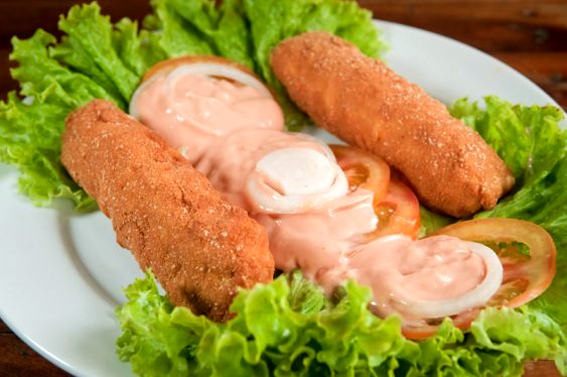
Bar do Papai - Pedacinho do Céu

A Bahian-style restaurant called Cabana da Negona (Big Mama's Hut) took second place with a dish of chunks of smoked pork loin on the grill, covered with roasted onion sliced, and accompanied by a sauce made from mayonnaise and manioc flour. Interestingly, there is nothing particularly Bahian about their winning dish, though it does sound (and look) delicious. Flavors of Brazil has reviewed Cabana da Negona previously, and the review can be seen here.)
Cabana da Negoa - Carne do Fumeiro na Chapa

A surprising (to us anyway) dish from a bar called Flórida Bar received the third highest score during Comida di Buteco. Their offering was Figado Acebolada - or in English, liver 'n' onions. Not that the dish doesn't have its fans, but liver is hated by as many people as those who love it, so we'd think that it wouldn't be a contest-winner. Clearly, Flavors of Brazil was wrong, and the fans of Flórida Bar's liver 'n' onions are legion.

Flórida Bar - Figado Acebolado

Of the three bars, only Flórida Bar is unknown to us here at Flavors of Brazil. But it won't remain that way for long - we intend to visit it soon, even if we don't order the liver! Which is the whole point of the Comida di Buteco program - to locate and identify good bar food, and to encourage diners to try out some of the best bar food in the city.

Friday, March 19, 2010

Feijoada - The Essential Ingredients

Although feijoada is often crowned with the title "Brazil's National Dish" it is not, in fact, a dish at all. Feijoada is a meal, in the same sense that Thanksgiving turkey dinner is not a dish but a meal. Just as one family might serve creamed pearl onions at Thanksgiving, while another family considers that heresy, and serves a broccoli casserole instead, the core ingredients of the Thanksgiving dinner rarely vary - turkey, stuffing, mashed potatoes, gravy, etc. Feijoada is exactly the same - there are a huge number of dishes that have made their way into a feijoada, but there is only a small number of dishes without which one cannot really call the meal a feijoada.

A true feijoada will consist, at the very least of:

Cuts of pork, including hocks, ears, and belly, cooked in black beans


Linguiça sausage cooked in black beans
Boiled white rice

 Peeled slices or cuts of fresh oranges

Farofa
Mineiro-style kale
 And to accompany this enormous repast, the traditional beverage of a feijoada:
Caipirinhas

Together, all these dishes constitute a proper feijoada, but other additional dishes may be added as desired. Note that the first two ingredients, the true core of a feijoada, are pork products cooked in black beans. Although in today's world, with today's sensibilities, vegetarian feijoadas do exist, the traditionalist Brazilian would refuse to call that concoction a feijoada at all. But if the 21st century universal compendium of food has allowed the entry of vegetarian haggis or a vegetarian pasty, then let's allow an exception for vegetarians to allow them to enjoy feijoada. However, truth be told, a true feijoada is a meal for carnivores only.

Tuesday, February 2, 2010

FENADOCE - Brazil's National Sweets Fair

Brazilians are notorious for having a sweet tooth, and most Brazilians will unashamedly admit to being addicted to desserts, candies and sweet drinks. There are several possible historical reasons for this including the importance of the cultivation of sugar historically in Brazil, and Brazil's colonial ties to Portugal, which has a rich tradition of its own of sweets, centered around baked goods from that county's convents and monasteries.

Being a nation of 200 million sweet-lovers, it's no surprise that Brazil celebrates this love affair with a national Fair. It's called FENADOCE, which is an abbreviation of its name in Portuguese, A Feira Nacional do Doce. It is held every year in the southern Brazilian town of Pelotas, in the state of Rio Grande do Sul. In 2010, FENADOCE will be celebrating its 18th annual fair, from the 26th of May to the 13th of June.

It is a bit unusual that a national event like FENADOCE would be held so far away from the population centers of the country, almost on the border with Uruguay and thousands of kilometres away from Rio de Janeiro and São Paulo. But Pelotas is a natural place for this event to be held according to the official website of FENADOCE:
The culture of sweets and sweet baking in Pelotas was inherited through the recipes brought to this city by the first Portuguese immigrants in the middle of the 18th Century. These immigrants brought with them such marvels as: ninhos, fios-de-ovos, babas-de-moça, camafeus, papos-de-anjo, canudinhos recheados, pastéis de Santa Clara and many more.
Later Italian and German immigrants became of the culture, each group bringing with them recipes for sweets and desserts. At that time, home gatherings and parties were showcases of sweets, since for the immigrant cultures sugar and sweet things were elements of any celebration. Immigrant families had traditions of passing on recipe for the families' favorite sweets from generation to generation.
Today Pelotas has become a place where artesanal production of sweets has combined with industrial production technique to create an ever-growing industry in our city. Because of this, the sweets of Pelotas are not just known locally, but are valued throughout Brazil.

The fair not only has food, but a variety of entertainment, from music, to clowns, to dance and theater. But the traditional sweets of Pelotas are still it's raison d'être. Here is a visual sampling:


In the next few posts, I will translate some of the recipes for traditional sweets that can be found on the website of FENADOCE.