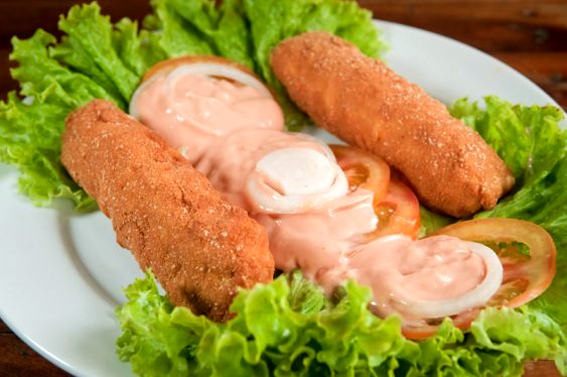
First place winner in Fortaleza in the 2012 edition of Brazil's largest national gastronomic competition, Comida di Buteco, Dona Zena's meatballs have been a favorite on Dona Zena's eponymous restaurant in downtown Fortaleza for more than 20 years. They're no flash in the pan - some of the dish's biggest fans grew up on these meatballs, and are now passing their love onto their children and grandchildren.
Previous posts on Flavors of Brazil have highlighted the restaurant and the prize-winning chef, so it's entirely appropriate that we end our series of posts on Dona Zena with her authentic recipe, courtesy of Brazilian food website Receitas & Dietas (Recipes and Diets).
This recipe is very simple, and maybe it's the simplicity itself which makes it appeal to so many people. There are no ingredients that are difficult to source or very expensive. True Brazilian comfort food that deserves a place in your repertory.
_____________________________________________
RECIPE - Dona Zena's Meatballs (Bola da Carne da Dona Zena)
Makes 12 large meatballs
2 1/4 lb (1 kg) good quality ground meat - ground chuck is best
1/2 cup ripe tomato, peeled, seeded and finely chopped
1/4 cup onion, peeled, seeded and finely chopped
1/4 cup green bell pepper, seeded and finely chopped
1/4 cup cilantro, leaves only, finely chopped
1 Tbsp garlic, minced
3 Tbsp white wine vinegar
3 Tbsp soy sauce
salt and pepper to taste
neutral vegetable oil for frying
In a large mixing bowl combine all the ingredients, mixing them together with your moistened hands. Try not to press or compact the mixture.
Line a cookie sheet with wax paper or cooking parchment. With moistened hands divide the meat mixture into twelve portions and form each portion into balls by rolling it between your palms. Don't over-compact the mixture - it should be pressed together only enough to make it keep its shape.
In a large deep frying pan, heat a small amount of oil, then fry the meatballs, in batchesof 4, turning them over frequently until they are cooked through and nicely brown on all sides. Remove each batch, reserving and keeping warm, before continuing with another batch, until all the meatballs are done.
Serve 3 or 4 meatballs per person, accompanied by a lettuce and sliced tomato salad and white rice.
Showing posts with label boteco. Show all posts
Monday, July 30, 2012
Thursday, July 26, 2012
Unadorned Jewel - Dona Zena Restaurant in Fortaleza, CE
Restaurants that become beloved local institutions aren't always the most luxurious, the most creative or the most expensive restaurants in town. In fact, they're likely to be exactly the opposite - comfortable and homey rather than luxurious, traditional and non-changing rather than creative and avant-garde, and a bargain rather than expensive. These are the restaurants that stay open for 30-40 year or more, often without ownership changing hands. These are the restaurants that locals began frequenting as children with their parents and now continue to frequent with their grandchildren. These are the restaurants that neighbors point to with pride and say, "I've known the owner of that restaurant for twenty-five years and I've never come here and not seen her (or him)".
In Fortaleza, Flavors of Brazil;s hometown, most people would tell you that Dona Zena, a small lunchtime-only restaurant located downtown, is exactly that kind of institution. Since Dona Zena opened more than 20 years ago, in a distinctly down-market street located between the commercial and university districts in the center of Fortaleza, the restaurant has filled to the rafters daily with diners eager to eat one of Dona Zena's PF's (PF = prato feito = blue plate special) or if it's a Friday or Saturday, her feijoada, generally conceded in Fortaleza to be among the city's best.
Owned, managed and operated by a 65-year old woman named (as you might guess) Dona Zena, the restaurant has recently begun to be noticed outside the neighborhood and indeed outside Fortaleza. In the 2012 edition of Comida di Buteco, a Brazil-wide celebration of boteco culture, one of Dona Zena's signature dishes, her meatballs, was voted the best dish in Fortaleza, beating out candidates from more than 15 other boteco-style restaurants. The same dish was featured on a national daytime TV show, Mais Você, hosted by Ana Maria Braga, Brazil's nearest equivalent to Martha Stewart. Dona Zena herself was flown to Rio de Janeiro to appear on Mais Você, where she shared her recipe with TV viewers from across the country.
Her new-found fame hasn't changed Dona Zena - the restaurant or the person. The restaurant's menu is unchanged, the prices are unchanged, and the loyalty of its customers is unchanged. As for Dona Zena herself, she's unchanged too. In a recent interview in one of Fortaleza's daily newspapers O Povo, Dona Zena talked about the difficult times of her childhood, the hard work that went into the creation and operation of her restaurant, and about her three loves - her family, her restaurant and her customers.
Tomorrow, we'll publish some highlights from that interview.
In Fortaleza, Flavors of Brazil;s hometown, most people would tell you that Dona Zena, a small lunchtime-only restaurant located downtown, is exactly that kind of institution. Since Dona Zena opened more than 20 years ago, in a distinctly down-market street located between the commercial and university districts in the center of Fortaleza, the restaurant has filled to the rafters daily with diners eager to eat one of Dona Zena's PF's (PF = prato feito = blue plate special) or if it's a Friday or Saturday, her feijoada, generally conceded in Fortaleza to be among the city's best.
Owned, managed and operated by a 65-year old woman named (as you might guess) Dona Zena, the restaurant has recently begun to be noticed outside the neighborhood and indeed outside Fortaleza. In the 2012 edition of Comida di Buteco, a Brazil-wide celebration of boteco culture, one of Dona Zena's signature dishes, her meatballs, was voted the best dish in Fortaleza, beating out candidates from more than 15 other boteco-style restaurants. The same dish was featured on a national daytime TV show, Mais Você, hosted by Ana Maria Braga, Brazil's nearest equivalent to Martha Stewart. Dona Zena herself was flown to Rio de Janeiro to appear on Mais Você, where she shared her recipe with TV viewers from across the country.
Her new-found fame hasn't changed Dona Zena - the restaurant or the person. The restaurant's menu is unchanged, the prices are unchanged, and the loyalty of its customers is unchanged. As for Dona Zena herself, she's unchanged too. In a recent interview in one of Fortaleza's daily newspapers O Povo, Dona Zena talked about the difficult times of her childhood, the hard work that went into the creation and operation of her restaurant, and about her three loves - her family, her restaurant and her customers.
Tomorrow, we'll publish some highlights from that interview.
Saturday, April 14, 2012
Comida Di Buteco 2012
Although it officially began yesterday, Friday the 13th, the 12th edition of Comida di Buteco, a celebration of Brazilian bar food that calls itself Brazil's largest culinary contest promises to be anything but unlucky for the bars who serve up this year's winning dishes.
Founded in 1999 in Belo Horizonte, Minas Gerais, by Eduardo Maya, a local radio personality and boteco enthusiast, Comida di Buteco has grown to include 16 cities in Brazil and more than 200 bars and botecos all vying for the honor of claiming that they have the best bar food in their city. Every city has a separate contest, and winners are chosen by ballot by bar patrons, not by professionals. There are no national prizes, but in each city three dishes, from three different bars, are chosen as first, second or third prize winners.
Comida di Buteco runs from April 13th to April 29th in most cities, although the contest in Belo Horizonte, the acknowledged mecca of Brazilian boteco culture, runs from April 13th to May 13th and in a few other cities, the competition is non-concurrent.
Of the 16 Brazilian cities involved this year, 5 including Belo Horizonte, are in the state of Minas Gerais, reflecting the importance of boteco culture in that interior state. This is also the first edition of the contest that will include Brazil's largest city, São Paulo.
In Fortaleza, Flavors of Brazil's home base, this year's edition will feature 19 botecos and bars. As the contest is only 16 days long, it would take a daily visit to one or more bars every day of the contest to sample all the dishes in contention. This is not likely to happen, but we hope to be able to report on some of the bars, and their contest entries, during the next two weeks.
Founded in 1999 in Belo Horizonte, Minas Gerais, by Eduardo Maya, a local radio personality and boteco enthusiast, Comida di Buteco has grown to include 16 cities in Brazil and more than 200 bars and botecos all vying for the honor of claiming that they have the best bar food in their city. Every city has a separate contest, and winners are chosen by ballot by bar patrons, not by professionals. There are no national prizes, but in each city three dishes, from three different bars, are chosen as first, second or third prize winners.
Comida di Buteco runs from April 13th to April 29th in most cities, although the contest in Belo Horizonte, the acknowledged mecca of Brazilian boteco culture, runs from April 13th to May 13th and in a few other cities, the competition is non-concurrent.
Of the 16 Brazilian cities involved this year, 5 including Belo Horizonte, are in the state of Minas Gerais, reflecting the importance of boteco culture in that interior state. This is also the first edition of the contest that will include Brazil's largest city, São Paulo.
In Fortaleza, Flavors of Brazil's home base, this year's edition will feature 19 botecos and bars. As the contest is only 16 days long, it would take a daily visit to one or more bars every day of the contest to sample all the dishes in contention. This is not likely to happen, but we hope to be able to report on some of the bars, and their contest entries, during the next two weeks.
Tuesday, November 29, 2011
RECIPE - Feijoada Fritters (Bolinho de Feijoada)
Up to now, we've been focusing on classic bolinho recipes in the current series of posts about one of Brazil's favorite bar snacks - manioc, cheese, carne de sol. These recipes have been around for a long time and bar patrons in Brazil have probably been noshing on these bolinhos since the days when Original beer really was original.
Today's recipe, which will be the last bolinho recipe for a while, is different. It's not a traditional recipe whose origins are lost in those fabled mists of time. We know whose idea is was to make a bolinho with the ingredients and flavors of Brazil's national dish feijoada - Kátia Barbosa e Kadu Tomé, owners, respectively, of Rio de Janeiro botecos Aconchego Carioca and Bracarense. They came up with the idea jointly at a gastronomic festival in the state of Minas Gerais, and according to website Receitaculo, the first attempts were less than successful.
Once back in Rio Kátia continued to play with the recipe and discovered that the secrets to making a great bolinho de feijoada were two. First, the bean-based fritters should be chilled thoroughly, almost to freezing, before cooking. Second, the oil used to fry them should be very hot, so that the dough is cooked through and the kale stuffing is hot.
At Kátia's bar, Aconchego Carioca, she serves her bolinhos de feijoada accompanied by slices of orange, fried pork-rinds (torresmo) and a batida de limão, a lime-juice cocktail. The current price is R$15 per portion or about USD $8.50. In a recent edition of the Comida di Buteco competition, these bolinhos were judged the second-best bar-food recipe in Rio de Janeiro.
_________________________________________________
RECIPE - Feijoada Fritters (Bolinho de Feijoada)
8 cups (2 liters) water
1 lb (500 gr) dried black beans
4 oz (100 gr) dried, salted beef (carne seca) - desalted and cut into very small cubes
4 oz (100 gr) pork loin - cut into very small cubes
2 links Italian, Spanish or Portuguese-style garlic sausage - peeled and cut into very small cubes
3 bay leaves
2 Tbsp extra-virgin olive oil
3 cloves garlic
salt to taste
300 gr fresh farinha (manioc flour)
1 Tbsp manioc starch (polvilho azedo)
1/2 lb (250 gr) smoked bacon, cut into small cubes
2 cloves garlic, peeled
2 bunches kale, washed, destemmed and cut into thin strips
additional farinha (manioc flour) for breading
neutral vegetable oil for frying
-------------------------------------------------------------------------
In a pressure cooker, add the water and combine with the beans, the cubed meats (except the bacon) and the bay leaves. Cover as directed, and place over medium high heat. Counting from when the pressure takes, cook for one hour. Remove from heat, let cool completely, then open the pressure cooker. Reserve.
Once the mixture in the pressure cooker is completely cooled, blend the beans, the broth and meats (discard the bay leaves) in a blender until homogenous and smooth. Do this is batches if necessary.
In a large sauce pan heat the olive oil, then fry the garlic until it just begins to brown. Add the blended bean mixture and correct the seasoning with salt. By small handfuls, begin to add the manioc flour, stirring constantly. Mix each batch in completely before adding another. When the mass (called tutu in Portuguese) begins to pull away cleanly from the side of the pan remove from heat, transfer the tutu to another pan or bowl and cool completely. Once it is cool, mix in the manioc starch and knead the mass until it is smooth and homogenous. Reserve.
In a large frying pan cook the bacon cubes until they are browned and crispy and have rendered their fat. Add the garlic cloves and cook for a minute or two more. Add the strips of kale and stir-fry only until the kale takes on color and softens slightly. Remove from heat.
Using wet hands or plastic gloves begin to form the balls. Grab a golf-ball-sized chunk of dough and open it out to disc shape in your palm. Put about 1 tsp of the cooked kale in the middle and close the dough around the filling, sealing it well. Roll the ball in farinha to lightly bread it then place it on a cookie sheet. Continue the process, placing finished balls on the cookie sheet, until all ingredients have been used up.
Place the cookie sheet in a freezer and cool until very cold but not frozen (about one hour).
Meanwhile prepare your deep-fryer and heat the oil until very hot but not smoking. Remove just enough balls from the freeze to make a first batch. Add them to the hot oil and cook, rolling them over from time to time, until the outside is deep brown and crispy and the filling is cooked through. Drain on paper towel and reserve, keeping warm, until all the balls have been fried.
Serve immediately, accompanied as above if desired.
Recipe translated and adapted from Receitaculo.com.
Today's recipe, which will be the last bolinho recipe for a while, is different. It's not a traditional recipe whose origins are lost in those fabled mists of time. We know whose idea is was to make a bolinho with the ingredients and flavors of Brazil's national dish feijoada - Kátia Barbosa e Kadu Tomé, owners, respectively, of Rio de Janeiro botecos Aconchego Carioca and Bracarense. They came up with the idea jointly at a gastronomic festival in the state of Minas Gerais, and according to website Receitaculo, the first attempts were less than successful.
Once back in Rio Kátia continued to play with the recipe and discovered that the secrets to making a great bolinho de feijoada were two. First, the bean-based fritters should be chilled thoroughly, almost to freezing, before cooking. Second, the oil used to fry them should be very hot, so that the dough is cooked through and the kale stuffing is hot.
At Kátia's bar, Aconchego Carioca, she serves her bolinhos de feijoada accompanied by slices of orange, fried pork-rinds (torresmo) and a batida de limão, a lime-juice cocktail. The current price is R$15 per portion or about USD $8.50. In a recent edition of the Comida di Buteco competition, these bolinhos were judged the second-best bar-food recipe in Rio de Janeiro.
_________________________________________________
RECIPE - Feijoada Fritters (Bolinho de Feijoada)
8 cups (2 liters) water
1 lb (500 gr) dried black beans
4 oz (100 gr) dried, salted beef (carne seca) - desalted and cut into very small cubes
4 oz (100 gr) pork loin - cut into very small cubes
2 links Italian, Spanish or Portuguese-style garlic sausage - peeled and cut into very small cubes
3 bay leaves
2 Tbsp extra-virgin olive oil
3 cloves garlic
salt to taste
300 gr fresh farinha (manioc flour)
1 Tbsp manioc starch (polvilho azedo)
1/2 lb (250 gr) smoked bacon, cut into small cubes
2 cloves garlic, peeled
2 bunches kale, washed, destemmed and cut into thin strips
additional farinha (manioc flour) for breading
neutral vegetable oil for frying
-------------------------------------------------------------------------
In a pressure cooker, add the water and combine with the beans, the cubed meats (except the bacon) and the bay leaves. Cover as directed, and place over medium high heat. Counting from when the pressure takes, cook for one hour. Remove from heat, let cool completely, then open the pressure cooker. Reserve.
Once the mixture in the pressure cooker is completely cooled, blend the beans, the broth and meats (discard the bay leaves) in a blender until homogenous and smooth. Do this is batches if necessary.
In a large sauce pan heat the olive oil, then fry the garlic until it just begins to brown. Add the blended bean mixture and correct the seasoning with salt. By small handfuls, begin to add the manioc flour, stirring constantly. Mix each batch in completely before adding another. When the mass (called tutu in Portuguese) begins to pull away cleanly from the side of the pan remove from heat, transfer the tutu to another pan or bowl and cool completely. Once it is cool, mix in the manioc starch and knead the mass until it is smooth and homogenous. Reserve.
In a large frying pan cook the bacon cubes until they are browned and crispy and have rendered their fat. Add the garlic cloves and cook for a minute or two more. Add the strips of kale and stir-fry only until the kale takes on color and softens slightly. Remove from heat.
Using wet hands or plastic gloves begin to form the balls. Grab a golf-ball-sized chunk of dough and open it out to disc shape in your palm. Put about 1 tsp of the cooked kale in the middle and close the dough around the filling, sealing it well. Roll the ball in farinha to lightly bread it then place it on a cookie sheet. Continue the process, placing finished balls on the cookie sheet, until all ingredients have been used up.
Place the cookie sheet in a freezer and cool until very cold but not frozen (about one hour).
Meanwhile prepare your deep-fryer and heat the oil until very hot but not smoking. Remove just enough balls from the freeze to make a first batch. Add them to the hot oil and cook, rolling them over from time to time, until the outside is deep brown and crispy and the filling is cooked through. Drain on paper towel and reserve, keeping warm, until all the balls have been fried.
Serve immediately, accompanied as above if desired.
Recipe translated and adapted from Receitaculo.com.
Monday, November 28, 2011
RECIPE - Sun-dried Beef Fritters (Bolinho de Carne de Sol)
Last week, when we began this short series of posts about the Brazilian snack food called bolinhos, one of our readers asked for a recipe for bolinhos with carne de sol. Carne de sol is Brazil's salted and semi-dried beef, known throughout the country and whose roots can be traced back to the early European settlers and their need to preserve meat in a hot climate in the absence of refrigeration. (Click here for more about carne de sol.)
This recipe, like the one posted last Saturday, uses manioc for the carbohydrate portion of the bolinho. In the earlier recipe the balls were stuffed with cubes of mozzarella cheese. In this recipe, in response to our reader's request, the filling is made from carne de sol.
Carne de sol is a product that is uniquely Brazilian and there really isn't much of an export market for it. However, it's easy to make a pretty-good imitation of carne de sol at home. Click here for a link to an earlier article on Flavors of Brazil that will tell you how.
You'll need fresh manioc root for this recipe. It can be found in many Latin American and African food stores. It's variously called manioc, cassava, yuca, aipim or macaxeira depending on the ethnic community the store caters too.
______________________________________________________
RECIPE - Sun-dried Meat Fritters (Bolinho de Carne de Sol)
Makes 30 bolinhos
2.2 lbs (1 kg) carne de sol, cooked
2.2 lbs (1 kg) fresh manioc roots, peeled, mashed and cooled
2.5 cups (300 gr) all-purpose flour
1 medium onion, finely chopped
3 cloves garlic, finely minced
1/2 bunch fresh cilantro, large stems removed
2 whole eggs, lightly beaten
extra-virgin olive oil
salt and pepper to taste
neutral vegetable oil for frying
----------------------------------------------------------------------------------
Prepare the carne de sol by desalting it if commercially bought. If homemode, desalting is not required. Grill, fry or simmer the meat until it is cooked through, then cool. Once cool, shred the meat using two forks, or roughly chop with a knife. Reserve.
In a heavy-duty frying pan heat the olive oil, then fry the onion and garlic until the onion is transparent but not browned. Add the shredded carne de sol and heat through. Taste for seasoning and add salt and pepper to taste. There is salt in the carne de sol so be careful not to over-salt. Remove from heat, mix in the fresh cilantro and reserve.
Put the mashed manioc in a large bowl. Add the two eggs then the flour by handfuls, mixing thoroughly after each addition. Finally mix in the reserved carne de sol mixture and combine completely.
Using your hands or two spoon form the mixture into approximately 30 small balls, placing completed balls on a cool working surface or cookie sheets.
Heat the cooking oil in a deep-fryer, according to the manufacturer's instructions. When the oil is hot but not smoking add the balls, a few at a time to avoid overcrowding, and cook until they are browned and crispy on the outside. Drain on paper towels while cooking the rest of the balls in batches.
Serve immediately, accompanied by a dipping sauce if desired.
This recipe, like the one posted last Saturday, uses manioc for the carbohydrate portion of the bolinho. In the earlier recipe the balls were stuffed with cubes of mozzarella cheese. In this recipe, in response to our reader's request, the filling is made from carne de sol.
Carne de sol is a product that is uniquely Brazilian and there really isn't much of an export market for it. However, it's easy to make a pretty-good imitation of carne de sol at home. Click here for a link to an earlier article on Flavors of Brazil that will tell you how.
You'll need fresh manioc root for this recipe. It can be found in many Latin American and African food stores. It's variously called manioc, cassava, yuca, aipim or macaxeira depending on the ethnic community the store caters too.
______________________________________________________
RECIPE - Sun-dried Meat Fritters (Bolinho de Carne de Sol)
Makes 30 bolinhos
2.2 lbs (1 kg) carne de sol, cooked
2.2 lbs (1 kg) fresh manioc roots, peeled, mashed and cooled
2.5 cups (300 gr) all-purpose flour
1 medium onion, finely chopped
3 cloves garlic, finely minced
1/2 bunch fresh cilantro, large stems removed
2 whole eggs, lightly beaten
extra-virgin olive oil
salt and pepper to taste
neutral vegetable oil for frying
----------------------------------------------------------------------------------
Prepare the carne de sol by desalting it if commercially bought. If homemode, desalting is not required. Grill, fry or simmer the meat until it is cooked through, then cool. Once cool, shred the meat using two forks, or roughly chop with a knife. Reserve.
In a heavy-duty frying pan heat the olive oil, then fry the onion and garlic until the onion is transparent but not browned. Add the shredded carne de sol and heat through. Taste for seasoning and add salt and pepper to taste. There is salt in the carne de sol so be careful not to over-salt. Remove from heat, mix in the fresh cilantro and reserve.
Put the mashed manioc in a large bowl. Add the two eggs then the flour by handfuls, mixing thoroughly after each addition. Finally mix in the reserved carne de sol mixture and combine completely.
Using your hands or two spoon form the mixture into approximately 30 small balls, placing completed balls on a cool working surface or cookie sheets.
Heat the cooking oil in a deep-fryer, according to the manufacturer's instructions. When the oil is hot but not smoking add the balls, a few at a time to avoid overcrowding, and cook until they are browned and crispy on the outside. Drain on paper towels while cooking the rest of the balls in batches.
Serve immediately, accompanied by a dipping sauce if desired.
Thursday, June 30, 2011
Brazil's Consumer Protection Law vs. Restaurants
Brazil's federal consumer protection law (Código Brasileiro de Defesa do Consumidor) is one of the strongest in the world. On paper it is probably the strongest worldwide in terms of the protection it affords the consumer from abusive practices on the part of businesses. In terms of actual business practices, however, the law is not always obeyed, and in many cases businesses continue practices that are explicitly forbidden in the law. It's a question of impunity, lack of enforcement, lack of consumer knowledge, or even at times lack of knowledge on the part of a business that a certain practice, common in their industry, is illegal.
There are two practices that are commonly encountered in Brazilian restaurants and bars which are forbidden by the law, yet which in many types of establishments are almost universal. A recent survey indicated that the majority of Brazilian consumers were unaware that these practices were illegal, and those that were aware were likely not to know what their remedies were. These practices are something called the couvert (cover charge) and a charge for live music.
Tourists visiting Brazil and dining in a restaurant (especially an upmarket one) are often pleasantly surprised when the waiter brings to the table, unasked, a selection of breads, olive oil, perhaps some cubes of cheese and salami. This is called a couvert in Portuguese, and is normally placed on the table while the diners are reading their menus and deciding what to eat. One might be forgiven for thinking, "what a nice gesture." It's only when the bill arrives, if then, that the customer realizes that they've been charged for that nice gesture. It might be only a small charge, but in fancy restaurants it can reach R$20 (about USD $12) or more.
The consumer law specifically prohibits the practice of placing a a couvert on the table without informing the customer that there is a charge for the plate and offering them the option to decline it. This almost never occurs. In the real world, customers have two options if they do not want the couvert. First, you can tell the waiter that you don't want the couvert and ask him not to place it on the table. Alternatively, you can eat nothing on the plate, and leave it to be cleared away at some point by the waiter. If you do this, be sure to check the bill carefully to make sure the couvert has not been charged for. If it has, speak to the waiter or the manager if necessary to have it removed. Note, however, that if you eat even one little olive or cube of cheese you have, in effect, contracted to buy the couvert and will be correctly charged for it in full. It's a bit like Persephone eating one pomegranate seed in Hades - you've locked yourself into a bargain, one that you may not want.
It should be pointed out that sometimes the couvert is very well done and well worth the price. Some restaurants are famed for the quality and variety of their coverts, and no one objects to paying for them in these establishments. The point of the consumer protection law is not to forbid couverts - it is to allow the consumer to make an informed choice whether she wants to eat and pay for the couvert or not.
The second way that the consumer protection law bumps into restaurant/bar practice is the charge for live music. One of the delights of many a Brazilian bar or boteco is the live music offered to accompany drinks, snacks and lively conversation. It can be someone singing bossa nova and playing an acoustic guitar. Or it might be a trio singing hits of the Beatles, Stevie Wonder and Lady Gaga in thickly-accented English. It can be the touch that completes a perfect night out with friends, or it can be something that will cause you to flee the bar with your hands over your ears. But what it cannot be, according to the law, is an item on your tab at the end of the night. The argument that the law makes is that the consumer goes to the bar for food and drink, and may or may not want to listen to the music. However, they have no choice whether to listen or not, and as listening is not a choice of the customer, it cannot be charged for.
In the case of a live music charge, however, the consumer law is more honored in the breach than the observance. A charge for live music is to be expected in bars and restaurants where it is offered. It's usually not very high, especially considering the quality of what you might be listening to - a few dollars at most. Unlike the couvert, which is easily refused on a per table basis, the practice of billing for live musica cannot easily be declined with grace. A restaurant is certainly not going to stop the music to accommodate you - and it seems a bit churlish to refuse to pay for what one has listened to, especially since the music charge usually goes directly to the musicians and is their only pay for their work.
So here we have two practices which theoretically are forbidden but which are often encountered. Flavors of Brazil, in its wise counsel, recommends that you make your own decision about whether to eat the couvert or not - it's easy to decline if done at the right time. As for the music charge, we pay it, and recommend that you do the same. Just mark it down as part of the cost of enjoying a typical Brazilian experience - a night out with a group of friends, good snacks, plenty of icy beer, all accompanied with a live music soundtrack.
There are two practices that are commonly encountered in Brazilian restaurants and bars which are forbidden by the law, yet which in many types of establishments are almost universal. A recent survey indicated that the majority of Brazilian consumers were unaware that these practices were illegal, and those that were aware were likely not to know what their remedies were. These practices are something called the couvert (cover charge) and a charge for live music.
Tourists visiting Brazil and dining in a restaurant (especially an upmarket one) are often pleasantly surprised when the waiter brings to the table, unasked, a selection of breads, olive oil, perhaps some cubes of cheese and salami. This is called a couvert in Portuguese, and is normally placed on the table while the diners are reading their menus and deciding what to eat. One might be forgiven for thinking, "what a nice gesture." It's only when the bill arrives, if then, that the customer realizes that they've been charged for that nice gesture. It might be only a small charge, but in fancy restaurants it can reach R$20 (about USD $12) or more.
The consumer law specifically prohibits the practice of placing a a couvert on the table without informing the customer that there is a charge for the plate and offering them the option to decline it. This almost never occurs. In the real world, customers have two options if they do not want the couvert. First, you can tell the waiter that you don't want the couvert and ask him not to place it on the table. Alternatively, you can eat nothing on the plate, and leave it to be cleared away at some point by the waiter. If you do this, be sure to check the bill carefully to make sure the couvert has not been charged for. If it has, speak to the waiter or the manager if necessary to have it removed. Note, however, that if you eat even one little olive or cube of cheese you have, in effect, contracted to buy the couvert and will be correctly charged for it in full. It's a bit like Persephone eating one pomegranate seed in Hades - you've locked yourself into a bargain, one that you may not want.
It should be pointed out that sometimes the couvert is very well done and well worth the price. Some restaurants are famed for the quality and variety of their coverts, and no one objects to paying for them in these establishments. The point of the consumer protection law is not to forbid couverts - it is to allow the consumer to make an informed choice whether she wants to eat and pay for the couvert or not.
The second way that the consumer protection law bumps into restaurant/bar practice is the charge for live music. One of the delights of many a Brazilian bar or boteco is the live music offered to accompany drinks, snacks and lively conversation. It can be someone singing bossa nova and playing an acoustic guitar. Or it might be a trio singing hits of the Beatles, Stevie Wonder and Lady Gaga in thickly-accented English. It can be the touch that completes a perfect night out with friends, or it can be something that will cause you to flee the bar with your hands over your ears. But what it cannot be, according to the law, is an item on your tab at the end of the night. The argument that the law makes is that the consumer goes to the bar for food and drink, and may or may not want to listen to the music. However, they have no choice whether to listen or not, and as listening is not a choice of the customer, it cannot be charged for.
![]() |
| Zug Choperia, Fortaleza |
In the case of a live music charge, however, the consumer law is more honored in the breach than the observance. A charge for live music is to be expected in bars and restaurants where it is offered. It's usually not very high, especially considering the quality of what you might be listening to - a few dollars at most. Unlike the couvert, which is easily refused on a per table basis, the practice of billing for live musica cannot easily be declined with grace. A restaurant is certainly not going to stop the music to accommodate you - and it seems a bit churlish to refuse to pay for what one has listened to, especially since the music charge usually goes directly to the musicians and is their only pay for their work.
So here we have two practices which theoretically are forbidden but which are often encountered. Flavors of Brazil, in its wise counsel, recommends that you make your own decision about whether to eat the couvert or not - it's easy to decline if done at the right time. As for the music charge, we pay it, and recommend that you do the same. Just mark it down as part of the cost of enjoying a typical Brazilian experience - a night out with a group of friends, good snacks, plenty of icy beer, all accompanied with a live music soundtrack.
Tuesday, May 17, 2011
Comida di Buteco - Fortaleza's Best Bar Food
Earlier this month, Flavors of Brazil reported on Brazil's Comida di Buteco promotional contest to find the best bar food (comida di buteco) in each of a number of Brazil's major cities. (Click here to read more on Comida di Buteco.)
In Fortaleza, the contest ran from April 15 to May 01, and within the past few days, the Comida di Buteco website announced the winning bars (botecos) and the platters which won them their accolades. Winners were chosen based on ballots filled out by diners during the contest period, on which each plate was scored on a number of factors, and the restaurant as well, on such things as cleanliness, quality of service, noise levels etc.
The first-place winner for 2011 in Fortaleza was a long-established favorite bar in Aldeota, one of Fortaleza's more upmarket neighborhoods. The bar is called Bar do Papai (Daddy's Bar) and is known for the quality of its live music as well as its food and drink. Bar do Papai took home the gold with a charmingly-entitled dish called Pedacinho do Céu (Little Piece of Heaven). The dish consists of rolled, breaded chicken cutlets stuffed with cheese and ham and served with a mayonnaise and ketchup sauce. In other words, rolled-up chicken cordon bleu. The bar has been known for this dish for years, so it's likely that a number of voters were already predisposed to vote for Pedacinho do Céu even before they sat down to eat and vote.
A Bahian-style restaurant called Cabana da Negona (Big Mama's Hut) took second place with a dish of chunks of smoked pork loin on the grill, covered with roasted onion sliced, and accompanied by a sauce made from mayonnaise and manioc flour. Interestingly, there is nothing particularly Bahian about their winning dish, though it does sound (and look) delicious. Flavors of Brazil has reviewed Cabana da Negona previously, and the review can be seen here.)
A surprising (to us anyway) dish from a bar called Flórida Bar received the third highest score during Comida di Buteco. Their offering was Figado Acebolada - or in English, liver 'n' onions. Not that the dish doesn't have its fans, but liver is hated by as many people as those who love it, so we'd think that it wouldn't be a contest-winner. Clearly, Flavors of Brazil was wrong, and the fans of Flórida Bar's liver 'n' onions are legion.
Of the three bars, only Flórida Bar is unknown to us here at Flavors of Brazil. But it won't remain that way for long - we intend to visit it soon, even if we don't order the liver! Which is the whole point of the Comida di Buteco program - to locate and identify good bar food, and to encourage diners to try out some of the best bar food in the city.
In Fortaleza, the contest ran from April 15 to May 01, and within the past few days, the Comida di Buteco website announced the winning bars (botecos) and the platters which won them their accolades. Winners were chosen based on ballots filled out by diners during the contest period, on which each plate was scored on a number of factors, and the restaurant as well, on such things as cleanliness, quality of service, noise levels etc.
The first-place winner for 2011 in Fortaleza was a long-established favorite bar in Aldeota, one of Fortaleza's more upmarket neighborhoods. The bar is called Bar do Papai (Daddy's Bar) and is known for the quality of its live music as well as its food and drink. Bar do Papai took home the gold with a charmingly-entitled dish called Pedacinho do Céu (Little Piece of Heaven). The dish consists of rolled, breaded chicken cutlets stuffed with cheese and ham and served with a mayonnaise and ketchup sauce. In other words, rolled-up chicken cordon bleu. The bar has been known for this dish for years, so it's likely that a number of voters were already predisposed to vote for Pedacinho do Céu even before they sat down to eat and vote.
![]() |
| Bar do Papai - Pedacinho do Céu |
A Bahian-style restaurant called Cabana da Negona (Big Mama's Hut) took second place with a dish of chunks of smoked pork loin on the grill, covered with roasted onion sliced, and accompanied by a sauce made from mayonnaise and manioc flour. Interestingly, there is nothing particularly Bahian about their winning dish, though it does sound (and look) delicious. Flavors of Brazil has reviewed Cabana da Negona previously, and the review can be seen here.)
![]() |
| Cabana da Negoa - Carne do Fumeiro na Chapa |
A surprising (to us anyway) dish from a bar called Flórida Bar received the third highest score during Comida di Buteco. Their offering was Figado Acebolada - or in English, liver 'n' onions. Not that the dish doesn't have its fans, but liver is hated by as many people as those who love it, so we'd think that it wouldn't be a contest-winner. Clearly, Flavors of Brazil was wrong, and the fans of Flórida Bar's liver 'n' onions are legion.
![]() |
| Flórida Bar - Figado Acebolado |
Of the three bars, only Flórida Bar is unknown to us here at Flavors of Brazil. But it won't remain that way for long - we intend to visit it soon, even if we don't order the liver! Which is the whole point of the Comida di Buteco program - to locate and identify good bar food, and to encourage diners to try out some of the best bar food in the city.
Monday, May 2, 2011
RESTAURANT REVIEW - Alpendre (Fortaleza, Brazil)
![]() |
| Inside Alpendre |
The annual celebration of the Brazilian boteco is simply and directly called Comida di Buteco (an alternatively-spelled way to say "Boteco Food." It began a few years back in the city of Belo Horizonte, Minas Gerais, considered by many Brazilians to be boteco heaven, and under the sponsorship of a nationally-distributed cachaça distillery, Ypioca, has branched out to a number of other Brazilian cities. This is the first year that Fortaleza has been a part of the festival. For two weeks, from the middle of April to the first of May, participating botecos enter one item from their menu into a city-wide contest for the best boteco dish. Diners who order that particular dish are givien an evaluation form to fill out and deposit into a ballot box. Once the festival is over, evaluation numbers are calculated to determine which boteco (and which dish) is the highest rated in the city.
It its first year, Fortaleza had 17 botecos which stepped up to the plate and presented a dish to contest for the championship. On Friday night of last week, Flavors of Brazil visited a boteco called Alpendre to try their dish and to cast a yea or nay vote for its dish, oven-roasted pork tenderloin served with seasoned manioc farofa and mango chutney . We chose Alpendre (the name means shed or shack) because it had already been named the city's best boteco in the 2010 edition of Veja magazine's annual food and drink ranking Comer & Beber, and we'd been waiting for an excuse to try it out.
![]() |
| Outside Alpendre |
During our visit the place was packed (both sides of the street). We arrived about 9:30 pm, which was lucky as we soon learned that the kitchen closed at 10, even though drinks are still available later into the night. We ordered the pork tenderloin so that we could enter our votes into the contest along with a bottle of Devassa beer - just one of a very extensive list of beers. The dish cost R$18, about USD $12, and was large enough to satisfy two of us. It consisted of about half of an entire pork tenderloin, roasted under a layer of almost-melted onion rings, sweet, moist and tender, served with a lightly seasoned and non-greasy farofa. Farofa is toasted manioc flour which has its own particular love-it-or-hate-it texture, and Alpendre's version is one of the best we've had recently. Alongside was a dollop of locally- and artisanally-produced mango chutney (available for sale in the shop). Our evaluation sheets, needless to say, gave the dish very high notes.
![]() |
| Oven-roasted pork tenderloin |
Although we only ate the one dish, a look at the menu gave us incentive to return to Alpendre in the future. The menu is heavy on local cuisine and local dishes, including those innard-based dishes which are so loved here in Fortaleza - dobradinha, panelada and buchada. One very helpful feature of the menu is that most dishes are available in three sizes - small or large portions, or on a per-kilo basis for take-out. There is a very interesting cheese list on the menu, and a huge number of small-distillery cachaças, both local and national.
It's easy to see why this place was chosen the best boteco in the city by Veja magazine. It will be interesting to see how it ranks in the Comida di Buteco festival rankings, and whether patrons themselves agree with the food professionals who vote in the Veja rankings. I have a feeling that Alpendre will do very well - not having tasted all 17 dishes in the contest it's impossible to say if Alpendre deserves first place - but Flavors of Brazil will be very surprised if they end up near the bottom of the rankings.
Subscribe to:
Posts (Atom)