Showing posts with label bar. Show all posts

Saturday, April 14, 2012

Comida Di Buteco 2012

Although it officially began yesterday, Friday the 13th, the 12th edition of Comida di Buteco, a celebration of Brazilian bar food that calls itself Brazil's largest culinary contest promises to be anything but unlucky for the bars who serve up this year's winning dishes.

Founded in 1999 in Belo Horizonte, Minas Gerais, by Eduardo Maya, a local radio personality and boteco enthusiast, Comida di Buteco has grown to include 16 cities in Brazil and more than 200 bars and botecos all vying for the honor of claiming that they have the best bar food in their city. Every city has a separate contest, and winners are chosen by ballot by bar patrons, not by professionals. There are no national prizes, but in each city three dishes, from three different bars, are chosen as first, second or third prize winners.

Comida di Buteco runs from April 13th to April 29th in most cities, although the contest in Belo Horizonte, the acknowledged mecca of Brazilian boteco culture, runs from April 13th to May 13th and in a few other cities, the competition is non-concurrent.

Of the 16 Brazilian cities involved this year, 5 including Belo Horizonte, are in the state of Minas Gerais, reflecting the importance of boteco culture in that interior state. This is also the first edition of the contest that will include Brazil's largest city, São Paulo.

In Fortaleza, Flavors of Brazil's home base, this year's edition will feature 19 botecos and bars. As the contest is only 16 days long, it would take a daily visit to one or more bars every day of the contest to sample all the dishes in contention. This is not likely to happen, but we hope to be able to report on some of the bars, and their contest entries, during the next two weeks.

Sunday, December 11, 2011

On the Road - Jericoacoara (Pt. 2)

One of the many pleasures of Jericoacoara is sitting at a table under the shade of a coconut palm at one of the town's many beachfront bar/restaurants, eating snacks, drinking ice cold beer, and watching  hundreds of windsurfers and kitesurfers skim the waves in front of you like a swarm of butterflies. Because of its privileged position facing into the prevailing easterly trade winds, which blow constantly, Jeri's beach is a prime destinations for windsurfers and kitesurfers from around the world. The conditions there are almost guaranteed to be perfect and in the cold Northern Hemisphere winter months, surf-starved surfers flock to the coast of Ceará and especially to Jericoacoara.

Last week, during Flavors of Brazil's exploration of Jericoacoara we spent a memorable Saturday afternoon sitting under the palms drinking "stupidly cold" Skol beer (as the Brazilians like to say, and eating an plate of piabinha. The word piabinha is the dimuitive form of the name of a  species of fish known in Brazil as piaba. Although the piaba grows to a significant size, it's liked best by Brazilians when it's still small. During the spawning season, massive schools of piaba can be found all along the Brazilian coast, and they are netted in large quantities (the fishery is still sustainable, however, and the species is not considered threatened).
piabinha

The Brazilian way to serve these tiny fish is whole - heads, tails and all. The best size is between 2 and 3 inches long, which means that each fish is only two or three bites. The piabinha  are cleaned, dipped in a breading of farinha, the ubiquitous manioc flour of Brazil, and quickly deep-fried in hot oil. Served hot from the fryer, a plate of salted, crunchy piabinha, accompanied by a wedge of lime and tartar sauce, crunchy and fresh-tasting without a hint of fishiness, makes just about the best food to combine with cold beer that we can imagine. The crunch, the salt, the acidity of the lime, and the tender piabinha flesh all combine to create the perfect bar snack. Serving them on a beach like Jericoacoara's is just icing on the cake.

Monday, November 28, 2011

RECIPE - Sun-dried Beef Fritters (Bolinho de Carne de Sol)

Last week, when we began this short series of posts about the Brazilian snack food called bolinhos, one of our readers asked for a recipe for bolinhos with carne de sol. Carne de sol is Brazil's salted and semi-dried beef, known throughout the country and whose roots can be traced back to the early European settlers and their need to preserve meat in a hot climate in the absence of refrigeration. (Click here for more about carne de sol.)

This recipe, like the one posted last Saturday, uses manioc for the carbohydrate portion of the bolinho. In the earlier recipe the balls were stuffed with cubes of mozzarella cheese. In this recipe, in response to our reader's request, the filling is made from carne de sol.

Carne de sol is a product that is uniquely Brazilian and there really isn't much of an export market for it. However, it's easy to make a pretty-good imitation of carne de sol at home. Click here for a link to an earlier article on Flavors of Brazil that will tell you how.

You'll need fresh manioc root for this recipe. It can be found in many Latin American and African food stores.  It's variously called manioc, cassava, yuca, aipim or macaxeira depending on the ethnic community the store caters too.
______________________________________________________
RECIPE - Sun-dried Meat Fritters (Bolinho de Carne de Sol)
Makes 30 bolinhos

2.2 lbs (1 kg) carne de sol, cooked
2.2 lbs (1 kg) fresh manioc roots, peeled, mashed and cooled
2.5 cups (300 gr) all-purpose flour
1 medium onion, finely chopped
3 cloves garlic, finely minced
1/2 bunch fresh cilantro, large stems removed
2 whole eggs, lightly beaten
extra-virgin olive oil
salt and pepper to taste
neutral vegetable oil for frying
----------------------------------------------------------------------------------
Prepare the carne de sol by desalting it if commercially bought. If homemode, desalting is not required. Grill, fry or simmer the meat until it is cooked through, then cool. Once cool, shred the meat using two forks, or roughly chop with a knife. Reserve.

In a heavy-duty frying pan heat the olive oil, then fry the onion and garlic until the onion is transparent but not browned. Add the shredded carne de sol and heat through. Taste for seasoning and add salt and pepper to taste. There is salt in the carne de sol so be careful not to over-salt. Remove from heat, mix in the fresh cilantro and reserve.

Put the mashed manioc in a large bowl. Add the two eggs then the flour by handfuls, mixing thoroughly after each addition. Finally mix in the reserved carne de sol mixture and combine completely.

Using your hands or two spoon form the mixture into approximately 30 small balls, placing completed balls on a cool working surface or cookie sheets.

Heat the cooking oil in a deep-fryer, according to the manufacturer's instructions. When the oil is hot but not smoking add the balls, a few at a time to avoid overcrowding, and cook until they are browned and crispy on the outside. Drain on paper towels while cooking the rest of the balls in batches.

Serve immediately, accompanied by a dipping sauce if desired.


Saturday, November 26, 2011

RECIPE- Manioc Fritters (Bolinho de Aipim)

This recipe comes from Rio de Janeiro where they call manioc aipim. In most others regions of Brazil this staple food is called mandioca or macaxeira, but in the very colorful laugauge of the cariocas (residents of Rio de Janeiro) it's aipim.

As mentioned in yesterday's post, bolinhos are typical Brazilian bar snacks, and are probably nowhere more popular than they are in Rio. We don't know of any statistical study of bolinho-recipe popularity, but we'd venture a guess that the most popular of all bolinhos in Rio is the classic bolinho de bacalhau, made from salt-cod. Bolinho de aipim must run a close second, however.

As we mentioned yesterday, the typical bolinho recipe includes some form of protein plus some type of carbohydrate. In this recipe, the protein is mozzarella cheese (the chewy, rubbery pizza type, not fresh or soft mozzarella) and the carbohydrate is the manioc.

Properly made, bolinho de aipim is light and fluffy and is best served piping hot, right out of the deep fryer. Best accompaniments are a wedge of fresh lime and a good hot sauce. And, it goes without saying, a cold, cold beer to wash it down.

Fresh manioc root can be found in many Latin American and African food stores.  It's variously called manioc, cassava, yuca, aipim or macaxeira depending on the ethnic community the store caters too.
___________________________________________________
RECIPE- Manioc Fritters (Bolinho de Aipim)
makes 20 bolinhos

2 lbs (1 kg) precooked manioc, mashed and cooled
2 whole eggs
1 Tbsp butter
salt to taste
6 oz. (200 gr.) pizza-style mozzarella, cut into small cubes
dry bread crumbs
fresh vegetable oil for deep frying
----------------------------------------------------------------------------
In a large mixing bowl, combine the mashed manioc, one egg lightly beaten, the butter and salt to taste. Mix well with a wooden spoon.

Using wet hands shape the mixture into small balls. Place each ball in the center of the palm of your hand, press in the center to make an indentation, then place one cube of cheese in the indentation. With your hands reform the ball around the cheese cube, sealing it in well. Reserve the balls on a smooth counter surface or cookie sheet.

In one deep soup plate lightly beat the remaining egg and in a second one add about 1 inch of dried bread crumbs. Pass each ball through the beaten egg first, then roll them in the bread crumbs. Return them to the counter or cookie sheet and reserve.

Heat the deep-fryer to recommended temperature for doughnuts. When hot add a few balls at a time to the hot oil - do not crowd them. When they are golden on all sides, remove from the oil and drain on several layers of paper towel. Continue with the remaining balls, frying in batches.

As soon as all the balls are cooked serve them immediately.

Tuesday, September 27, 2011

RECIPE - Bolinho de Bacalhau (Salt Cod Fritters)

This is one of Brazil's favorite bar snacks, and many Brazilians I know judge the quality of a bar or boteco by the care and attention with which it prepares bolinho de bacalhau. When a bolinho is well-made, light, with a crispy crust and an almost creamy inside, with plenty of bacalhau (salt cold), there's no better accompaniment in the world to icy-cold beer . When a bolinho is not well-made, when it's stodgy, soggy and greasy, with a strong fishy flavor, there's almost nothing worse.

In the title of this post, I've chosen to translate the Portuguese name for this snack as salt cod fritters. In fact a more literal translation would be little cod fish balls. A number of Internet sources use this translation, but for me it always brings back the old joke about not knowing that cod fish had balls, so Flavors of Brazil is going to stick with fritters. And besides, bolinhos de bacalhau are often not even spherically shaped - I've often seen them in the shape of small American footballs, or shaped like cigars.

Bolinhos de bacalhau are a dish that most people eat in bars or restaurants and few Brazilians make them at home. This is partly because making them is a multi-day process if you include the soaking and de-salting time the fish requires. Also, deep-frying fish in one's kitchen is an experience which leaves a lingering aroma behind - an aroma that doesn't improve with time. So, we're including the recipe here more to give a sense of what the dish is than in expectation that the blog's readers are all going to run out to prepare salt cod fritters for dinner tonight. For those few brave souls who might want to impress some Brazilian friends, or who want to offer an absolutely delicious canape to dinner guests, the recipe's for you.

In Brazil, bolinhos de bacalhau are always served with a wedge of fresh lime to squeeze over the fish and often with some sort of mayonnaise-type sauce for dipping. The proper etiquette for eating them is to use a toothpick to dip them if desired then to pop them in the mouth. Many Brazilians are noticeably uncomfortable to see anyone use their hands to help themselves to a communal appetizer. Foreigners sharing a plate of french fries with a bunch of Brazilians be warned.
__________________________________________________
RECIPE - Bolinho de Bacalhau (Salt Cod Fritters)

1 lb (500 gr) good quality salt cod
1 small onion, thinly sliced
1 bay leaf
4 black peppercorns
2 cups cold mashed potatoes (left-over is fine)
2 Tbsp Italian parsley, finely chopped
2 large eggs, lightly beaten
salt and pepper to taste
neutral vegetable oil for deep-frying
---------------------------------------------------------------------------
At least 24 hours before beginning to cook, soak the cod in cold water in the refrigerator, draining the fish and changing the water at least 4 times - you can begin up to 48 hours before cooking. Remove the soaked fish from the refrigerator, rinse well in plenty of running cold water, drain well and reserve.

In a medium sauce pan add the sliced onion, bay leaf and peppercorns and 2 cups cold water. Bring to a simmer and let simmer for 5 minutes. Add the cod and 2 more cups cold water and again bring to a simmer. Once it has reached the simmering point, remove from the heat. Let the fish cool completely in the cooking liquid. Reserve, in the refrigerator if not cooking immediately.

Remove the cod from the cooking liquid, and using forks or your fingers flake it well. The flakes should be quite small. Combine the cod and the mashed potatoes in a mixing bowl, then stir in the chopped parsley. Season to taste with salt and pepper, watching the salt carefully because of the cod. When thoroughly mixed reserve at room temperature for 30 minutes.

Meantime, prepare a deep fryer using fresh oil, and bring the oil to 375F (190C). Using lightly oiled hands form the cod-potato mixture into small balls about 1.5 in in diameter (3 cm). Fry them in the hot oil until nicely browned and crisp, in batches if necessary to avoid crowding. Drain briefly on paper towels then serve immediately, garnished with fresh lime wedges and (optionally any type of mayonnaise-based sauce, such as tartar sauce).

Friday, September 16, 2011

RECIPE - Hot Hole Sandwich (Sanduiche Buraco Quente)

This Brazilian snack-bar and luncheonette classic is Brazil's answer to the Sloppy joe. A mixture of seasoned ground beef inside a french roll, the hot hole sandwich is a perfectly packaged quick meal or between meal snack. The somewhat suggestive name (it's just as suggestive in Portuguese as it is in English) in fact is nothing more than a quick description of what the sandwich is and how it works.

To make a hot hole sandwich you need the filling (recipe below) and a good quality french roll, about the right size to fit comfortably in your hand. Brazilians eat french rolls by the bazillions every day, and most Brazilians wouldn't consider sitting down to breakfast unless there are some fresh french rolls on the table. Although Brazilians agree that they all love these rolls, they can't agree on what to call them. In Ceará, Flavor of Brazil's home state, they're called pão carioquinha (little carioca bread). In Rio de Janeiro, where the real cariocas live, they call them simply pão francês (French bread). Elsewhere, they are variously pão de sal (salt bread), pão massa grossa (thick dough bread), pão careca (bald bread) and cacetinho (little club).

Whatever they are called, these rolls (pictured at right) are the basis of a hot hole sandwich. A Brazilian french roll normally has a hard, crunchy crust and a very light, fluffy interior. To compile a hot hole sandwich, the roll is cut in two down the middle vertically. The halves are hollowed out, leaving only the crust (this is the hole in the hot hole). Then hot crumbled ground beef is packed into the halves (this is the hot in the hot hole) and the sandwich is served, ready to eat in the hand.

Good quality french rolls are almost universally available, so this recipe is easy to make and is very family- and kid-friendly. Almost nobody doesn't like a hot hole sandwich, with the obvious exception of vegetarians and vegans. It's also something that's easy to make for a crowd and the recipe can be doubled, tripled or more. A perfect picnic food, just as long as you can reheat the filling or keep it hot, and you make sure that the rolls are fresh and still crunchy.
_________________________________________________
RECIPE - Hot Hole Sandwich (Sanduiche Buraco Quente)
Makes 4 sandwiches

1/2 cup stuffed green olives, chopped
1 Tbsp Italian parsley, finely chopped
1 hard boiled egg, peeled and finely chopped
2 Tbsp extra-virgin olive oil
12 oz (3/4 lb, 300 gr) good-quality lean ground beef
1 medium onion, finely chopped
1 clove garlic, minced
2 medium tomatoes, peeled, seeded and chopped
1/4 cup grated parmesan cheese
salt and pepper to taste
4 crusty french rolls, heated in the oven to harden the crusts if necessary
------------------------------------------------------------------------
In a small mixing bowl combine the olives, the parsley and the chopped egg. Reserve.

Heat the olive oil in a deep frying pan, add the ground beef and cook, breaking up the lumps with a wooden spoon, until all traces of pink have disappeared. Drain excess fat if desired before continuing.

Add the onion, garlic and tomato to the ground beef in the frying pan and cook, stirring frequently, until the onion is transparent and the tomato has begun to break up. Remove from heat and stir in the olive, parsley and egg mixture. Mix thoroughly, then add the grated cheese and mix again. Reserve, keeping hot.

Cut the rolls in half, pull out the interior crumb with your fingers, then pack the crusts with the reserved ground meat mixture. Serve immediately, two halves per person.

Thursday, July 21, 2011

Fifty Years Waiting Tables and Still At It

Seu Luiz
If Luiz de Oliveira isn't the world's oldest practicing waiter he's surely close to being so, as we can't imagine there are many other men who still wait tables at the age of 90. Sr. Oliveira, or Seu Luiz as he's known to the legions of his faithful customers, still works at Bar Leo, a very traditional bar in downtown São Paulo, something he has done for more than 50 years. These days he works Mondays to Thursdays from 2 pm to "when I'm tired", as he puts it.

According to Seu Luiz (as told to the Folha de S. Paulo newspaper recently) the two most important achievements in his life are having been a waiter at Bar Leo for 50 years and a Palmeirista (a supporter of São Paulo football/soccer team Palmeiras) for 90.

During his long career at the bar seu Luiz estimates that he has served at least half a million glasses of draft beer (chope). His faithful customers are numberless, but among them are some very famous people - in the 1960s, Che Guevara, who loved the bar's potato salad, and in the 50s Jânio Quadros, who would go on to be President of Brazil.

Seu Luiz is famed as a friendly, competent and fast waiter, but he does have his standards, which he will not bend for any customer. He will not serve a beer without a three-finger foamy head, and he won't serve canapes without mustard. Don't even bother asking - seu Luiz's usual response to customers who ask for a draft without a head is, "Draft with a head is the way it's served here. If you don't want it that way, no problem though. There's a bakery across the street that serves draft without a head."

A few weeks ago customers, present-day and former staff, and many members of the press gathered at Bar Leo to celebrate seu Luiz's illustrious career. Although he refuses to give interviews, he did answer a few questions at the celebration:

When were you born? 1921

Where? The city of São Paulo

Being a waiter is?  A calling

Your passion is?  Palmeiras

Draft beer without a head is?  Not draft beer

Women? I'm a bachelor, but I don't fault for women, ok?

Your dream? To live another 90 years

Let's all hope his dream comes true. He's an inspiration to us all.

Thursday, June 30, 2011

Brazil's Consumer Protection Law vs. Restaurants

Brazil's federal consumer protection law (Código Brasileiro de Defesa do Consumidor) is one of the strongest in the world. On paper it is probably the strongest worldwide in terms of the protection it affords the consumer from abusive practices on the part of businesses. In terms of actual business practices, however, the law is not always obeyed, and in many cases businesses continue practices that are explicitly forbidden in the law. It's a question of impunity, lack of enforcement, lack of consumer knowledge, or even at times lack of knowledge on the part of a business that a certain practice, common in their industry, is illegal.

There are two practices that are commonly encountered in Brazilian restaurants and bars which are forbidden by the law, yet which in many types of establishments are almost universal. A recent survey indicated that the majority of Brazilian consumers were unaware that these practices were illegal, and those that were aware were likely not to know what their remedies were. These practices are something called the couvert (cover charge) and a charge for live music.

Tourists visiting Brazil and dining in a restaurant (especially an upmarket one) are often pleasantly surprised when the waiter brings to the table, unasked, a selection of breads, olive oil, perhaps some cubes of cheese and salami. This is called a couvert in Portuguese, and is normally placed on the table while the diners are reading their menus and deciding what to eat. One might be forgiven for thinking, "what a nice gesture." It's only when the bill arrives, if then, that the customer realizes that they've been charged for that nice gesture. It might be only a small charge, but in fancy restaurants it can reach R$20 (about USD $12) or more.

The consumer law specifically prohibits the practice of placing a a couvert on the table without informing the customer that there is a charge for the plate and offering them the option to decline it. This almost never occurs. In the real world, customers have two options if they do not want the couvert. First, you can tell the waiter that you don't want the couvert and ask him not to place it on the table. Alternatively, you can eat nothing on the plate, and leave it to be cleared away at some point by the waiter. If you do this, be sure to check the bill carefully to make sure the couvert has not been charged for. If it has, speak to the waiter or the manager if necessary to have it removed. Note, however, that if you eat even one little olive or cube of cheese you have, in effect, contracted to buy the couvert and will be correctly charged for it in full. It's a bit like Persephone eating one pomegranate seed in Hades - you've locked yourself into a bargain, one that you may not want.

It should be pointed out that sometimes the couvert is very well done and well worth the price. Some restaurants are famed for the quality and variety of their coverts, and no one objects to paying for them in these establishments. The point of the consumer protection law is not to forbid couverts - it is to allow the consumer to make an informed choice whether she wants to eat and pay for the couvert or not.

The second way that the consumer protection law bumps into restaurant/bar practice is the charge for live music. One of the delights of many a Brazilian bar or boteco is the live music offered to accompany drinks, snacks and lively conversation. It can be someone singing bossa nova and playing an acoustic guitar. Or it might be a trio singing hits of the Beatles, Stevie Wonder and Lady Gaga in thickly-accented English. It can be the touch that completes a perfect night out with friends, or it can be something that will cause you to flee the bar with your hands over your ears. But what it cannot be, according to the law, is an item on your tab at the end of the night. The argument that the law makes is that the consumer goes to the bar for food and drink, and may or may not want to listen to the music. However, they have no choice whether to listen or not, and as listening is not a choice of the customer, it cannot be charged for.
Zug Choperia, Fortaleza

In the case of a live music charge, however, the consumer law is more honored in the breach than the observance. A charge for live music is to be expected in bars and restaurants where it is offered. It's usually not very high, especially considering the quality of what you might be listening to - a few dollars at most. Unlike the couvert, which is easily refused on a per table basis, the practice of billing for live musica cannot easily be declined with grace. A restaurant is certainly not going to stop the music to accommodate you - and it seems a bit churlish to refuse to pay for what one has listened to, especially since the music charge usually goes directly to the musicians and is their only pay for their work.

So here we have two practices which theoretically are forbidden but which are often encountered. Flavors of Brazil, in its wise counsel, recommends that you make your own decision about whether to eat the couvert or not - it's easy to decline if done at the right time. As for the music charge, we pay it, and recommend that you do the same. Just mark it down as part of the cost of enjoying a typical Brazilian experience - a night out with a group of friends, good snacks, plenty of icy beer, all accompanied with a live music soundtrack.

Tuesday, May 17, 2011

Comida di Buteco - Fortaleza's Best Bar Food

Earlier this month, Flavors of Brazil reported on Brazil's Comida di Buteco promotional contest to find the best bar food (comida di buteco) in each of a number of Brazil's major cities. (Click here to read more on Comida di Buteco.)

In Fortaleza, the contest ran from April 15 to May 01, and within the past few days, the Comida di Buteco website announced the winning bars (botecos) and the platters which won them their accolades. Winners were chosen based on ballots filled out by diners during the contest period, on which each plate was scored on a number of factors, and the restaurant as well, on such things as cleanliness, quality of service, noise levels etc.

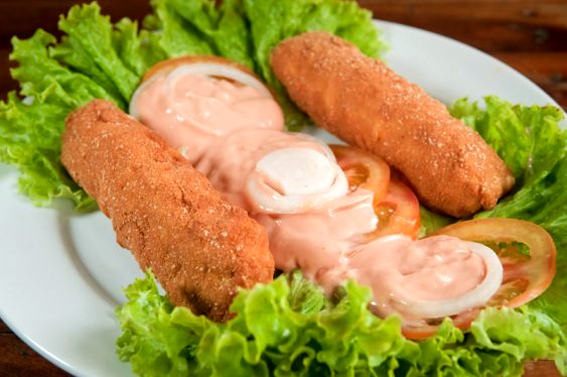
The first-place winner for 2011 in Fortaleza was a long-established favorite bar in Aldeota, one of Fortaleza's more upmarket neighborhoods. The bar is called Bar do Papai (Daddy's Bar) and is known for the quality of its live music as well as its food and drink. Bar do Papai took home the gold with a charmingly-entitled dish called Pedacinho do Céu (Little Piece of Heaven). The dish consists of rolled, breaded chicken cutlets stuffed with cheese and ham and served with a mayonnaise and ketchup sauce. In other words, rolled-up chicken cordon bleu. The bar has been known for this dish for years, so it's likely that a number of voters were already predisposed to vote for Pedacinho do Céu even before they sat down to eat and vote.
Bar do Papai - Pedacinho do Céu

A Bahian-style restaurant called Cabana da Negona (Big Mama's Hut) took second place with a dish of chunks of smoked pork loin on the grill, covered with roasted onion sliced, and accompanied by a sauce made from mayonnaise and manioc flour. Interestingly, there is nothing particularly Bahian about their winning dish, though it does sound (and look) delicious. Flavors of Brazil has reviewed Cabana da Negona previously, and the review can be seen here.)
Cabana da Negoa - Carne do Fumeiro na Chapa

A surprising (to us anyway) dish from a bar called Flórida Bar received the third highest score during Comida di Buteco. Their offering was Figado Acebolada - or in English, liver 'n' onions. Not that the dish doesn't have its fans, but liver is hated by as many people as those who love it, so we'd think that it wouldn't be a contest-winner. Clearly, Flavors of Brazil was wrong, and the fans of Flórida Bar's liver 'n' onions are legion.

Flórida Bar - Figado Acebolado

Of the three bars, only Flórida Bar is unknown to us here at Flavors of Brazil. But it won't remain that way for long - we intend to visit it soon, even if we don't order the liver! Which is the whole point of the Comida di Buteco program - to locate and identify good bar food, and to encourage diners to try out some of the best bar food in the city.

Friday, April 1, 2011

Just How Cold Do Brazilians Like Their Beer?

It's been mentioned several times on Flavors of Brazil that Brazilians generally like their beer to be served cold - extremely cold. When asking for a beer, most will tell the waiter that they want the beer to be bem gelada (well chilled), geladinha (quite cold), or even estupidamente gelada (stupidly cold). The Brazilian gold standard in a beer is a medium-light lager served at the coldest possible temperature. But what IS the coldest possible temperature for beer, and how close to Brazilians come to achieving that standard?

This question came to mind to me last night when I was visiting a neighborhood bar here in Fortaleza with a bunch of friends. It's common in Brazilian bars to see large refrigerators behind the bar used only for storing bottles of beer, and most of these refrigerators are branded by one or another of the Brazilian breweries, most often one of the brands of beer giant AmBev which controls the largest market share in Brazil for beer. (The photo at right shows a refrigerator advertising Antartica beer, one of AmBev's products.I'm not certain, but I'm guessing that the bars receive these fridges free from the breweries in exchange for selling that brewery's brand in the bar. These fridges normally have a digital thermometer prominently displayed near the top of the door. This allows the bartender or waiter (and discerning customers) to monitor the temperature inside the fridge.

Beer freezes at a lower temperature than water, due to the presence of alcohol in the brew. Pure alcohol has an extremely low freezing temperature: -114C or -173F. But beer of course is only 4 or 5% alcohol, and the rest is water, which freezes at 0C or 32F. The fact that beer is carbonated and bottled under pressure also lowers the freezing temperature.

So last night, while chatting and snacking with my party, I began to watch the temperature changes for one particular fridge. When the door hadn't been opened in a while, the temperature hovered around -7.5C or -8C. That's cold! In Fahrenheit it would be between 17 and 18F. Every time the door was opened for someone to grab a bottle of beer, the internal temperature would rise to -5C or so, then settle back down to -8C. My curiosity was spiked, so this morning I did some elementary research on the internet. It appears that the freezing temperature of most beers is around -8.5C or 16.5F. The beer in that fridge last night, when first removed from the fridge, were very close, therefore, to the coldest possible beer. No wonder it tasted so good - particularly as we were outside in the tropical night, and the air temperature at midnight was about 28C or 82F. That means there were 36C or nearly 100F degrees of difference between a freshly poured beer in that bar and the ambient temperature!

There is one undesired side-effect of this Brazilian passion for ice-cold beer and bars attempts to please their customers. From time to time the fridges get too cold and the beer reaches a temperature at which it is still liquid in the unopened bottle, which is pressurized, but at which the beer freezes instantly when the bottle is opened and the pressure is released. It's happened to me several times - a bottle of beer arrives at the table looking nice and frosty. The waiter opens the bottle and then tips it to pour out the first round into our glasses, but nothing comes out. The beer is a solid chunk of beer-popsicle inside the bottle. At that point nothing can be done, as thawed beer loses all of its charm and carbonization. Waiters are generally good-natured about it when it happens though, and soon return with a beer that's only slightly less estupidamente gelada.

Tuesday, February 1, 2011

RECIPE - Gizzards in Passion Fruit Sauce (Moela no Molho de Maracujá)

This contemporary uptake on a traditional Brazilian bar snack, gizzards in a sauce, was created by chef Sol Caldeira, of São Paulo's Tubaína Bar, and was presented by the chef during the recent São Paulo food exhibition and trade show Semana Mesa SP, sponsored by Brazilian magazine Prazeres da Mesa.

Tubaína Bar is a casual and hip bar in the Baixa Augusta neighborhood in central São Paulo. It's name honors an iconic soft drink from the interior of São Paulo state, one that has nostalgic appeal for many dwellers in the megapolitan city of São Paulo. The decor and the menu reflect the culture and tastes of the interior of São Paulo, but updated and rendered more sophisticated to match the tastes of young urbanites. This dish takes a traditional bar snack, chicken gizzards (moelas) braised in a sauce, and updates and lightens it with a bright, acidic sauce made from passion fruit (maracujá)
____________________________________________________
RECIPE - Gizzards in Passion Fruit Sauce (Moela no Molho de Maracujá)
Serves 6

1 1/2 lb (600 gr) cleaned chicken gizzards
1/2 cup (100 ml) passion fruit juice, concentrated
4 Tbsp. finely minced onion
2 Tbsp. finely minced garlic
2 Tbsp. extravirgin olive oil
4 thin slices fresh ginger
water
vinegar
salt and pepper to taste
pinch cayenne pepper
sprig of rosemary and a few pink peppercorns (to garnish)
-----------------------------------------------------------------------------
Cut the gizzards into halves, or quarters if they are large. Wash them thoroughly, place them in a mixing bowl and cover with a mixture of water and vinegar in 80% to 20% proportion. Let sit in water for 15 minutes.

In a heavy saucepan with cover, preferably enameled cast iron, heat the olive oil over medium high heat, then sauté the onions and garlic until they are soft and the onions are transparent but not browned. Drain the gizzards, then add them to the pan. Season with salt and pepper to taste, then add the ginger slices and cayenne pepper. Stir to mix thoroughly.

Sauté the gizzards until they have given up their juices and are dry. Add the concentrated passion fruit juice and 2 cups (500 ml) water. Bring to a boil over high heat, then reduce heat to low and cover pan. Cook for about 45 minutes, adding additional water if the sauce begins to dry up, until the gizzards are cooked through and tender. If the sauce is watery, briefly increase heat to reduce the liquid.

Place the gizzards and sauce in the center of a deep plate and decorate with the rosemary and pink peppercorns. Surround the gizzards with thick slices of toasted baguette.

Tuesday, January 11, 2011

On the Road - Rio de Janeiro (Pt. 6) - The Botecos of Rio

The hole-in-the-wall-push-out-onto-the-sidewalk type bar known as a boteco, botequim or butequim is to Rio de Janeiro what the neighborhood tavern is to Milwaukee, WI or Boston, MA, or what the local pub is to denizens of small towns and villages throughout the UK and Ireland. It's an institution, and anyone who wants to mess with the formula had better be careful, because it's a beloved institution. Cariocas (residents of Rio) are fiercely loyal to the idea of the boteco in general, and to their own particular boteco in particular.

Botecos can be found in all corners of this sprawling city, from tony Lebon and Ipanema, to the tourist haunt of Copacabana, and right through to the middle-class suburbs in the northern zone of the city. Even the hillside slums known as favelas have botecos.

The standard boteco is a small space open to the sidewalk, with a small stand-up bar, a cashier's cage, a display case for pre-cooked snacks, plenty of refrigerators for icy-cold beer, a minimal kitchen and a rudimentary bathroom. On the sidewalk in front are any number of plastic tables and plastic chairs, all sponsored by one or another of Brazil's major breweries and sporting the brewery's colors. There's often barely enough room to stand inside the boteco itself, so the majority of patrons stand outside or sit at one of the sidewalk tables. During the day, when stores and shops are open, the tables might be restricted to the space directly in front of the boteco, but as soon as retail stores close, the number of tables blossoms, and the sidewalk for half-a-block or more can be taken up with patrons sitting, chatting, drinking and snacking.

All botecos sell beer, and a they sell a lot of it. They all also serve soft drinks and bottled water, but in minimal quantities. It seems that mixed drinks are almost unheard of. Beer is normally sold in 600 ml (20 oz) bottles, and served in thermal coolers to be poured into small glasses. This avoids the problem of warm beer, which Brazilians universally detest and which is the inevitable result of a too-large glass.

Botecos sell snacks and sandwiches too - packaged snacks like potato chips and nuts, savory pastries and pies almost everywhere, and "blue-plate special" meals at some botecos during meal times. The quality of these snacks and meals varies greatly and customer loyalty often depends on the quality of the food - after all, as long as it's served properly cold, a bottle of Brahma or Antartica beer is not going to vary from boteco to boteco.

These bars are extremely social places, and also extremely casual. In the frequently hot climate of Rio, it's not at all unusual to see a bunch of guys standing at the bar in a boteco dressed only in flip-flops and skin-tight Speedo-style bathing suits. (And it's not only the young and well-built who adopt this style of dress). I sometimes wonder where they keep their money and keys! Everyone seems to know everyone in a boteco, and a stranger is likely to be questioned, in a friendly manner, about where he or she is from and what he or she thinks of Rio and this boteco. In short order a newcomer can become a regular - it happens here almost as fast as it does in Ireland, but not quite.

The original-style botecos, of which many remain, have recently been joined by more up-market cousins. In the newer, more stylish botecos, there will be space to sit at a table inside, the decor will be cleaner and more tasteful, and there is likely to be waitstaff. The menu will be more varied, and the quality of the food is higher, as are the prices, of course. (The whole concept of these new botecos is a bit like the British gastropub.) To distinguish between the two styles, cariocas have begun to use the terms -sujo and -limpo. Translated these mean "dirty feet" and "clean feet". The original style, naturally, is the "dirty-feet" boteco, and they newer style, where patrons are expected to have at the very minimum washed their feet before entering, is the "clean-feet" boteco.

To travel to Rio and not spend some time getting to know the boteco culture would be a shame. Probably even a crime. In the sections of the city that tourists are likely to visit, botecos are very safe, if a bit rowdy at times, and the most worrying thing might be the unwanted attention of the local drunkard. Take it all with a smile, a word or two of Portuguese, and soon you'll be everybody's new best friend. And when they tell you that they mean it.

Wednesday, September 8, 2010

RESTAURANT REVIEW - Docentes & Decentes (Fortaleza, Brazil)

One of the most popular styles of restaurant in Brazil is a combination bar-restaurant where people can go after work, with a group of friends on the weekend or with the extended family to celebrate a happy event in a large, animated, and often noisy atmosphere. These restaurants serve a variety of drinks, although beer (cerveja) is by far the largest seller, and casual food ranging from finger-food snacks to full course meals of local favorites. In my Brazilian hometown, Fortaleza, these bar-restaurants are all open-air, as the year-round tropical climate allows outdoor dining almost every night of the year. In cooler regions of Brazil, they often have both indoor and outdoor spaces. Such restaurants are often enormous establishments, and some of them seat several hundred customers at a time.

One of the best Fortaleza restaurants of this type is called Docentes & Decentes (which somewhat enigmatically translates in English as "Academicians & Decent Folks). It has been around for 23 years, and has two branches, one on a major commercial avenue, and the other in neighborhood Varjota, which is Fortaleza's "restaurant mecca".

I've only visited the Varjota branch, but I'm told that the menu and ambiance is the same in both branches. Docentes & Decentes is open all day and late into the night - from 10 a.m. until the final client decides to call it a night - and it's busy at almost all times. Evenings there is live acoustic music, usually a group playing Brazilian pop standards. The place has indoor and outdoor dining spaces, though the interior space is usually reserved for family, school or work celebrations. Outside there is space for about 250 people, and there is a large number of tables that seat groups for 6-10 persons. Most of the outdoor space is a large patio space, open to the air, though there is one section that has a roof - perfect for those few nights of the year when it rains.

The all-male waitstaff is very fast and efficient and is kept hopping by the Brazilian habit of ordering additional drinks and dishes throughout the meal. Beer is served in 600 ml (20 oz) bottles, which arrive in thermal covers to keep the beer icy-cold and which are shared by everyone at the table. Docentes & Decentes' customers seem to be of two minds as far as dining goes. There are those who look at the menu, order a complete meal, and leave it at that. They are far outnumbered by those who keep a menu handy at the table, ordering dish by dish as the mood strikes, always to be shared by all the diners at the table. It could be french-fries, pastels, bolinhos and other snack food, or it might be something more hardy, like crabs, a kilo or two of shrimp with garlic, carne de sol, or the house's signature dish - fresh black-eyed peas (feijão verde).

No one would consider Docentes & Decentes a temple of gastronomy - the whole point of the place is to meet friends and family, share drink, food and chat, hear some good music, and have a fun night out. However, the restaurant does put more thought and care into their food than many of its competitors, and there is rarely a dish that disappoints.  In many visits, I've never received cold fries, less-than-fresh shrimp, or warm beer - things which can ruin the experience at some other similar restaurants in Fortaleza. The service is friendly and professional. And the prices are fair - it's easy for a group of four or five to spend an evening at Docentes & Decentes, have several dishes of good food, and more than several beers, and end up paying about R$25 (USD $15) per person.

Docentes & Decentes, being situated away from the beachfront and major hotels, is not a tourist-oriented restaurant. It's a local's hangout. This means that the menu will be only in Portuguese, and the waiter is likely to speak that language only. However, for an authentic Brazilian night out, I'd highly recommend visitors to Fortaleza to try it out. Anyone at a neighboring table will help you out with ordering, even if there is a language barrier, and you'll soon end up a new set of Brazilian friends. Taxis in Fortaleza are safe and not expensive - from the beachfront hotel district to Docentes & Decentes, you can expect to pay R$10-15 (USD $6-10). If you go, remember to do yourself a favor, and order feijão verde - I can guarantee you'll love it.

In the next Flavors of Brazil post, I'll include a recipe for feijão verde Docentes & Decentes style.

Docentes & Decentes
Avenida Santos Dumont 6180
Bairro Papicu
Fortaleza, Brazil

Docentes & Decentes
Rua Ana Bilhar 1445
Bairro Varjota
Fortaleza, Brazil