Showing posts with label pumpkin. Show all posts

Tuesday, January 8, 2013

RECIPE - Mashed Squash, Brazilian-style (Purê de Jerimum)

There's something uniquely appealing about mashed vegetables - which is probably why they're often atop lists of favorite "comfort foods". Perhaps it's because they are a throwback to one's early childhood when all solid food was mashed, perhaps it's because of the large amount of fat (dairy, vegetable) that mashed vegetables can carry. Whatever it is, who doesn't like mashed potatoes, or mashed anything for that matter?

Brazilians are no exception to this rule. Mashed potatoes are universally loved in Brazil, and here they really do pack a caloric punch, as they are laden with generous amounts of cream, butter and even cream cheese. But other vegetables get the mashing treatment here, and Flavors of Brazil would venture to guess that "Miss Runner-Up" in the mashed vegetable popularity contest in Brazil would be mashed pumpkin, or as it's called in Brazil, purê de jerimum.

The most common name for pumpkins in Brazil is abóbora, but they are also known, particularly in Brazil's northestern region as jerimum. The etymology of abóbora leads one back to Latin roots, and the word came to Brazil with the Portuguese. Jerimum, however, comes from the Amerindian Tupi-Guarani family of languages, and hearkens back to the vegetable's New World origins.

Like mashed potatoes, purê de jerimum is basically a mixture of mashed, cooked vegetable plus additional liquid and fat. What distinguishes purê de jerimum is that the additional liquid and fat are in the form of coconut milk, which gives the final dish an unusual and distinctive flavor, with the pumpkin's inherent sweetness brought out by the coconut milk. The high fat content of coconut milk also ensures the silky mouth-feel that's so important in mashed veggies.

Try this dish as a new side dish with roasted meats or poultry. It will be a rousing success, we promise. Even if your guests can't identify the flavor of coconut milk in the dish, they'll appreciate what it adds to the flavor profile.
_________________________________________________
RECIPE - Mashed Squash, Brazilian-style (Purê de Jerimum)  
Serves 6

1 lb (450 gr) peeled, seeded and cubed pumpkin or other winter squash
1 1/2 cup (375 ml) canned or bottled coconut milk
salt to taste
chopped cilantro (optional)
---------------------------------------------------------------------------
Cook the pumpkin in plenty of boiling water until it is very tender. Drain thoroughly in a colander, and then place the cubes in a large mixing bowl.

Using a potato mashed, mash the squash to desired consistency (some people like some texture remaining in the dish, others prefer a smooth puree).

Stir in the coconut milk and mash for a few more seconds until the coconut milk is thoroughly mixed in. Season to taste with salt.

If desired, stir in a handful or two of chopped cilantro.

Put the pumpkin in a decorative serving bowl and serve immediately as a side dish.

Recipe translated and adapted from Namorando na Cozinha blog.

Sunday, January 6, 2013

RECIPE - Shrimp in a Pumpkin (Camarão na Moranga)

(First off, a note for students who are just beginning to study Portuguese. This is not a recipe for shimp in a strawberry! The word for strawberry is morango, and this recipe is for shrimp in a moranga - with a final "a". Moranga is a word that means pumpkin, or at least one of those winter squashes that can be used like a pumpkin). Even native Portuguese speakers get these two words mixed up sometimes, and the Brazilian version of Internet sites like Ask Yahoo are full of questions asking basically "Are morango and moranga the same thing?" To avoid confusion, we'll skip the Portuguese terms in this post and just refer to the vegetable in question as a pumpkin.)


A stand-out centerpiece for a fancy dinner table, or a buffet, Shrimp in a Pumpkin is a familiar showpiece for Brazilian dinner parties, Christmas and New Year's feasts, birthdays, and anniversaries. Undeniably spectacular, it's also undeniably delicious, and for many Brazilians, it's their favorite way to eat shrimp. It's also undoubtedly one of the best ways to serve shrimp to a crowd.

You can use any large winter squash for this dish, though a bright orange pumpkin makes a visually appealing presentation. In contemporary Brazilian restaurants, the dish is even popping up in individual servings, using the small mini-pumpkins that arrive in supermarkets in the holiday season. One of those, filled with shrimp and sauce is just perfect for one person. The traditional version, however, employs a large pumpkin to serve the entire party.
__________________________________________________
RECIPE - Shrimp in a Pumpkin (Camarão na Moranga)
Serves 6

a 6 lb (3 kg) pumpkin or other squash
2 lbs (1 kg) medium shrimp, cleaned, peeled and deveined
2 limes
2 tsp salt
1 small serrano or jalapeno chile (optional), halved and seeded
3 bay leaves
2 cups shrimp stock (recipe here)
2 medium onions, chopped
2 Tbsp butter
2 Tbsp extra-virgin olive oil
5 medium tomatoes, peeled, seeded and chopped
3 cups cream cheese
2 Tbsp all-purpose flour
2 Tbsp good-quality curry powder
2 tsp Tabasco sauce (optional)
3 Tbsp extra-virgin olive oil
3 Tbsp neutral vegetable oil
4 Tbsp finely-chopped Italian parsley
-----------------------------------------------------------------------------
Cut a circular opening in the top of the pumpkin (as you would for a jack-o-lantern). Using a spoon and your hands, remove all the seeds and strings from inside the pumpkin. Wash the pumpkin thoroughly inside and out, then dry the inside with paper towel. Reserve.

Preheat the oven to 205C (400F).

Put the shrimp in a large mixing bowl, then add the fresh-squeezed juice of two limes, the salt, the halved chile and the bay leaves. Mix thoroughly and refrigerate for about one hour (while the pumpkin roasts).

Wrap the pumpkin in aluminum foil, place a large baking pan, and roast in the oven for about 50 minutes. Remove from the oven and reserve, keeping warm. No not turn off the oven.

In a large saucepan, heat 2 Tbsp each of butter and olive oil, then saute the chopped onions for a few minutes, or until the onions are transparent but not browned. Add the tomatoes and cook, stirring frequently, for a few minutes, or until the tomato begins to break down. Add the cream cheese, and combine thoroughly, making sure that the cheese has melted and combined with the other ingredients. Reserve, keeping warm.

In a mixing bowl containing the shrimp stock, whisk in the flour and continue to whisk until their are no lumps. Mix in the curry powder and optional Tabasco sauce. Stir this mixture into the cream cheese/tomato sauce, and reserve, keeping warm.

In a large frying pan, heat 3 Tbsp each of olive oil and neutral vegetable oil. Remove the shrimp from the refrigerator and saute (in two batches if necessary to avoid overcrowding). Cook for a few minutes only, stirring constantly but gently, until all the shrimp have become opaque and turned pink. Do not overcook. Stir the shrimp gently in the the sauce mixture.

Open the top of the pumpkin (leaving the rest of it still covered with aluminum foil. Reserve the top. Pour the shrimp mixture into the pumpkin, filling it completely if possible. Return the filled pumpkin to the hot oven and cook for 10 minutes. Remove from the oven, remove the aluminum foil, then place the pumpkin on a large serving platter. Sprinkle the surface of the shrimp mixture with chopped parsley. Serve on a buffet table or at the center of a dining table, with a large ladle for serving the shrimp from inside the pumpkin, along with a bit of the cooked pumpkin.

Friday, January 4, 2013

RECIPE - Homestyle Squash Compote (Doce de Abóbora Caseiro)

When you think of squashes, what comes to mind first - main course or dessert? We'd bet that for the majority of our readers, squash brings to mind something that's served with the main course - to accompany meat or chicken, for example. Many might even say that squash has nothing to do with desserts. It's only when they are reminded that traditional Thanksgiving and Christmas feasts often feature pumpkin pie for dessert, and that pumpkin is merely one of many kinds of squash, that they might concede that squash and sugar go together.

Some squashes are quite sweet in and of themselves, of course, but combining members of the squash family with sugar, honey or coconut milk is an old culinary tradition in Brazil, and for many Brazilians, abóbora (Portuguese for squash or pumpkin) is something seen more often on the dessert table or buffet than it is as a vegetable side dish.

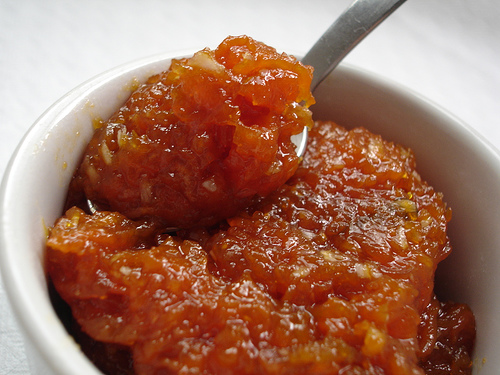
Throughout Brazil, one of the oldest, most traditional (and easiest) ways to turn squash or pumpkin into a dessert is to cook it down to a thick puree, spice it with cinnamon and clove, then sweeten it with sugar and a splash of coconut milk. This recipe is so basic that Brazilians simple call it Doce de Abóbora, which means Squash Dessert or Squash Sweet. It's served at weekday family meals, and it's served on fancy dessert tables. It's popular with all economic classes in Brazil, as squashes are generally very cheap in Brazil, and it doesn't require expensive ingredients.

This recipe can be made with any type of winter squash - Hubbard, Butternut, Acorn, etc. It can also be made with pumpkin. Summer squashes (e.g. zucchini, pattypan) are not suitable as they contain too much water. It can be served warm or cold (though cold is more typically Brazilian). If you wish to make it a bit richer, pour a couple of tablespoons of coconut milk over the squash once you've put it into individual serving dishes.
_________________________________________________________
RECIPE - Homestyle Squash Compote (Doce de Abóbora Caseiro)
Serves 6

2 lbs (1 kg) winter squash, any type, peeled and cored, cut into 1 inch cubes
1/4 cup coconut milk
3 cups granulated white sugar (more or less, to taste)
2 small sticks cinnamon
4 cloves
-----------------------------------------------------------------------------
Put the squash into a large heavy saucepan,. Add a very small quantity of water (less than half a cup). Add the sugar and stir to mix. Heat the mixture over low heat, stirring constantly, until the sugar dissolves. When the sugar has dissolved, add the cinnamon and cloves, and continue to cook, mixing and stirring constantly with a wooden spoon. Continue to cook until the cubes of squash have become very tender.

When the squash is tender, using the same wooden spoon, begin to mash the cubes against the sides of the pan while continuing to cook over low heat. When all the squash is mashed and the mixture begins to pull away from the bottom and the sides of the pan, add the coconut milk and mix it in.

Cook for an additional two or three minutes only, stirring constantly. Remove from heat and let cool. Can be served slightly warm, at room temperature, or chilled. Divide the mixture between six dessert dishes, and pour additional coconut milk over the puree if desired.

Wednesday, January 2, 2013

VEGETABLES OF BRAZIL - The Squash Family (Abóboras)

Although when speaking English we are accustomed to speaking in terms of butternut or acorn squashes, pumpkins, gourds, marrows, pattypans, zucchinis, etc., as separate foods, in fact all these vegetables are squashes - that is, botanically, they are all members of the genus Curcubita, the squashes. In Brazilian Portuguese, they are all inguistically linked together and called abóbora. To Brazilians a giant pumpkin and a small baby zucchini are both abóboras, although to help consumers along, some types are identified separately by modifiers or unique names. Zucchinis, for example, are generally referred to as abóbora italiana (Italian squash) or abobrinha (little squash). There are also unique regional names which are largely American in origin, such as jerimum, which is a Northeastern term for large pumpkin-type squashes.

The cultivation of squash goes back a very long way in human history, and archeological evidence seems to indicate that squashes were first cultivated in Mesoamerica between 8,000 and 10,000 years ago. Native Americans referred to squashes as one the "three sisters" (the three main native food crops), along with corn (maize) and beans. In native American cultures, all parts of the squash were eaten (as they still are today in the area). The flesh, the seeds and even the blossoms are all essential ingredients in traditional Mexican, Peruvian, Brazilian and other New World cuisines.

Brazilians cook and eat squashes in many forms - in soups, in purees, which can be either savory or sweetened with sugar, salads, in breads and cakes, and in stews and hot-pots. Larger, sturdier squashes, are even used as containers for other foods. In the next few posts on Flavors of Brazil, we'll detail some of the uniquely Brazilian treatments of this important family of vegetables.

Sunday, January 15, 2012

RECIPE - Pumpkin Pudding (Curau de Abóbora)

Pumpkin pie is unknown in Brazil, or it seems to be from what we've discovered researching Brazilian cookbooks, websites and blogs. Nonetheless, Brazilians cook frequently with pumpkins - in fact, with all the hard winter squashes - and they are familiar with pumpkin's ability to shine in sweet dishes as well as savory ones.

In this easy dessert dish, which comes from the northeastern state of Ceará, pureed pumpkin is combined with coconut milk and whole milk, then cooked down to create a thickened pudding. The use of coconut milk adds a distinctly Brazilian touch and the addition of powdered cinnamon at the end of the cooking process recalls the way pumpkin is spiced in North American sweet dishes.

__________________________________________________
RECIPE - Pumpkin Pudding (Curau de Abóbora) 
Serves 4

1 lb peeled and cubed pumpkin or winter squash
1 cup (250 ml) coconut milk
2 cups whole milk
1/2 cup granulated white sugar
1/2 tsp salt
2 Tbsp cornstarch
3 Tbsp unsalted butter
powdered cinnamon
__________________________________________________
Cook the cubed pumpkin in boiling water until it is very soft. Drain thoroughly. When slightly cool, place the pumpkin in a blender or food processor with the coconut milk, the milk, the sugar, salt, cornstarch and butter. Blend until completely homogenous.

Put the blended mixture in a double boiler and cook over boiling water, stirring constantly, for thirty minutes, or until the mixture has thickened. Remove from heat.

Pour the mixture into four ramekins or custard cups. Sprinkle the surface with powdered cinnamon. Place the cups in the refrigerator for at least three hours and serve cold.