Showing posts with label coconut milk. Show all posts

Tuesday, January 8, 2013

RECIPE - Mashed Squash, Brazilian-style (Purê de Jerimum)

There's something uniquely appealing about mashed vegetables - which is probably why they're often atop lists of favorite "comfort foods". Perhaps it's because they are a throwback to one's early childhood when all solid food was mashed, perhaps it's because of the large amount of fat (dairy, vegetable) that mashed vegetables can carry. Whatever it is, who doesn't like mashed potatoes, or mashed anything for that matter?

Brazilians are no exception to this rule. Mashed potatoes are universally loved in Brazil, and here they really do pack a caloric punch, as they are laden with generous amounts of cream, butter and even cream cheese. But other vegetables get the mashing treatment here, and Flavors of Brazil would venture to guess that "Miss Runner-Up" in the mashed vegetable popularity contest in Brazil would be mashed pumpkin, or as it's called in Brazil, purê de jerimum.

The most common name for pumpkins in Brazil is abóbora, but they are also known, particularly in Brazil's northestern region as jerimum. The etymology of abóbora leads one back to Latin roots, and the word came to Brazil with the Portuguese. Jerimum, however, comes from the Amerindian Tupi-Guarani family of languages, and hearkens back to the vegetable's New World origins.

Like mashed potatoes, purê de jerimum is basically a mixture of mashed, cooked vegetable plus additional liquid and fat. What distinguishes purê de jerimum is that the additional liquid and fat are in the form of coconut milk, which gives the final dish an unusual and distinctive flavor, with the pumpkin's inherent sweetness brought out by the coconut milk. The high fat content of coconut milk also ensures the silky mouth-feel that's so important in mashed veggies.

Try this dish as a new side dish with roasted meats or poultry. It will be a rousing success, we promise. Even if your guests can't identify the flavor of coconut milk in the dish, they'll appreciate what it adds to the flavor profile.
_________________________________________________
RECIPE - Mashed Squash, Brazilian-style (Purê de Jerimum)  
Serves 6

1 lb (450 gr) peeled, seeded and cubed pumpkin or other winter squash
1 1/2 cup (375 ml) canned or bottled coconut milk
salt to taste
chopped cilantro (optional)
---------------------------------------------------------------------------
Cook the pumpkin in plenty of boiling water until it is very tender. Drain thoroughly in a colander, and then place the cubes in a large mixing bowl.

Using a potato mashed, mash the squash to desired consistency (some people like some texture remaining in the dish, others prefer a smooth puree).

Stir in the coconut milk and mash for a few more seconds until the coconut milk is thoroughly mixed in. Season to taste with salt.

If desired, stir in a handful or two of chopped cilantro.

Put the pumpkin in a decorative serving bowl and serve immediately as a side dish.

Recipe translated and adapted from Namorando na Cozinha blog.

Monday, November 19, 2012

RECIPE - Mixed Vegetables in Coconut Milk (Legumes Cozidos ao Leite de Coco)

Here's a Brazilian solution to an age-old dilemma - how to jazz up a side dish of vegetables and turn them into something special. We all know that a good serving of vegetables is an important part of a nutritionally balanced a dinner plate, but night after night of meat and two veg can be deadly boring.

This traditional Brazilian recipe uses one of the most important ingredients in the Brazilian larder, coconut milk, to give mixed vegetables (or even single vegetables) a spark of life. If we were Mad Men, we'd say that the coconut milk puts the "extra-" in ordinary vegetables.

It's easy to keep a can or tetra-pak of coconut milk on your pantry shelf, so this recipes great when you're lacking inspiration. Just choose a mix of vegetables to suit, add the coconut milk and you've turned your meal tropical.

Note: The vegetables indicated in the recipe below are simply suggestions. You can change them, use only one or two, or even just one vegetable. Just make sure the total weight remains approximately the same.
__________________________________________
RECIPE - Mixed Vegetables in Coconut Milk (Legumes Cozidos ao Leite de Coco)
Serves 4

1/2 lb boiling potatoes, peeled and cubed
1/2 lb carrots, peeled and cubed
1/4 lb green beens, cut into 1 inch lengths
1/4 lb broccoli crowns, cut into florets
1/4 lb cauliflower, cut into florets
1/2 cup coconut milk
1 inch piece of fresh ginger, peeled
1 Tbsp finely minced fresh Italian parsley
1 bay leaf
salt and pepper to taste
-----------------------------------------------------------------
Put all the vegetables in a large saucepan along with the bay leaf and the piece of ginger. Add just enough water to come about half way up the vegetables. Bring the water to a boil, then cover the pan, reduce heat and cook just until the vegetables are tender. Add the coconut milk, increase the heat and cook uncovered until the liquid reduces by about half. Remove from heat, remove the ginger and bay leaf, season to taste and serve immediately, spooning a bit of the liquid over each serving, then sprinkling a bit of parsley on top.

Recipe translated and adapted from Portal Sabores website.

Monday, June 25, 2012

RECIPE - Crab in Coconut Milk (Caranguejo ao Leite de Coco)

In yesterday's post, we discussed Fortaleza's Thursday night ritual of heading out to a beach bar or casual restaurant for a crab feast. Every beach bar along Fortaleza's principal beach, Praia do Futuro, touts their own recipe as the best, but in fact, almost anywhere you go the basic recipe is the same. The recipe is so closely associated with Fortaleza and surrounding beach communities that it's sometimes called Caranguejo Cearense, meaning "Crab from Ceará" the state of which Fortaleza is the capital.

At its simplest, and most traditional, the recipe calls for cooking/steaming the crabs in a broth of rich coconut milk seasoned with garlic, onions, and tomatoes and garnished with lavish amounts of chopped cilantro. During the cooking process, the coconut milk is infused with the juices of the crabs so that when the dish is presented the aromas of the coconut milk and of briny seafood combine into a mouth-watering invitation to pick up the hammer, grab a crab and begin to smash and nosh the night away.

In Fortaleza, this recipe is made with local caranguejo-uçá crabs but can be successfully be made with whatever species of crab is available in your local market - with the possible exception of Alaska king crabs which are better suited to other treatments due to their enormous size.
_______________________________________________
RECIPE - Crab in Coconut Milk (Caranguejo ao Leite de Coco)
Serves 4 - 8 depending on size of crabs

4 cloves garlic, finely chopped
2 medium tomatoes, peeled, seeded and chopped
1 medium onion, chopped
2 Tbsp extra-virgin olive oil
2 cups (500 ml) coconut milk
1 tsp. annatto powder or oil (can substitute sweet paprika)
1 bunch cilantro, large stems removed, finely chopped
8 small crabs, thoroughly washed
----------------------------------------------------------------------
In a large saucepan with a lid, heat the olive oil, then add the garlic, tomatoes and onion and fry until the onion and garlic are softened and the tomato is breaking up. Stir in the coconut milk, the annato or paprika and half of the cilantro. Cook a few more minutes or until the tomato has completely broken up. Bring the liquid to the boiling point.

Add the crabs plus just enough water to cover them. Reduce heat, cover the pan and let the crabs cook/steam for 10 minutes. Remove from heat.

Put the crabs in a deep serving bowl, pour the cooking liquid over, then sprinkle the remaining cilantro over all. Serve immediately, to be eaten by hand.

Tuesday, March 13, 2012

RECIPE - Salt Cod with Coconut Milk and Ginger (Bacalhau ao leite de coco e gengibre)

This recipe, which comes from A Crítica newspaper in Manaus, the largest city in Brazil's Amazonian region, highlights the local-produced  "salt cod" made from piracuru, the world's largest fresh-water fish. (Click here to read more about this salt-cod, known in Brazil as bacalhau da Amazônia.) Although this dish was developed by Manaus chef  Felipe Schaedler specifically to showcase the recently-introduced Amazonian salt cod, it can easily be adapted to standard salt cod, made from fish found in the North Atlantic. Chef Schaedler was recently named Manaus' chef of the year at the young age of 25 by Veja magazine's Comer & Beber Manaus. Currently, unless you live in the Amazon basin, you'll have to make this substitution, as bacalhau da Amazônia is only available in the region. Soon, however, it should be available elsewhere in Brazil, and potentially in other world markets.

Chef Schaedler combines the fish with local flavorings coconut milk, ginger and orange juice to give the dish a tropical feel. Most traditional Brazilian recipes for salt cod derive from Portuguese originals, and consequently are combined with vegetables that can grow in temperate zones and with seasoning found in European pantries. This modern take on salt cod Brazilianizes it by combining it with flavorings that are tropical in origin. However, in today's global economy, these flavorings are widely available in non-tropical countries, so the ingredients for this dish should not be difficult to source almost anywhere.
_______________________________________________
RECIPE - Salt Cod with Coconut Milk and Ginger (Bacalhau ao leite de coco e gengibre)

2 lbs (1 kg) good-quality salt cod
extra-virgin olive oil
1 medium onion, finely chopped
2 cloves garlic, finely chopped
1 red bell-pepper, seeded and diced
1 cup coconut milk
1 Tbsp fresh ginger, grated, with its juice
4 Tbsp fresh-squeezed orange juice
cilantro or Italian parsley (optional)
 ----------------------------------------------------------------------
Three days before cooking, place the salt cod in a pan or deep platter and cover with fresh cold water. Place in the refrigerator. Twice a day remove the fish from the refrigerator, drain it, cover again with fresh cold water and replace in the fridge. When ready to cook, drain thoroughly, cut into serving sized pieces and reserve.

Preheat the oven to 350F (170C). Place the fish in a roasting pan, drizzle with plenty of extra-virgin olive oil, and roast for about 20-25 minutes, or until the fish begins to brown and is starting to flake.

Meanwhile, in a medium sauce pan, heat a small amount of olive oil, then saute the onions, garlic and red bell peppers until the vegetables are softened but not browned. Add the orange juice, bring to a boil and reduce the liquid by half. Stir in the grated ginger. Add the coconut milk, bring to a boil, reduce slightly to thicken. Reserve.

When the fish is cooked, remove it from the oven. Spread some of the coconut milk-ginger sauce on the bottom of a deep dinner plate, then place a piece of roasted fish on top. You may garnish with a leaf of two of Italian parsley or cilantro. Serve with write rice or mashed potato.


Sunday, January 15, 2012

RECIPE - Pumpkin Pudding (Curau de Abóbora)

Pumpkin pie is unknown in Brazil, or it seems to be from what we've discovered researching Brazilian cookbooks, websites and blogs. Nonetheless, Brazilians cook frequently with pumpkins - in fact, with all the hard winter squashes - and they are familiar with pumpkin's ability to shine in sweet dishes as well as savory ones.

In this easy dessert dish, which comes from the northeastern state of Ceará, pureed pumpkin is combined with coconut milk and whole milk, then cooked down to create a thickened pudding. The use of coconut milk adds a distinctly Brazilian touch and the addition of powdered cinnamon at the end of the cooking process recalls the way pumpkin is spiced in North American sweet dishes.

__________________________________________________
RECIPE - Pumpkin Pudding (Curau de Abóbora) 
Serves 4

1 lb peeled and cubed pumpkin or winter squash
1 cup (250 ml) coconut milk
2 cups whole milk
1/2 cup granulated white sugar
1/2 tsp salt
2 Tbsp cornstarch
3 Tbsp unsalted butter
powdered cinnamon
__________________________________________________
Cook the cubed pumpkin in boiling water until it is very soft. Drain thoroughly. When slightly cool, place the pumpkin in a blender or food processor with the coconut milk, the milk, the sugar, salt, cornstarch and butter. Blend until completely homogenous.

Put the blended mixture in a double boiler and cook over boiling water, stirring constantly, for thirty minutes, or until the mixture has thickened. Remove from heat.

Pour the mixture into four ramekins or custard cups. Sprinkle the surface with powdered cinnamon. Place the cups in the refrigerator for at least three hours and serve cold.

Thursday, December 1, 2011

RECIPE - Fish Moqueca (Moqueca de Peixe)

The bright orange palm oil dendê, featured in yesterday's post on Flavors of Brazil, is closely connected in most Brazilians' minds to the cooking styles of the northeastern Brazilian state of Bahia, where African cultural traditions have survived the longest and are the most vibrant of any place in Brazil.

One of the most characteristic cooking techniques in Bahia is called moqueca, and there are hundreds if not thousands of moquecas to be found in Bahia. One of Brazil's most authoritative dictionaries, Houaiss, defines a moqueca as:

a stew of fish, seafood, meat or eggs, made with coconut milk and  dendê oil plus seasonings (cilantro, onion, bell peppers, dried shrimps and chili peppers), cooked preferably in a clay casserole and served in the same dish. [Originally from northeastern Brazil, especially Bahia, but now considered characteristic of Brazilian cuisine in general, being found in various states of Brazil.]
Since the etymology of the word moqueca traces it back to an African word mu'keka meaning "fish chowder" or "fish stew" it's probably true that the first moquecas used fish as their principal ingredient and that other variations followed. So to begin with the beginning, here's a recipe for fish moqueca that comes from Bahia.
___________________________________________________
RECIPE - Fish Moqueca (Moqueca de Peixe)
Serves 4

2 lb (1 kg) snook, grouper, or other firm, non-flaking white fish, cut into steaks or large chunks
juice of 1 lemon
salt and black pepper to taste
1 Tbsp extra-virgin olive oil
4 medium tomatoes
1 medium green bell pepper
1 medium red bell pepper
1/4 cup firmly-packed chopped cilantro
3 Tbsp dendê oil (click here to read about purchasing and about substitutes)
2 cups coconut milk
------------------------------------------------------------------------------
Season the fish with the lime juice, olive oil and salt and pepper to taste. Reserve, marinading, for 30 minutes.

In a blender or food processor, blend the tomatoes, the onion, peppers and the cilantro until you have a homogenous but still slightly chunky liquid.

In a large frying pan, head the dendê oil, then add the mixture from the blender and cook for about 5 minutes, or until the sauce is hot and bubbling. Add the fish, covering the pieces with the tomato mixture and cook for one or two minutes. Stir in the coconut milk, bring to a simmer and cook for about 25 minutes, or until the fish is completely cooked and the sauce has thickened.

Serve in a decorative bowl, preferably of unglazed earthenware, garnished with cilantro leaves, a few rings of onions and bell peppers if desired. Accompany with white rice and a good, preferably homestyle hot sauce.

Recipe translated and adapted from Cozinha Regional Brazileira by Abril Editora.

Wednesday, September 14, 2011

RECIPE - Pureed Beans with Coconut Milk (Feijão de Coco)

 
A portion of beans is an almost-universal part of a Brazilian meal plate, along with rice, and if the budget allows, some sort of animal protein. If meat or fish is too expensive, which it is for many Brazilians, then the plate will consist of rice and beans alone, adorned perhaps with a piece of lettuce and a slice of tomato.

Nine time out of ten the beans are prepared dried beans cooked in water until soft, and then seasoned with onion, garlic and salt. But everybody likes a bit of varietyonce in a while, even those very conservative Brazilians who will tell you that they eat rice and beans every day, in the same style.

One unusual and unexpectedly delicious way to serve beans at any meal is this recipe for pureed beans flavored with coconut milk, which comes from the north-eastern state of Pernambuco. It can be made quick thick, sort of like Mexican-style refried beans, or with additional liquid can become a thinner puree - the choice is yours. Obviously, additional coconut milk will not only thin out the pureed-bean mixture, but it will also crank up the coconut flavor in the dish. If you want a thinner puree, but don't want to increase the flavor of coconut, you can use some of the water the beans were cooked in. See the photos accompanying this post to see the results of using less liquid (above) or more (below).

You can serve this dish, plus the obligatory plain white rice, alongside a nice piece of grilled fish, a thin steak or slice of pot roast, or a piece of roast chicken. To make it a perfect copy of a Brazilian meal, just add the piece of lettuce and slice of tomato to the plate and make sure there's some type of hot sauce on the table.
__________________________________________________
RECIPE - Pureed Beans with Coconut Milk (Feijão de Coco)
Serves 4

3 cups precooked dried beans (pinto beans are best, but other types can be used)
1 medium onion, chopped
1 cup coconut milk, canned or home-made
2 Tbsp extra-virgin olive oil
salt to taste
chopped cilantro to garnish (optional)
-----------------------------------------------------------------------------
Drain the precooked beans, reserving their cooking liquid if desired. Put them in a blender or food processor along with the chopped onion, the coconut milk and the olive oil. Blend for about one minute at high speed, or until you have a completely homogenous mixture. Check for consistency and if it is too thick add additional coconut milk or some of the reserved cooking liquid and blend again for a few seconds.

Pour into a heavy sauce pan and cook over medium low heat for about 20 minutes, stirring frequently to avoid burning on the bottom and adding additional liquid as needed. Remove from heat.

Season with salt to taste. Spoon into a decorative serving bowl and sprinkle with chopped cilantro if desired. Serve hot.

Thursday, September 8, 2011

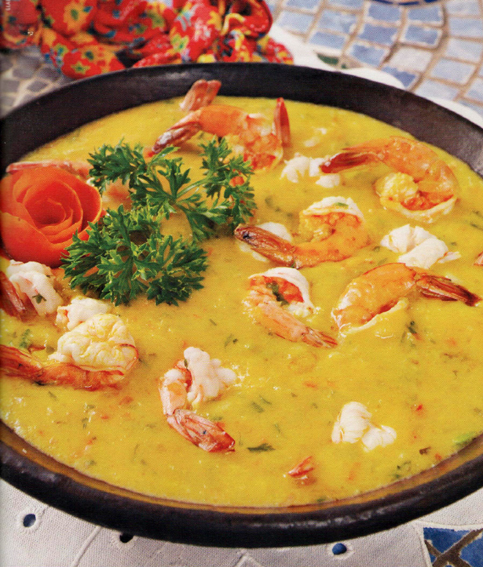
RECIPE - Shrimp Bobo (Bobó de Camarão)

This classic dish from the state of Bahia is one of the cornerstones of the Afro-Bahian tradition of cooking that is so strongly linked to the state and to its capital, Salvador. It contains most of the fundamental ingredients in the Bahian cook's larder - manioc, coconut milk (lots of it!), dendê palm oil and the sweet fresh shrimps for which Brazil's north-east coast is so famous.

A bobó is a manioc cream or puree, which can be served unadorned or finished with shrimp or other protein.  Depending on the recipe and on the cook the puree can be as thin as a soup or something more substantial. The word bobó comes to Brazil from the language of the Ewe people who inhabited current-day Ghana, Togo and Benin and who were brought to Brazil as slaves in large numbers during the era of the trans-Atlantic slave trade. In their language, bobó means "a dish made with beans." Today, there are no beans in bobó, at least in Brazil. Instead the cream is made with manioc, a native South American staple and one to which Afro-Brazilian slaves took enthusiastically when they were introduced to it in the New World.

For anyone who has any culinary curiousity or interest in Brazilian cooking and eating traditions, going to Salvador or anywhere else in Bahia and not trying bobó de camarão at least once would be nearly as great a gastronomic sin as not trying acarajé while visiting Bahia. (Nearly as great, but not quite). Fortunately, bobó de camarão is easy to find in restaurants that feature local dishes and is a staple dish on buffet tables in Bahian self-serve restaurants. It's also quite easy to make, and can be a great centerpiece for a casual dinner for a small group.  This recipe serves 8 well. White rice is an obligatory side dish, and if you add a green salad you have a complete meal.

The only ingredient that can be difficult to source outside Brazil (and which is absolutely necessary in a bobó) is the shockingly-brilliant orange palm oil called dendê. In North America and Europe it can be ordered online, or usually can be sourced in Latin American and African food markets. If the product is destined to the African trade, it might just be labelled "palm oil" - if it's orange and solid or semi-solid at room temperature, then it the right stuff. Manioc is available in the same markets, though it may be labelled cassava root, or yuca depending on the ethnic variety of the market.
______________________________________________________
RECIPE - Shrimp Bobo (Bobó de Camarão)
Serves 8

For the manioc cream:
2 lbs (1 kg) cooking onions, peeled and chopped
2 lbs (1 kg) firm, ripe tomatoes, seeded and chopped
2 green bell peppers, seeded and chopped
4 Tbsp finely cilantro, finely chopped
2 lbs (1 kgs) manioc/cassava/yuca root, peeled, boiled and mashed
2 cups (500 ml) extra-virgin olive oil
4 cups (1 liter) coconut milk

For the shrimp:
4 lbs (4 kgs) medium or large shrimp, peeled, deheaded and deveined, with tails left on
1 clove garlic, minced
1 Tbsp salt
2 Tbsp cilantro, finely chopped
3 medium tomatoes, seeded and chopped
3 medium onions, chopped
1 green bell pepper, seeded and chopped
1/2 cup (125 ml) extra-virgin olive oil
4 cups (1 liter)coconut milk
2 Tbsp dendê oil
-------------------------------------------------------------------
 Prepare the manioc cream:  In a large heavy saucepan, combine the onion, tomatoes, green pepper and cilantro with the mashed manioc. Stir in the olive oil and coconut milk, then heat over medium-high heat, stirring constantly. Cook for 10 minutes, stirring constantly, or until the cream begins to pull away from the bottom of the pan when you stir. Remove from the heat and reserve.

Prepare the shrimp: Rinse the shrimp well in plenty of cold running water. Drain. In a large, deep saucepan combine the drained shrimp, chopped garlic, salt, cilantro, tomatoes, onions, green pepper and the olive oil. Heat over medium high heat, stirring frequently. When hot, add the coconut milk in 1/2 cup amounts, stirring after each addition to completely mix. Continue to cook for 5 minutes more, stirring constantly.

Add the reserved manioc puree to the shrimps and continue to cook for 5 more minutes, stirring frequently. Just before removing from the heat, add the dendê oil and mix it in completely. Remove from heat, pour into a decorative deep serving platter, sprinkle with additional cilantro if desired and serve immediately.

Thursday, August 18, 2011

RECIPE - Creole Salad (Salada Crioula)

The word creole has several definitions in English and its Portuguese equivalent crioulo has just as many. And the meanings can be contradictory - one of the English definitions is "a person born in the West Indies or Spanish America, but of European, usually Spanish, ancestry", while in the best-known Brazilian Portuguese dictionary, Houaiss, one of the definitions is "blacks (slaves, or descendents of slaves) born in Brazil." In both English and Portuguese, the word can also refer not to persons but to languages. The Oxford Concise Dictionary defines a creole language this way: "A mother tongue formed from the contact of a European language with a local language (especially African languages spoken by slaves in the West Indies."

All of which is to explain that the name for the recipe featured in this post, creole salad, really doesn't provide any useful information about the recipe - what it contains, where it comes from, how or when it's to be eaten. This is one of those recipes with a poetic name, one that is meant to be evocative and inviting. If creole salad were to have a descriptive title, it would probably be called shrimp and avocado salad. For that's what it is - a combination of avocado, coconut milk, cilantro and boiled shrimps.

Whether the name is prosaic or poetic, however, this dish is simple, quick and delicious. It makes a great first course at dinner, or a lunchtime main course. When shopping for ingredients be sure to get good-sized shrimp or increase the number if only small shrimp are available. In Brazil, this recipe would be made with a large, bright-green avocado and half an avocado is sufficient for one person. If only the very small, black and knobby Hass avocados are available to you then a whole one per person is better.
________________________________________________________
RECIPE - Creole Salad (Salada Crioula)
Serves 2

6 medium shrimp, peeled but with tails attached
4 sprigs fresh cilantro, chopped
2 Tbsp coconut milk
2 Tbsp olive oil
1 small jalapeno or serrano chile, seeded and finely chopped (optional)
juice of one medium lime
1 or 2 ripe (but not over-ripe) avocados (see note above)
salt and pepper to taste
------------------------------------------------------------------------------
Cut the avocado(s) in half lengthwise and remove the pit. Using a spoon remove the flesh from the skin, taking care not to tear the skin. Reserve the shells.

Put the avocado flesh in a small mixing bowl, the mix in the coconut milk, the olive oil, and the lime juice. With a spoon mash and mix all the ingredients, but don't overmix. You want some texture remaining at the end of the process, not a homogenous pulp. Season with salt and pepper to taste and reserve.

Bring salted water to a boil in a medium saucepan. Add the shrimps and cook until just pink and opaque, about three minutes. Drain into a sieve or colander and refresh in cold water to stop the cooking process. Reserve.

Divide the mashed avocado among the shells, then top with the shrimp, dividing them among the shells as well. Sprinkle with the chopped cilantro and if desired with the chopped hot chili pepper. Serve immediately.

Recipe translated and adapted from recipe by chef Jeff Colas of Maison do Bonfim restaurant in Olinda, Brazil, as published in Prazeres da Mesa magazine. 

Thursday, July 7, 2011

RECIPE - Spicy Shrimps on Rice (Arroz de Camarão Picante)

One of the best things about cooking with Brazilian shrimps (other than the fact that they're so tasty) is that they're a breeze to cook. At the fish market located on the beach in Fortaleza you can buy them any size you want, and whether you prefer them peeled or unpeeled, with heads or without, cultivated or from the sea is merely a matter of personal choice. To cook the shrimps is only a matter minutes, literally. To be specific, usually about three of them (minutes, that is).

If you're as much of a fan of hot, spicy dishes as you are of shrimp, then this is a recipe for you. The heat of the dish can be adjusted by modifying the quantity of hot sauce, and if there are fire-eaters at your table you can serve the same hot sauce at the table for those who want to increase the Scoville-unit count of the dish. This dish can be genteely spiced, or it can be kickass hot - it's good either way. Just remember that you can always increase the heat level at the table, but you can't reduce it!
_______________________________________________
RECIPE - Spicy Shrimps on Rice (Arroz de Camarão Picante)
Serves 4

1 1/2 lbs (750 gr) small shrimps, peeled
bottled hot sauce to taste, any brand
juice of one lime
grated peel of one lime
1 Tbsp soy sauce
3 cloves garlic, minced
1 tsp light brown sugar
1/4 cup coconut milk
1 Tbsp extra-virgin olive oil
1 medium onion, finely chopped
1/4 cup cilantro, finely chopped and loosely packed
-----------------------------------------------------------------------
In a medium mixing bowl combine all the ingredients with the exception of the onion and cilantro. Let marinade at room temperature for 30 minutes.

In a large frying pan heat the olive oil over medium heat. Add the chopped onion and cook until the onion is just transparent. Stir in the shrimps and all the marinade ingredients. Increase heat to bring to a rapid boil - then reduce heat and cook for about three minutes, or until the shrimps are just cooked through.

Remove from the heat and put into a serving bowl. Stir in the cilantro, then serve immediately, accompanied with white rice. Place a bottle of the hot sauce used in the recipe on the table for those who wish a spicier dish.

Tuesday, June 21, 2011

RECIPE - Eggplant with Coconut Milk (Berinjela com Leite de Coco)

Eggplants can be cultivated just about everywhere in Brazil, including the tropical north where the climate is similar to India, which is where eggplants were first grown for food. This very simple recipe is a good example of how eggplants are used in Brazil's north, and how they are combined with other tropical ingredients, in this case coconut milk and hot chili peppers. Brazilian cooks tend to be quite liberal with amounts of chili peppers, and this dish in normally quite spicy in Brazil. However you can "defuse" the dish if you wish by lowering the amount of chilis or substituting red or green bell peppers.

The resulting dish takes eggplant in a new direction - away from the Italian, Middle Eastern or Asian flavors we've come to associate with eggplant. Try making eggplant with coconut milk as a side dish next time you serve grilled fish or shrimps. Fish, this eggplant dish and white rice are all you need to make an authentic and marvelously tasty Brazilian meal.
____________________________________________________
RECIPE - Eggplant with Coconut Milk (Berinjela com Leite de Coco)
Serves 4

1 large European-style eggplant, sliced thinly along horizontal axis
3 medium white onions, thinly sliced and separated into rings
1 cup (250 ml) cononut milk
1 cup (250 ml) whole milk
red or green hot chili pepper to taste, seeded and finely minced (Note: for non-spicy dish, substitute finely diced red or green bell pepper)
salt to taste
--------------------------------------------------------------------------------
Preheat oven to 350F (180C). In a glass or aluminum lasagne pan place the slices of eggplant in layers until you have used up all the eggplant. Salt them to taste.  Next toss the onions rings over the eggplant, making sure that all the eggplant is covered. Next, combine the coconut milk and the dairy milk in a large measuring cup and stir to mix thoroughly. Finally, sprinkle as much chili pepper or red pepper as you want to top off the dish.

Cover the pan with aluminum foil, and place in the preheated oven. Bake for 40 minutes. Remove the tin foil, then bake for an additional ten minutes. Remove from the oven, let stand for 5 minutes, then serve immediately.


Recipe translated and adapted from Brigadeiro de Colher blog.

Friday, June 10, 2011

RECIPE - Brazilian "Refried Beans" (Feijão de Leite)

We've never quite understood why the Mexican dish called frijoles refritos in Spanish and refried beans in English has that particular name. The beans really aren't fried even once, much less refried. They are cooked, mashed, and then reheated on a stove or over a flame with some lard or oil. Perhaps it's the presence of some form of fat that caused the dish to be named refried beans. We don't know.

Whatever the problems the dish has with nomenclature, it's a wonderfully delicious way to serve dried beans, and makes a perfect accompaniment to a simple plate of some sort of protein (meat or fish) with rice. The beans turn the duopoly of protein and starch into a complete meal - and make the dish almost perfectly nutricious as long as a dollop of salsa tops it off.

Traditional Brazilian cuisine has a very similar dish, which in Portuguese is wisely NOT called feijão refrito. It's known instead as feijão de leite (meaning beans with milk). It comes from the northeastern state of Bahia, and typicallof Bahian cooking, the milk employed comes not from a cow, or even a sheep or a goat. It comes from a palm tree - the milk in this dish is coconut milk.

In  feijão de leite, dried beans are cooked in the normal way then they're mashed. Coconut milk is stirred in, and the mashed beans are heated just until they boil. It's a perfect way to use leftover beans, and with (again) protein and rice creates a balanced, delicious plate of food. Since it's just as easy to make a large quantity of beans as it is to make a small one, and since cooked beans freeze beautifully, making this dish from defrosted beans from your freezer is a snap and requires almost no preparation time at all. Next time you make beans freeze some just for this purpose. You'll be glad you did.

(Note: In Brazil this dish is usually made with a type of bean known as feijão mulatinho. The closest equivalent is pinto beans, which work beautifully in this recipe, but almost any sort of dried bean is acceptable as a substitute.)
__________________________________________________
RECIPE - Brazilian "Refried Beans"  (Feijão de Leite)
Serves 8

4 cups (1l) precooked basic beans (click here for recipe for basic beans)
1 cup coconut milk, canned or homemade
salt to taste
1/4 cup sugar (optional)

Put the cooked beans, with their liquid, in a blender along with the coconut milk. Blend until smooth and homogenous. Add the sugar (if desired) and correct the salt.

Put the blended beans in a large, heavy pan and heat over medium-high heat, stirring frequently to avoid burning. Heat until the mixture just begins to bubble, remove from heat and serve immediately.

Recipe translated and adapted from Cozinha Regional Brasileira by Abril Editora.

Tuesday, March 1, 2011

How the Coconut Got Its Name

The thing one learns while researching articles for Flavors of Brazil! I'll bet you didn't know that the coconut (Cocos nucifera) was named after the Bogeyman. You know, the scary monster that lurks in children's closets, or hides out under the basement stairs. I certainly didn't. It's hard to guess the connection, but any etymological dictionary of English will explain the origin of the word coco is Portuguese, which English then picked up from that language and changed slightly to coconut.

It turns out that in the folklore and mythology of the Iberian peninsula, there is a ghostly figure which is very similar to the Bogeyman and which is called coco or cuco. In his scariest incarnation, he is known as a child-eater and/or kidnapper, and parents for centuries have used the threat of his appearance to scare children into obedience. He is often represented as a ghost with the head of a pumpkin, similar in appearance to the familiar Jack o'Lantern. The Goya engraving at right is entitled "Que Viene el Coco". Over time, coco or cuco came to mean head or skull in colloquial Spanish and Portuguese.

The coconut wasn't known in medieval Europe as it originates in Asia and Oceania. In the early stages of the Age of Exploration, Portuguese sailors encountered this fruit on their journeys in search of spices and gold. They were struck by the appearance of the fruit, particularly by the three holes at one end of it, and by how the holes gave it the appearance of a head or skull - a coco, as it were. They began to call the fruit coco and that name became established first in the Portuguese language and then in some variation of that word in most Western European languages, including English.

Thus, the Iberian Bogeyman, the coco, ended up achieving world wide fame not so much for his frightful qualities, but for the fact that his head resembles nothing so much as a coconut.

(Here is a link to the article on coconut oil in the New York Times that is discussed in the comments below - coconut oil )

Friday, January 14, 2011

A New Look at the Columbian Exchange

Christopher Columbus
The Columbian Exchange, a term coined in 1972 by Alfred W. Crosby in a book of the same name, was the dramatic exchange of food plants and animals between the Eastern and Western Hemispheres in the years after the European "discovery" of the New World in 1492. In the Age of Exploration that followed Columbus' initial voyage across the Atlantic, foodstuffs from the New World, whether animal or vegetable in origin, made their way eastward to the Old World, and an equal number moved in the opposite direction, arriving on American shores with Pilgrims, conquistadores, bandeirantes, and countless other immigrant groups.

Today it's hard to imagine what people ate and how they cooked prior to the Columbian Exchange. Try to imagine Italian cooking and Italian food culture without tomatoes. Or Thai or Indian cooking without chili peppers. Or Brazilian food without limes or coconuts or mangoes. Impossible. Yet, until sometime after 1492 cooks in these cultures did not have these ingredients available, though today these ingredients are essential to the food culture of these countries. For an interesting chart of all the foods that were part of the Columbian Exchange, click on this link to a Wikipedia article - incidentally, the chart also shows the diseases that were part of this same exchange.

Recently a Portuguese scholar and historian, José Eduardo Mendes Ferrão, published a book on the Columbian Exchange, with particular emphasis on the role that Portuguese navigators and explorers played in this process. The book is entitled A Aventura das Plantas e Os Descobrimentos Portugueses (The Adventure of Plants a The Portuguese Discoveries) and was published by the Portuguese institute IICF - Instituto de Investigação Científica Tropical or Institute of Scientific Tropical Research. Sr. Ferrão's thesis is that because of the patterns and the history of Portuguese exploration and colonization in the 16th and 17th centuries, Portugal played a major role in the Columbian Exchange, a role that was far larger than might be expected. And because Brazil was Portuguese territory during those times, it played a large part in the Exchange as well.

Unlike Spanish colonization during those centuries which was centered on the New World, Portugal explored and colonized not only the Americas, but also Africa and Asia. According to Sr. Ferrão is it the geographically widespread nature of Portuguese exploration that makes Portugal such a major player in the Columbian Exchange. Another factor, as he points out, was that Portugal possessed islands in the Atlantic, such as Madeira, Porto Santo and the Cabo Verde archipelago. These semi-tropical islands allowed Portuguese planters to acclimatize new species to the cooler European climate prior to bringing them to mainland Portugal. They survived, whereas plants carried directly from the tropics to the Iberian peninsula might not have. In effect, these off-shore territories became botanical laboratories for the Europeanization of Asian, African and American foods.

A good example of the role Portugal played in the Columbian exchange is the dissemination of corn (maize) - milho in Portuguese. Although this plant did not originate in Brazil but came from Central America, it was already widespread in the indigenous cultures of Brazil prior to the arrival of Europeans in 1500. The Portuguese carried corn back to Europe with them, and from there, carried it to their colonies in Africa. From these colonies it spread throughout the continent, and today corn is the most widely-eaten staple food on the African continent. In the other direction, the Portuguese brought the coconut palm from Asia (either South Asia or Southeast Asia) to Africa and thence to Brazil. Brazilian food, particularly the African-based cuisine of Bahia, is unimaginable without the presence of coconut and coconut milk.

As far as I've been able to determine, Sr. Ferrão's book has not yet been translated into English. As the field of historic gastronomy grows and becomes a more prominent academic subject, I hope that this situation will be remedied. The Columbian Exchange is one of the fundamental shifts in the history of world gastronomy, and the Portuguese contribution to it should be made better known.

Tuesday, November 30, 2010

RECIPE - Risi e Bisi of Crab (Risi Pisi de Caranguejo)

This dish, which was recently featured at Fortaleza's Prazeres da Mesa Ao Vivo gastronomic trade-show and exposition, is a creation of European-Brazilian chef Bernard Twardy, one of Fortaleza's most successful and highly-regarded chefs. Sr. Twardy was born in Germany and grew up in France, where he was classically trained as a chef.  Many of Brazil's most famous chefs share a European background with Twardy. At some point in their lives these European chefs arrived in Brazil as tourists or immigrants, and for any number of reasons decided to make Brazil their home. As a unofficial group, they combine classical European techniques and dishes with Brazilian ingredients, techniques and dishes to create food that in many ways marries the best of the Old and the New Worlds. I hesitate to call it fusion cuisine, but it is a re-imagining of European gastronomy in a specifically Brazilian context.

Sr. Twardy's recipe for Risi Pisi de Caranguejo is an excellent example of this bi-continental style of cooking. His opening point of reference is the classic Venetian dish risi e bisi (rice and peas) - a risotto-style combination of Arborio rice and fresh green peas. Substituting orzo pasta for the rice and adding locally-caught crab, Brazilians herbs and spices, and livening the dish with coconut milk, he has created something that certainly is not Venetian, but not entirely Brazilian either. Whatever else it is, though, it's absolutely delicious.
____________________________________________________
RECIPE - Risi e Bisi of Crab (Risi Pisi de Caranguejo)
Serves 4

1 pound picked-over fresh or thawed crab meat
2 cups (500 ml) coconut milk
3 cups (750 ml) cooked orzo pasta, al dente, cooled to room temperature
2 cups (500 ml) ripe tomatoes, peeled, seeded and diced
1/2 cup (250 ml) mixed green and yellow bell peppers, finely diced
1/2 cup (250 ml) strongly-brewed lemon balm infusion
1/4 cup finely chopped cilantro
1/2 cup (250 ml) extra-virgin olive oil
1/2 tsp habanero chile, minced
3 cloves garlic, minced
1 small red onion, finely chopped
crab claws to decorate
salt to taste
----------------------------------------------------------------------------
Heat half the olive oil in a large sauté pan, add half the garlic and all of the onion, and sweat them for a few minutes. Add the chopped bell peppers and habanero chile and continue to cook the mixture for about three minutes, or until the peppers have softened. Add the tomatoes, the the coconut milk and the lemon balm infusion and cook for about five more minutes, or until the tomatoes have softened, but not dissolved. Remove from heat and reserve.

In a medium saucepan heat the remaining olive oil, then add the remaining garlic. Cook until the garlic is softened, then add the crab meat and mix thoroughly. Remove from heat. Add the reserved tomato mixture, and let stand at room temperature for at least one hour, covered. Combine the crab/tomato mixture with the orzo pasta, and correct seasoning for salt. Mound the mixture into a decorative serving bowl, decorate with a sprinkling of finely chopped cilantro plus crab claws if desired and serve.

Recipe translated and adapted from Prazeres da Mesa magazine - Oct. 2010

Friday, November 5, 2010

A Tale of Two Dishes - Vatapá

"The glory of Bahian cuisine", "The most typical Bahian dish", "Bahia's definitive dish" - These are just a few of the many, many descriptions of the creamy, fragrant and evocative mixture of bread, coconut milk, peanuts or cashew nuts, dried shrimp and an almost-unlimited variety of other ingredients called vatapá. Firmly established as a central component in the Afro-Brazilian cuisine of the Brazilian state of Bahia, vatapá is today enjoyed throughout Brazil though everywhere it continues to be considered a Bahian dish.

Vatapá has long been celebrated as a culinary treasure in Bahia and an integral part of that states culture. In his novel "Dona Flor and Her Two Husbands" Brazilian author Jorge Amado extols the virtues of vatapá through the words of his cooking-school-teacher heroine Dona Flor speaking to her class, "Let's move to the stove: vatapá made of fish (or chicken) is a dish that requires both care and whimsy, the most most famous dish of Bahian cuisine. Take two whole heads of grouper, add salt, cilantro, garlic and onion, a few tomatoes plus some fresh lime juice..." and from there Amado continues to include an entire recipe for vatapá in his novel. The Bahian singer-songwriter Dorival Caymmi composed a paean to the dish titled, naturally, "Vatapá" which has become a Brazilian standard. They lyrics of his song include a list of essential ingredients for a successful  vatapá, including a Baiana (a black woman from Bahia) who "knows how to stir." Here's a video from YouTube of this marvelous song, as sung by Gal Costa:


The origins of vatapá are unknown, though all culinary historians agree that even if the basic concept came from Africa on board slave ships, it was developed in Bahia itself. The word come from Yoruba, an African language, where it means "a spicy seafood paste", yet the dish isn't part of contemporary African cooking. Most Bahian dishes that came fully developed from Africa are ritual foods in the Afro-Brazilian religion Candomblé, but vatapá has no part in the ceremonies of that religion.

The essential ingredients for vatapá, common to almost all recipes include stale bread, coconut milk, ground nuts and dried shrimp. And all recipes use one technique or another to create a thick sauce or paste. Beyond that, the variations are innumerable. However, over time two distinct, and distinctly different, dishes have developed, both called vatapá. One is the fairly thick homogenous paste that is an essential filling for the Bahian bean fritter called acarajé. The other is less homogenous, with chunks and pieces of the various ingredients in a thick sauce. It is served as a side dish in a Bahian meal, or as part of a Bahian buffet. Both are vatapá but they are quite different preparations. The next two posts on Flavors of Brazil will include recipes for both styles of vatapá.

Monday, May 24, 2010

RECIPE - Souza Leão Cake (Bolo Souza Leão)

One of Pernambuco's most well-loved gifts to the cooking traditions of Brazil is this decadently rich custard-cake, Souza Leão Cake (Bolo Souza Leão). Invented in the 19th Century by someone in the Souza Leão family, on one of their eleven sugar plantations, this cake is now served at wedding receptions, birthday and anniversary parties, and even funeral receptions around Brazil.

Their are innumerable variations of this cake, and many, many recipes for it, but this one, from Viagem Gastronómica Atraves do Brasil, was given to the author of that book by dona Rita de Souza Leão Barreto Coutinho, of the Moreno Plantation branch of the family, who is seen in the center of the photo at right seated between Izabel de Souza Leão Veiga and Eudes de Souza Leão Pinto, from the same branch of the family.

Unlike Luis Felipe cake, a similar custard-cake which requires only ingredients easily obtained in North America and Europe, Souza Leão cake uses a manioc dough called puba which means it is difficult to make outside Brazil. Puba is made from manioc that is allowed to ferment, covered with water, for seven days. After fermentation, the manioc is drained, washed thoroughly, and then grated. Finally the grated manioc is squeezed to remove all liquid from the pulp, wrapped tightly and refrigerated for up to one week. At this point, the puba is ready to use.

So, notwithstanding the possibilities of problems in finding puba, you might enjoy reading this recipe which has a long history, and I'm sure a longer future ahead of it.
_________________________________________________
RECIPE - Souza Leão Cake
Makes 22 portions

2.2 lbs. (1 kg.) granulated sugar
2 cups cold water
2 cups unsalted butter
1 tsp. salt
2.2 lbs. (1 kg.) manioc dough (puba)
16 egg yolks
3 cups coconut milk
3 cinnamon sticks
1 tsp. ground cloves
1 tsp. ground anise seed
------------------------------------------------------------------------
Preheat the oven to 425F (220C). Grease a large round cake pan, with high sides, with softened butter.

In a saucepan, dissolve the sugar in cold water, heat over high heat and, stirring constantly,bring to a boil. Stop stirring at this point, and cook the syrup to soft-string stage. Do not let color or caramelize. Remove from heat, and stir in the unsalted butter and salt. Let cool completely.

Place the manioc dough in a large bowl, then add the egg yolks one at a time, alternating with small aounts of coconut milk, making sure that each is incorporated before adding more. Finally, add the cold sugar syrup and mix everything completely. Pour the batter through a fine sieve, then add the spices.

Pour the batter into the greased cake pan, place the pan in a roasting dish and pour hot water into it to the height of the top of the batter and place in pre-heated oven for 50 minutes, or until it is golden and a toothpick inserted into the center of the cake comes out clean.

Remove from heat, and let cool in the cake pan. When only warm, unmould the cake onto a serving platter and let cool completely, serving from the same platter.