This light and healthy Brazilian salad, which features the Asian green known in English as Napa cabbage or Chinese cabbage and which is called acelga in Brazil, can successfully be served as a side salad or in larger portions as a main course for a light lunch, particularly on hot days (which are the norm in Brazil).
The dressing is made with plain unflavored yogurt, and although the recipe calls for natural, full-fat yogurt, if you want to make a less caloric version you can successfully substitute non-fat yogurt.
________________________________________________
RECIPE - Napa Cabbage Salad (Salada de Acelga)
Serves 5 as side salad, 2-3 as main course
1 medium head Napa cabbage (acelga)
1 large carrot, coarsely grated on a box grater or julienned with a mandoline
1/2 cup sliced black olives
1 small tub natural yogurt
1 Tbsp fresh-squeezed lime juice
1 Tbsp honey
1 Tbsp finely chopped fresh mint
salt and pepper to taste
------------------------------------------------------------------------
Tear off the outer leaves of the head of cabbage. Starting at the end away from the stem, thinly slice the cabbage, only going down about 2/3 of the way to the stem end.
Place the cabbage in a large salad bowl, and toss the leaves to separate them. Sprinkle the grated or julienned carrot and the olives on top. Reserve, preferably in the refrigerator.
In a medium mixing bowl, combine the yogurt, lime juice and honey and mix well with a fork. Add the mint and mix again. Season to taste with salt and pepper.
Serve the salad with the dressing on the side so that diners can add to taste.
Recipe translated and adapted from Gastronomia & Negócios, a UOL website.
Showing posts with label salad. Show all posts
Friday, March 16, 2012
Thursday, January 12, 2012
RECIPE - Kisir Salad (Salada Kisir)
This salad makes a light and refreshing side dish for a grilled piece of meat, chicken or fish on those days when it's just too hot to cook (which, in many parts of Brazil, is almost any day of the year). Made with couscous, served at room temperature or slightly chilled, it is substantial enough to stand as a meal's carbohydrate, yet light enough not to overstuff diners. It also obviates the need to serve a side dish and a salad as it functions as both.
What most of the rest of the world considers garden-variety couscous is known in Brazil as Moroccan couscous (cuzcuz marroquinho). Brazilians have to add the term Moroccan because cuzcuz plain and simple asmade in Brazil is fabricated not from wheat but from corn. (Click here for more information about Brazilian cuzcuz.)
In addition to its other virtues, this salad is very quick and easy to make. Since spending a lot of time in the kitchen is something that one tends not to want to do on a hot day, it's just one more reason that makes this salad a perfect summer-time treat. (For readers of this blog who are suffering through a wintry January, save the recipe for next summer!)
_________________________________________________
RECIPE - Kisir Salad (Salada Kisir)
Serves 4
1 1/4 cup (200 gr) dry quick-cook couscous
3/4 cup (200 ml) extra-virgin olive oil
3/4 cup (200 ml) water
pinch of salt
3 medium tomatoes, peeled, seeded and diced
1/4 cup diced red bell pepper
1/4 cup diced green bell pepper
8 oz (200 gr) mixed baby salad greens
diced green onion, to taste
salt and fresh-ground black pepper
---------------------------------------------------------------------------
Put the dry couscous in a large mixing bowl. Sprinkle half of the olive oil over, then mix well with a fork to cover all the grains. Let rest 5 minutes.
Bring the water, with a pinch of salt added, to the boil, then pour over the couscous. Mix briefly then let stand until the couscous is cool. Toss with a fork to loosen the grains.
When the couscous is cool, mix in the tomato and peppers. Mould in ring molds if desired (as in photo), or mound on salad plates. Top with the mixed salad greens, then sprinkle the remaining olive oil over all. Season with salt and pepper and serve.
Recipe translated and adapted from Gula magazine.
What most of the rest of the world considers garden-variety couscous is known in Brazil as Moroccan couscous (cuzcuz marroquinho). Brazilians have to add the term Moroccan because cuzcuz plain and simple asmade in Brazil is fabricated not from wheat but from corn. (Click here for more information about Brazilian cuzcuz.)
In addition to its other virtues, this salad is very quick and easy to make. Since spending a lot of time in the kitchen is something that one tends not to want to do on a hot day, it's just one more reason that makes this salad a perfect summer-time treat. (For readers of this blog who are suffering through a wintry January, save the recipe for next summer!)
_________________________________________________
RECIPE - Kisir Salad (Salada Kisir)
Serves 4
1 1/4 cup (200 gr) dry quick-cook couscous
3/4 cup (200 ml) extra-virgin olive oil
3/4 cup (200 ml) water
pinch of salt
3 medium tomatoes, peeled, seeded and diced
1/4 cup diced red bell pepper
1/4 cup diced green bell pepper
8 oz (200 gr) mixed baby salad greens
diced green onion, to taste
salt and fresh-ground black pepper
---------------------------------------------------------------------------
Put the dry couscous in a large mixing bowl. Sprinkle half of the olive oil over, then mix well with a fork to cover all the grains. Let rest 5 minutes.
Bring the water, with a pinch of salt added, to the boil, then pour over the couscous. Mix briefly then let stand until the couscous is cool. Toss with a fork to loosen the grains.
When the couscous is cool, mix in the tomato and peppers. Mould in ring molds if desired (as in photo), or mound on salad plates. Top with the mixed salad greens, then sprinkle the remaining olive oil over all. Season with salt and pepper and serve.
Recipe translated and adapted from Gula magazine.
Thursday, November 17, 2011
RECIPE - Warm German Potato Salad (Salada Morna Alemã de Batatas)
Admittedly, Flavors of Brazil has gone in heavily this week for the more exotic aspects of Brazilian cuisine with posts about flying ants and turtles. So we thought it might be appropriate at this point to feature some plain old Brazilian comfort food - simple to make and simple to eat. In fact this recipe was comfort food long before it even reached Brazil - it was comfort food back home in Europe, too.
The southern Brazilian state of Santa Catarina is home to a large community of Brazilians who can look back to German ancestry. In the north and west of the state, those of German heritage are the largest enthic group, and German culture, language and cuisine still thrive even though it's been almost 200 years since the first German immigrants came to Santa Catarina in 1828. Along with Italian, Portuguese and Eastern Europeans, the German population in Santa Catarina helps to make the state the most European in Brazil, with over 86% of the population identifying themselves as Caucasian in the most recent census (in the country as a whole Caucasians are just under 50% of the population).
German food (and drink) are featured at many of the cultural festivals held annually in Santa Catarina, in particular the various encarnations of Oktoberfest held around the state. Sausages, beer, saurkraut, smoked pork chops - all these classic German dishes survived the journey to Brazil and are virtually identical to the original dishes "back home."
This recipe for warm potato salad is a perfect accompaniment for a plate of sausages or pork and in cool or cold weather provides the nourishment for body and soul that identifies a dish as comfort food. It can also be served at room temperature or even chilled, but to enjoy it at its best, serve it warm.
NB. Some versions of this dish contain chopped bacon, but this version is suitable for vegetarians.
___________________________________________________
RECIPE - Warm German Potato Salad (Salada Morna Alemã de Batatas)
Serves 4
2 Tbsp extravirgin olive oil
1 medium onion, chopped
6 Tbsp white wine or cider vinegar
6 medium boiling potatoes, cooked, peeled and cubed - at room temperature
1 tsp Dijon or German-style mustard
1 hard-cooked egg, cooled, peeled and finely chopped- at room temperature
2 Tbsp green onion, green parts only, chopped
1 Tbsp lime juice
salt to taste
----------------------------------------------------------------------------
Place the cubed potatoes in a decorative heat-proof serving bowl.
Make the dressing: Combine the mustard, the chopped egg, the chopped green onion and the lime juice. Whisk to emulsify, season with salt to taste and reserve.
In a medium saucepan, heat the olive oil and lightly fry the chopped onion, until it is transparent but not browned. Add the vinegar, bring to a boil, then pour over the cubed potatoes. Add the dressing and toss gently to mix thoroughly. Correct seasoning with salt if desired.
Serve immediately, or let stand to return to room temperature.
The southern Brazilian state of Santa Catarina is home to a large community of Brazilians who can look back to German ancestry. In the north and west of the state, those of German heritage are the largest enthic group, and German culture, language and cuisine still thrive even though it's been almost 200 years since the first German immigrants came to Santa Catarina in 1828. Along with Italian, Portuguese and Eastern Europeans, the German population in Santa Catarina helps to make the state the most European in Brazil, with over 86% of the population identifying themselves as Caucasian in the most recent census (in the country as a whole Caucasians are just under 50% of the population).
German food (and drink) are featured at many of the cultural festivals held annually in Santa Catarina, in particular the various encarnations of Oktoberfest held around the state. Sausages, beer, saurkraut, smoked pork chops - all these classic German dishes survived the journey to Brazil and are virtually identical to the original dishes "back home."
This recipe for warm potato salad is a perfect accompaniment for a plate of sausages or pork and in cool or cold weather provides the nourishment for body and soul that identifies a dish as comfort food. It can also be served at room temperature or even chilled, but to enjoy it at its best, serve it warm.
NB. Some versions of this dish contain chopped bacon, but this version is suitable for vegetarians.
___________________________________________________
RECIPE - Warm German Potato Salad (Salada Morna Alemã de Batatas)
Serves 4
2 Tbsp extravirgin olive oil
1 medium onion, chopped
6 Tbsp white wine or cider vinegar
6 medium boiling potatoes, cooked, peeled and cubed - at room temperature
1 tsp Dijon or German-style mustard
1 hard-cooked egg, cooled, peeled and finely chopped- at room temperature
2 Tbsp green onion, green parts only, chopped
1 Tbsp lime juice
salt to taste
----------------------------------------------------------------------------
Place the cubed potatoes in a decorative heat-proof serving bowl.
Make the dressing: Combine the mustard, the chopped egg, the chopped green onion and the lime juice. Whisk to emulsify, season with salt to taste and reserve.
In a medium saucepan, heat the olive oil and lightly fry the chopped onion, until it is transparent but not browned. Add the vinegar, bring to a boil, then pour over the cubed potatoes. Add the dressing and toss gently to mix thoroughly. Correct seasoning with salt if desired.
Serve immediately, or let stand to return to room temperature.
Thursday, November 10, 2011
RECIPE - Spicy Mango Salad (Salada Apimentada de Manga)
One's first thoughts when contemplating how to cook or prepare fruits are normally in the dessert or sweet category. After all, fruits are full of natural and healthy sugars, and many of them are sweet enough to be served fresh and unadorned as a dessert course. A slice of pineapple, a bowl of perfectly ripe strawberries, a handful of frozen grapes - all are fantastic ways to end a meal. Or, alternatively, fruits can be gussied up and played with to create extravagant dessert creations - tarte tatin, key lime pie, pears poched in red wine. All these are based on the sweetness and the flavor of fruits.
But going sweet is not the only way to go with fruits in the kitchen. Fruits can create complex flavor surprises when combined with savory ingredients. Think of Moroccan tagines in which the sweet flavor of dried apricots or quinces is used to cut the fatty richness of slow-cooked lamb. Or think of (heaven forbid!) Hawaiian pizza with its ham and pineapple chunks.
Mangoes are a very versatile fruits and they can arrive at the table as a sweet course, or as a savory one. Although the sugar level of mangoes is very high - a perfect mango is one of the sweetest fruits in existance - they can be mixed with savory ingredients to create stellar and surprising dishes. Brazilians have long known this, and many traditional Brazilian recipes use mangoes in non-dessert dishes. This salad, whose flavor profile closely resembles the mango salsas that are one of the signatures of nuevo Latino cooking, is a perfect example. It mixes mangoes with a lime-based vinagrette, chopped onions and cilantro, and spices the whole thing up with hot chili-pepper flakes. Easy to make when mangoes are in season, it's a wonderful first course for a light, refreshing meal.
____________________________________________________
RECIPE - Spicy Mango Salad (Salada Apimentada de Manga)
Serves 6
4 medium-sized mangoes, peeled and cubed
1/4 cup (60 ml) fresh-squeezed lime juice
2 Tbsp extra-virgin olive oil
1 Tbsp (or to taste) flaked, dried chili peppers***
2 Tbsp finely chopped cilantro
2 Tbsp finely minced red onion
salt and black pepper to taste
*** note: If you use a full Tbsp of flaked chilis, this salad will be quite spicy - the way Brazilians like it. If you're wary of chilis, start with a tsp only, sample, then add more if desired.
---------------------------------------------------------------------------
Place the mango cubes in a large bowl. In a small mixing bowl, whisk the lime juice and olive oil together. Stir in the chili flakes, the cilantro and the onion. Whisk again briefly, then pour the dressing over the mango cubes. Mix well, making sure that all the mango cubes are coated with dressing. Season to taste with salt and pepper.
Place in the refrigerator for about 30 minutes to chill the salad and to allow the flavors to blend. Serve chilled.
But going sweet is not the only way to go with fruits in the kitchen. Fruits can create complex flavor surprises when combined with savory ingredients. Think of Moroccan tagines in which the sweet flavor of dried apricots or quinces is used to cut the fatty richness of slow-cooked lamb. Or think of (heaven forbid!) Hawaiian pizza with its ham and pineapple chunks.
Mangoes are a very versatile fruits and they can arrive at the table as a sweet course, or as a savory one. Although the sugar level of mangoes is very high - a perfect mango is one of the sweetest fruits in existance - they can be mixed with savory ingredients to create stellar and surprising dishes. Brazilians have long known this, and many traditional Brazilian recipes use mangoes in non-dessert dishes. This salad, whose flavor profile closely resembles the mango salsas that are one of the signatures of nuevo Latino cooking, is a perfect example. It mixes mangoes with a lime-based vinagrette, chopped onions and cilantro, and spices the whole thing up with hot chili-pepper flakes. Easy to make when mangoes are in season, it's a wonderful first course for a light, refreshing meal.
____________________________________________________
RECIPE - Spicy Mango Salad (Salada Apimentada de Manga)
Serves 6
4 medium-sized mangoes, peeled and cubed
1/4 cup (60 ml) fresh-squeezed lime juice
2 Tbsp extra-virgin olive oil
1 Tbsp (or to taste) flaked, dried chili peppers***
2 Tbsp finely chopped cilantro
2 Tbsp finely minced red onion
salt and black pepper to taste
*** note: If you use a full Tbsp of flaked chilis, this salad will be quite spicy - the way Brazilians like it. If you're wary of chilis, start with a tsp only, sample, then add more if desired.
---------------------------------------------------------------------------
Place the mango cubes in a large bowl. In a small mixing bowl, whisk the lime juice and olive oil together. Stir in the chili flakes, the cilantro and the onion. Whisk again briefly, then pour the dressing over the mango cubes. Mix well, making sure that all the mango cubes are coated with dressing. Season to taste with salt and pepper.
Place in the refrigerator for about 30 minutes to chill the salad and to allow the flavors to blend. Serve chilled.
Thursday, November 3, 2011
Dieting? Try This Brazilian Salad...
Salads are a good option when dieting, right? After all they're mostly lettuce and other greens, so they can't have many calories. Um-humm.
We all know that often salads are, in fact, not good choices when one wants to shed a few kilos (or pounds). The greens might have very few calories, but what goes with them, well that's another story.
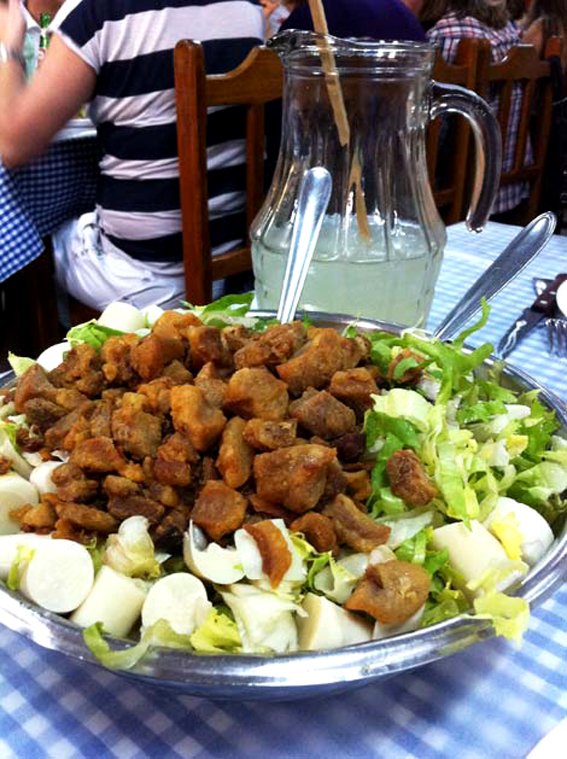
All of this was brought to mind by a recent article I read in one of the blogs in the food section of the Folha de S. Paulo newspaper. The journalist who writes the blog, Marcelo Katsuki, describes a meal he had at a restaurant called Rosa's Churrascaria in the city of Santo André, which is near São Paulo. On the restaurant's menu, it's called Salada de Escarola, which translates as a very innocuous-sounding Escarole Salad. One might even wonder why such a prosaically-named salad is the most famous and most-ordered dish on the menu. Well this salad is no bowl of greens, and is a dieter's disaster, not a dieter's salvation.
The salad (which costs R$28.00, or about USD $16.00) does have escarole leaves, and plenty of them. However, it also has a mountain of torresmo - the fried pork rinds that Brazilians adore. Plus lots of hearts of palm (palmito) and a red-wine vinaigrette for tossing it all together. Look at the photo below, taken at Rosa's - there must be about a thousand calories-worth of torresmo, and although the salad isn't yet dressed, the quantity of vinaigrette required to moisten all that escarole would be significant calorically.
So if you ever find yourself at Rosa's Churrascaria and want to watch your waistline, or just don't feel that hungry, whatever you do, don't say "Acho que eu vou só comer uma salada " ("I'll just have a salad")!
We all know that often salads are, in fact, not good choices when one wants to shed a few kilos (or pounds). The greens might have very few calories, but what goes with them, well that's another story.
All of this was brought to mind by a recent article I read in one of the blogs in the food section of the Folha de S. Paulo newspaper. The journalist who writes the blog, Marcelo Katsuki, describes a meal he had at a restaurant called Rosa's Churrascaria in the city of Santo André, which is near São Paulo. On the restaurant's menu, it's called Salada de Escarola, which translates as a very innocuous-sounding Escarole Salad. One might even wonder why such a prosaically-named salad is the most famous and most-ordered dish on the menu. Well this salad is no bowl of greens, and is a dieter's disaster, not a dieter's salvation.
The salad (which costs R$28.00, or about USD $16.00) does have escarole leaves, and plenty of them. However, it also has a mountain of torresmo - the fried pork rinds that Brazilians adore. Plus lots of hearts of palm (palmito) and a red-wine vinaigrette for tossing it all together. Look at the photo below, taken at Rosa's - there must be about a thousand calories-worth of torresmo, and although the salad isn't yet dressed, the quantity of vinaigrette required to moisten all that escarole would be significant calorically.
So if you ever find yourself at Rosa's Churrascaria and want to watch your waistline, or just don't feel that hungry, whatever you do, don't say "Acho que eu vou só comer uma salada " ("I'll just have a salad")!
Friday, April 8, 2011
RECIPE - Lentil and Salt Cod Salad (Salada de Lentilhas com Bacalhau)
The past few days, we've been concentrating here at Flavors of Brazil on salt cod (bacalhau) associated in Brazil and elsewhere with Lent and the pre-Easter season. Although the most traditional uses of this fish are in main-course hot dishes, salt cod is an adaptable ingredient, and innovative chefs in Brazil are finding new uses for it in all kinds of dishes - particularly salads.
This recipe, from gula.com.br, is a main-course salad featuring lentils and flaked salt cod. Combined with plenty of good, crusty French bread, it's all you need for a substantial mid-day meal. Just remember that you need to plan in advance, though, as the salt cod takes 48 hours for the de-salting process.
____________________________________________________
RECIPE - Lentil and Salt Cod Salad (Salada de Lentilhas com Bacalhau)
Serves 8
1 1/2 cup lentils, French Le Puy lentils preferred, but brown lentils can be substituted
1 bay leaf
1 large onion, finely chopped
1 clove garlic, minced
2 lb (1 kg) good-quality salt cod fillets
8 ripe tomatoes, peeled, seeded and cubed
1 cup loosely-packed, chopped, fresh herbs - choose from a mixture of parsley, mint, cilantro, basil, green onion
1/3 cup red wine vinegar
salt and pepper to taste.
-----------------------------------------------------------------------------
48 hours before serving cover the salt cod with plenty of cold water and place in refrigerator. Drain and change the water several times a day. When de-salted, simmer the fillet in a large pan, with water to cover, for about 20-30 minutes, or until the fish is tender and begins to flake. Remove the pan from the heat, and let the fish cool in it. When cool, drain the fish then separate it into flakes. Let the flakes cool completely, then reserve.
Using a large heavy pan add the lentils then cover with cold water. Bring to a boil over medium heat, the reduce heat and cook for 15-20 minutes or until the lentils are tender but still firm enough to retain their shape. Check frequently to make sure the lentils do not overcook. When cooked, drain the lentils into a colander and refresh immediately with plenty of running cold water. Let drain completely and reserve.
In a heavy frying pan heat a few tablespoons of olive oil, and when hot add the chopped onions. and cook until the onions are golden. Add the minced garlic, cooking for a minute or so until the garlic releases its aroma. Then add the reserved salt cod and cook for a few minutes, stirring carefully from time to time. Try not to break up the flakes of fish. Remove from heat.
Put the salt cod mixture in a large mixing bowl, then the lentils, the tomato cubes and the chopped herbs. Pour the vinegar over the top, then add olive oil slowly while carefully stirring the mixture until the right consistency has been reached (well-dressed but not overly oily). Season with salt and pepper to taste. Refrigerate for at least two hours to allow the flavors to blend.
Remove from the refrigerator 15 minutes before serving. Mound the salad on individual serving plates, and just before serving drizzle additional olive oil over each salad.
This recipe, from gula.com.br, is a main-course salad featuring lentils and flaked salt cod. Combined with plenty of good, crusty French bread, it's all you need for a substantial mid-day meal. Just remember that you need to plan in advance, though, as the salt cod takes 48 hours for the de-salting process.
____________________________________________________
RECIPE - Lentil and Salt Cod Salad (Salada de Lentilhas com Bacalhau)
Serves 8
1 1/2 cup lentils, French Le Puy lentils preferred, but brown lentils can be substituted
1 bay leaf
1 large onion, finely chopped
1 clove garlic, minced
2 lb (1 kg) good-quality salt cod fillets
8 ripe tomatoes, peeled, seeded and cubed
1 cup loosely-packed, chopped, fresh herbs - choose from a mixture of parsley, mint, cilantro, basil, green onion
1/3 cup red wine vinegar
salt and pepper to taste.
-----------------------------------------------------------------------------
48 hours before serving cover the salt cod with plenty of cold water and place in refrigerator. Drain and change the water several times a day. When de-salted, simmer the fillet in a large pan, with water to cover, for about 20-30 minutes, or until the fish is tender and begins to flake. Remove the pan from the heat, and let the fish cool in it. When cool, drain the fish then separate it into flakes. Let the flakes cool completely, then reserve.
Using a large heavy pan add the lentils then cover with cold water. Bring to a boil over medium heat, the reduce heat and cook for 15-20 minutes or until the lentils are tender but still firm enough to retain their shape. Check frequently to make sure the lentils do not overcook. When cooked, drain the lentils into a colander and refresh immediately with plenty of running cold water. Let drain completely and reserve.
In a heavy frying pan heat a few tablespoons of olive oil, and when hot add the chopped onions. and cook until the onions are golden. Add the minced garlic, cooking for a minute or so until the garlic releases its aroma. Then add the reserved salt cod and cook for a few minutes, stirring carefully from time to time. Try not to break up the flakes of fish. Remove from heat.
Put the salt cod mixture in a large mixing bowl, then the lentils, the tomato cubes and the chopped herbs. Pour the vinegar over the top, then add olive oil slowly while carefully stirring the mixture until the right consistency has been reached (well-dressed but not overly oily). Season with salt and pepper to taste. Refrigerate for at least two hours to allow the flavors to blend.
Remove from the refrigerator 15 minutes before serving. Mound the salad on individual serving plates, and just before serving drizzle additional olive oil over each salad.
Thursday, March 24, 2011
RECIPE - Spicy Chayote Salad (Salada de Chuchu Picante)
This very-easy and quick-to-prepare salad of baby chayotes (mini chuchus in Portuguese), from the Brazilian website Receitas e Dicas, can be served warm or at room temperature. It's best not to chill it, as refrigeration diminishes the already-subtle flavor of chayote and will result in a very bland salad experience. The spiciness of the salad can be adjusted up or down by regulating the quantity of garlic and red pepper flakes. In Brazil this salad would be quite spicy but the heat of the peppers shouldn't overwhelm the chayote itself.
____________________________________________________
RECIPE - Spicy Chayote Salad (Salada de Chuchu Picante)
Serves 4
3 medium chayotes
1 medium yellow onion, not-too-finely chopped
1 clove garlic, very thinly sliced
1 Tbsp red or white wine vinegar
hot red pepper flakes, to taste
salt and pepper to taste
extra-virgin olive oil
-----------------------------------------------------------------------------
Peel the chayotes using a vegetable peeler, cut them in half in the wider direction, then using a spoon scoop out the large seed. Cut the chayote flesh into 1/4 in (1 cm) slices.
Bring a large quantity of water to a boil in a large pan. Add the chayote slices and cook until just softened. Do not overcook. Drain into a colander, then refresh in running cold water to stop the cooking process. Drain again, reserve.
In a small sauté pan heat some olive oil, then add the garlic slices. Cook until brown and crispy, adding the desired quantity of red pepper flakes about halfway through the cooking process. Reserve.
In a large frying pan, heat additional oil then add the chopped onion. Cook until transparent but not browned. Add the vinegar and cook briefly. Add the chayote slices, and with a wooden spoon mix them with the dressing carefully, making sure not to break up the slices. Remove from heat, then add the garlic/red pepper/oil mixture from the sauté pan. Stir again, carefully.
Let rest a few minutes if you wish to serve the salad warm, or reserve until cooled to room temperature and then serve.
____________________________________________________
RECIPE - Spicy Chayote Salad (Salada de Chuchu Picante)
Serves 4
3 medium chayotes
1 medium yellow onion, not-too-finely chopped
1 clove garlic, very thinly sliced
1 Tbsp red or white wine vinegar
hot red pepper flakes, to taste
salt and pepper to taste
extra-virgin olive oil
-----------------------------------------------------------------------------
Peel the chayotes using a vegetable peeler, cut them in half in the wider direction, then using a spoon scoop out the large seed. Cut the chayote flesh into 1/4 in (1 cm) slices.
Bring a large quantity of water to a boil in a large pan. Add the chayote slices and cook until just softened. Do not overcook. Drain into a colander, then refresh in running cold water to stop the cooking process. Drain again, reserve.
In a small sauté pan heat some olive oil, then add the garlic slices. Cook until brown and crispy, adding the desired quantity of red pepper flakes about halfway through the cooking process. Reserve.
In a large frying pan, heat additional oil then add the chopped onion. Cook until transparent but not browned. Add the vinegar and cook briefly. Add the chayote slices, and with a wooden spoon mix them with the dressing carefully, making sure not to break up the slices. Remove from heat, then add the garlic/red pepper/oil mixture from the sauté pan. Stir again, carefully.
Let rest a few minutes if you wish to serve the salad warm, or reserve until cooled to room temperature and then serve.
Wednesday, November 24, 2010
RECIPE - Grilled Seafood Salad with Parsley and Mint Pesto
This simple, elegant and light salad features a variety of grilled seafood dressed with a pesto made from fresh parsley and mint, drizzled with best-quality olive oil, and served with a wedge of lime. the recipe comes from Prazeres da Mesa, a Brazilian food and wine magazine, where it was suggested as an first course for a formal Christmas dinner. I think it would also make an excellent main-course salad at lunch, as it's rather substantial.
As originally published, the recipe calls for large shrimp, rings of squid cut from the tube, and rabalo (snook) fish. (Click here to read about rabalo on Flavors of Brazil.) Any firm-fleshed white fish, such as halibut, can be substituted as long as it isn't a fish that would flake if grilled. Although neither parsley nor mint are native to Brazil, both herbs are an essential part of Brazilian cooking traditions and are established as integral parts of the Brazilian flavoring spectrum.
____________________________________________________
RECIPE - Grilled Seafood Salad with Parsley and Mint Pesto
Serves 6
Pesto
6 Tbsp extra-virgin olive oil
4 Tbsp freshly grated parmesan cheese
1/4 cup Brazil nuts, roasted but unsalted
1/2 cup finely chopped Italian parsley
1/2 cup finely chopped fresh mint
Seafood
12 large shrimp, headless, peeled but with tails left on, deveined
6 small squid tubes, cut into thick rings
1 lb (500 gr) robalo or other white fish fillets, cut into large pieces
3 Tbsp extra-virgin olive oil
juice of one large lime
salt and freshly-ground black pepper to taste
-----------------------------------------------------------------------------
To make the pesto - In a blender or food processor combine the olive oil, the parmesan cheese and the Brazil nuts. Process until you have a coarse, chunky mixture- do not overprocess. Add the herbs and process until you have a homogenous but not smooth mixture. Season to taste with salt and reserve.
To make the seafood - Season all the seafood with lime juice and salt and pepper to taste. In a non-stick frying pan or grill pan brushed with olive oil grill the shrimps for about 3 minutes per side. Reserve. Repeat the grilling operation with the squid, then the fish, reserving each.
Assembling the salad - Arrange the seafood nicely on plates, drizzle with a some pesto and a bit of olive oil. Serve, and pass the remaining pesto in a small bowl.
As originally published, the recipe calls for large shrimp, rings of squid cut from the tube, and rabalo (snook) fish. (Click here to read about rabalo on Flavors of Brazil.) Any firm-fleshed white fish, such as halibut, can be substituted as long as it isn't a fish that would flake if grilled. Although neither parsley nor mint are native to Brazil, both herbs are an essential part of Brazilian cooking traditions and are established as integral parts of the Brazilian flavoring spectrum.
____________________________________________________
RECIPE - Grilled Seafood Salad with Parsley and Mint Pesto
Serves 6
Pesto
6 Tbsp extra-virgin olive oil
4 Tbsp freshly grated parmesan cheese
1/4 cup Brazil nuts, roasted but unsalted
1/2 cup finely chopped Italian parsley
1/2 cup finely chopped fresh mint
Seafood
12 large shrimp, headless, peeled but with tails left on, deveined
6 small squid tubes, cut into thick rings
1 lb (500 gr) robalo or other white fish fillets, cut into large pieces
3 Tbsp extra-virgin olive oil
juice of one large lime
salt and freshly-ground black pepper to taste
-----------------------------------------------------------------------------
To make the pesto - In a blender or food processor combine the olive oil, the parmesan cheese and the Brazil nuts. Process until you have a coarse, chunky mixture- do not overprocess. Add the herbs and process until you have a homogenous but not smooth mixture. Season to taste with salt and reserve.
To make the seafood - Season all the seafood with lime juice and salt and pepper to taste. In a non-stick frying pan or grill pan brushed with olive oil grill the shrimps for about 3 minutes per side. Reserve. Repeat the grilling operation with the squid, then the fish, reserving each.
Assembling the salad - Arrange the seafood nicely on plates, drizzle with a some pesto and a bit of olive oil. Serve, and pass the remaining pesto in a small bowl.
Saturday, October 30, 2010
RECIPE - Brazilian Chicken Salad (Salpicão)
As mentioned in this earlier post on Flavors of Brazil, the Brazilian chicken salad called salpicão can be wonderful when it's homemade and light, and can be dreadful when it's a commercially made stodgy mess. Sort of like North American potato salad, which can range from heavenly to hellish depending on who made it and what kind of profit margin was desired.
This recipe from the Brazilian food blog Frango com Banana is a good example of a homestyle recipe for salpicão. Being a very traditional recipe it called for canned corn and canned peas - both standard ingredients in salpicão. I'm not a fan of either, so in my translation of the recipe, I've substituted fresh or frozen corn and peas. If you want to duplicate an authentic salpicão, please feel free to open a can of corn and one of peas instead and add them to the mix.
This recipe, like many such recipes for salads and cold dishes, is a guideline not a template. Feel free to substitute and modify. If you want the final product to be salpicão, however, you may NOT omit the packaged shoestring potatoes. They're what makes salpicão salpicão and what prevents it from just being chicken salad.
__________________________________________________
RECIPE - Brazilian Chicken Salad (Salpicão)
1 whole chicken breast, boneless and skinless, poached, cooled and shredded
2 medium carrots, peeled and grated
1/2 cup fresh or frozen corn kernels, cooked and cooled
1/2 cup fresh or frozen peans, cooked and cooled
2 small green apples (Granny Smith or similar) cored, peeled an cubed
1/3 cup seedless raisins or sultanas
2 springs fresh Italian parsley, finely chopped
1 small red onion, finely chopped
1 1/2 cup good-quality commercial or homemade mayonnaise
1/2 cup creme fraiche or sour cream
1 standard package shoestring potatoes
-----------------------------------------------------------------------------
In a large mixing bowl, combine the chicken, grated carrot, corn, peas, apples, raisins, parsley and red onion. Stir well with wooden spoon to combine. Add 1/2 of the package of shoestring potatoes, and stir again. Add the mayonnais and creme fraiche or sour cream, and stir until all ingredients are combined and coated with dressing. Taste for seasoning and and add salt and pepper to taste (remember that the shoestring potatoes and already salted, so be careful not to oversalt).
Put into a large serving bowl, or onto a serving platter, and sprinkle the remaining 1/2 package of shoestring potatoes over the top.
This recipe from the Brazilian food blog Frango com Banana is a good example of a homestyle recipe for salpicão. Being a very traditional recipe it called for canned corn and canned peas - both standard ingredients in salpicão. I'm not a fan of either, so in my translation of the recipe, I've substituted fresh or frozen corn and peas. If you want to duplicate an authentic salpicão, please feel free to open a can of corn and one of peas instead and add them to the mix.
This recipe, like many such recipes for salads and cold dishes, is a guideline not a template. Feel free to substitute and modify. If you want the final product to be salpicão, however, you may NOT omit the packaged shoestring potatoes. They're what makes salpicão salpicão and what prevents it from just being chicken salad.
__________________________________________________
RECIPE - Brazilian Chicken Salad (Salpicão)
1 whole chicken breast, boneless and skinless, poached, cooled and shredded
2 medium carrots, peeled and grated
1/2 cup fresh or frozen corn kernels, cooked and cooled
1/2 cup fresh or frozen peans, cooked and cooled
2 small green apples (Granny Smith or similar) cored, peeled an cubed
1/3 cup seedless raisins or sultanas
2 springs fresh Italian parsley, finely chopped
1 small red onion, finely chopped
1 1/2 cup good-quality commercial or homemade mayonnaise
1/2 cup creme fraiche or sour cream
1 standard package shoestring potatoes
-----------------------------------------------------------------------------
In a large mixing bowl, combine the chicken, grated carrot, corn, peas, apples, raisins, parsley and red onion. Stir well with wooden spoon to combine. Add 1/2 of the package of shoestring potatoes, and stir again. Add the mayonnais and creme fraiche or sour cream, and stir until all ingredients are combined and coated with dressing. Taste for seasoning and and add salt and pepper to taste (remember that the shoestring potatoes and already salted, so be careful not to oversalt).
Put into a large serving bowl, or onto a serving platter, and sprinkle the remaining 1/2 package of shoestring potatoes over the top.
Subscribe to:
Posts (Atom)