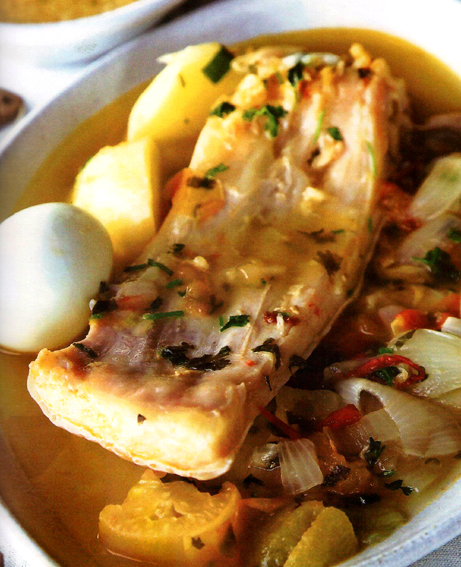
In yesterday's post about peixada cearense, we mentioned that the dish, like many other traditional dishes in Brazil and elsewhere, has numerous recipes and an untold number of variations. But unlike, for example, moqueca de peixe from Bahia or something like Greek moussaka, peixada cearense was popularized by one particular restaurateur in Ceará's capital, Fortaleza, only fifty-plus years ago. Thus, the myriad of recipes for peixada cearense can be thought of as theme and variations. There is Alfredo, Rei dos Peixes' recipe (the theme) and everybody else's (the variations).
In studying classical piano, it doesn't make any sense to practice the variations until you know the theme. Same thing with peixada cearense. The recipe below is Alfredo's original - once mastered, it can be changed, amended, altered and varied as you see fit. But you should try it this way the first time, just so you know the original.
One thing that you might have to vary, even the first time through, is the kind of fish that you use. Alfredo uses fish that are caught locally - right outside the front door of his restaurant, in fact. Fish like dourado, garoupa and badejo. You should too - use only fish that are fresh in your own city's fish markets. Firm-fleshed white fish are best, particularly those that can be bought in the form of steaks. We're found that one of the best is halibut, but in others can be just as successfully substituted in making your own peixada.
_____________________________________________________
RECIPE - Ceará Fish Stew (Peixada Cearense)
Serves 4
2 lb (800 gr) fish steaks - any firm-fleshed white variety
1 small (1/2 medium) green cabbage, cut into chunks
2 large boiling potatoes, peeled and halved or quartered depending on size
2 tomatoes, seeded and halved
2 medium carrots, peeled and quartered
1 green bell pepper, seeded and cut into large pieces
2 whole eggs, hardboiled and peeled
1 cup (250 ml) coconut milk
3 Tbsp extra-virgin olive oil
annatto oil (can substitute 1 Tbsp sweet paprika
1/4 cup chopped cilantro
1/4 cup chopped green onion, green parts only
salt and pepper to taste
--------------------------------------------------------------------------------
Heat the olive oil in a large saucepan. Add the onion, carrot, and bell pepper and cook for about five minutes. Add the annatto oil or paprika, mix well, then add the tomato, cabbage and potato. Add water just to cover the ingredients, then cover the pan, reduce heat and cook just until the potatoes and carrots are almost cooked.
Add the fish steaks, salt and pepper to taste, and the coconut milk. Stir gently to mix. Cook for about five minutes, uncovered, or until the fish is cooked and just beginning to flake. Add the whole eggs, continue to cook just until they are heated through, then remove from heat.
Stir in the cilantro and green onion, pour into a deep serving bowl and serve accompanied by white rice.
Showing posts with label stew. Show all posts
Friday, April 13, 2012
Monday, February 6, 2012
RECIPE - Panelada
Should you decide that you want to make the traditional Brazilian stew called panelada, you're likely to run into two obstacles en route to a culinary home run at the dinner table. First, if you live in North America or metropolitan areas of Europe you're likely to have problems finding sources for some of the ingredients that the dish demands. Things like cow stomach (including but not limited to tripe) and cow intestines. The other problem (at least if you consider honesty a virtue) is convincing family members, dinner guests or amyone else to whom you serve the dish to try panelada with an open mind. (If you don't consider honesty a virtue and try to lie your way into general acceptance of panelada the shape and form of the stomach and intestines will probably give your game away.)
But there are always those culinary pioneers who boldly go where no cook has gone before, and for them we offer this recipe for panelada from the northeastern Brazilian state of Ceará, where panelada is considered an iconic dish.
___________________________________________________
RECIPE - Panelada
Serves 4
1/2 lb (250 gr) cow stomach (tripe may be substituted)
1/2 lb (250 gr ) cow intestine
juice of 3 limes
1/2 Tbsp salt
2 large tomatoes, seeded and chopped
2 medium onions, chopped
1/2 Tbsp annatto powder (sweet paprika may be substituted)
2 bay leaves
1 red or green bell pepper, seeded and chopped
1 cup chopped cilantro
fresh-ground black pepper to taste
6 cloves garlic, minced
1 jalapeno or serrano chili
----------------------------------------------------------------------------
Using kitchen scissors, cut the stomach (or tripe) into small squares and the intestine into 1/2 in (1 cm) rings. Wash them very well in several changes of water. Put them in a heavy saucepan, cover with cold water, add the lime juice and bring to a boil over medium high heat. Let boil for one minute, then drain them in a sieve. When cool, wash again in several changes of fresh water.
In a large pan, combine the washed stomach or tripe and intestine, the salt, the chopped tomato and onions, the annatto or paprika and the bay leaves. Heat over medium heat, partially covered. Stir from time to time to mix ingredients and to help the tomato to break down. When liquid comes to a boil, reduce heat and simmer for approximately 40 minutes, adding a small amount of water from time to time if the dish appears to be drying out.
Stir in the bell peppers, the garlic and chilis. Cover the pan and cook over low heat until the meats can be easily pierced with a fork and are tender.
Remove from heat, pour into a deep serving bowl and mix in the chopped cilantro. Serve immediately accompanied by white rice.
But there are always those culinary pioneers who boldly go where no cook has gone before, and for them we offer this recipe for panelada from the northeastern Brazilian state of Ceará, where panelada is considered an iconic dish.
___________________________________________________
RECIPE - Panelada
Serves 4
1/2 lb (250 gr) cow stomach (tripe may be substituted)
1/2 lb (250 gr ) cow intestine
juice of 3 limes
1/2 Tbsp salt
2 large tomatoes, seeded and chopped
2 medium onions, chopped
1/2 Tbsp annatto powder (sweet paprika may be substituted)
2 bay leaves
1 red or green bell pepper, seeded and chopped
1 cup chopped cilantro
fresh-ground black pepper to taste
6 cloves garlic, minced
1 jalapeno or serrano chili
----------------------------------------------------------------------------
Using kitchen scissors, cut the stomach (or tripe) into small squares and the intestine into 1/2 in (1 cm) rings. Wash them very well in several changes of water. Put them in a heavy saucepan, cover with cold water, add the lime juice and bring to a boil over medium high heat. Let boil for one minute, then drain them in a sieve. When cool, wash again in several changes of fresh water.
In a large pan, combine the washed stomach or tripe and intestine, the salt, the chopped tomato and onions, the annatto or paprika and the bay leaves. Heat over medium heat, partially covered. Stir from time to time to mix ingredients and to help the tomato to break down. When liquid comes to a boil, reduce heat and simmer for approximately 40 minutes, adding a small amount of water from time to time if the dish appears to be drying out.
Stir in the bell peppers, the garlic and chilis. Cover the pan and cook over low heat until the meats can be easily pierced with a fork and are tender.
Remove from heat, pour into a deep serving bowl and mix in the chopped cilantro. Serve immediately accompanied by white rice.
Sunday, February 5, 2012
Panelada - A Polarizing Dish
Some foods, and some prepared dishes, evoke strongly opposing reactions among those who try or sample them. Call them the "love 'em or hate 'em" items of the food world. In a recent article in Huffington Post, ten foods were listed as being among the most polarizing - no one seems to be neutral about them. The ten were, in no special order, cilantro, blue cheese, Vegamite/Marmite, celery, coconut, liver, mayonnaise, marzipan, green pepper and licorice.
Just like those foods, there are some prepared dishes that get some folks' mouths watering and others trying to stifle a gag reaction. Scottish haggis, Norwegian lutefisk, Dutch raw herring, Chinese Dim Sum chicken feet, even sushi. Those who love these dishes don't just love them, they adore them. And those who don't - well, they can't abide them.
In Brazil, even though it contains such potential troublesome pig parts such as salted ears, salted tail and salted belly fat, almost everybody loves the dish often considered Brazil's national dish - feijoada. Or at least no one will admit they don't like it. But another widely loved traditional stew, called panelada, evokes a strong pro or con reaction even among Brazilians. For some Brazilians, panelada is the ultimate comfort food - something to eat on a cold rainy day, or the best cure for a wicked hangover. For others, even the smell of panelada cooking is enough to send them flying out of the kitchen with their hand over their mouths.
Panelada is just one of the many Brazilian variants of a stew - meat and vegetables cooked in a thick broth, all served together. Writer Roberto Da Matta, in his book "O Que Faz o Brasil, Brasil?" (What makes Brazil Brazil?), talks about the general Brazilian preference for stew-type dishes, from feijoada to peixada, to dobradinha, and of course, to panelada, "It appears we (Brazilians) have a prediliction for food that is neither liquid nor solid but halfway between the two."
So it's not the fact that it's a stew that makes panelada a "problematic" dish. It's what that stew contains. A proper panelada contains a wide variety of those parts of an animal collectively known as offal. One recipe, for example, calls for 2 lbs (1 kg) each of tripe, intestines, nerves and feet. another calls for hoof instead of foot. Most recipes will call for, at minimum, tripe, intestines and foot. It's these ingredients that make panelada, to coin a phrase, one man's meat and another man's poison.
Although panelada is made, and loved or hated, all around Brazil, it is particularly associated in most Brazilians' minds with the northeastern region of the country. Tomorrow we'll publish a recipe for a northeastern panelada, one from the state of Ceará.
Just like those foods, there are some prepared dishes that get some folks' mouths watering and others trying to stifle a gag reaction. Scottish haggis, Norwegian lutefisk, Dutch raw herring, Chinese Dim Sum chicken feet, even sushi. Those who love these dishes don't just love them, they adore them. And those who don't - well, they can't abide them.
In Brazil, even though it contains such potential troublesome pig parts such as salted ears, salted tail and salted belly fat, almost everybody loves the dish often considered Brazil's national dish - feijoada. Or at least no one will admit they don't like it. But another widely loved traditional stew, called panelada, evokes a strong pro or con reaction even among Brazilians. For some Brazilians, panelada is the ultimate comfort food - something to eat on a cold rainy day, or the best cure for a wicked hangover. For others, even the smell of panelada cooking is enough to send them flying out of the kitchen with their hand over their mouths.
Panelada is just one of the many Brazilian variants of a stew - meat and vegetables cooked in a thick broth, all served together. Writer Roberto Da Matta, in his book "O Que Faz o Brasil, Brasil?" (What makes Brazil Brazil?), talks about the general Brazilian preference for stew-type dishes, from feijoada to peixada, to dobradinha, and of course, to panelada, "It appears we (Brazilians) have a prediliction for food that is neither liquid nor solid but halfway between the two."
![]() |
| panelada |
Although panelada is made, and loved or hated, all around Brazil, it is particularly associated in most Brazilians' minds with the northeastern region of the country. Tomorrow we'll publish a recipe for a northeastern panelada, one from the state of Ceará.
Wednesday, July 13, 2011
RECIPE - Stewed Tambaqui Ribs (Caldeirada de Costela de Tambaqui)
Yesterday Flavors of Brazil suggested that farming the colossal Brazilian freshwater fish known as tambaqui could create an international market for this species and expecially for its ribs, which are the size and shape of pork baby back ribs - and just a wee bit healthier, being full of beneficial omega-3 oils rather than saturated pork fat.
In the meantime, you'll just have to come to Brazil for a dish of fish ribs - which isn't necessarily a bad thing at all. Here's a typical Brazilian presentation for these ribs - a variation on a traditional way of cooking any number of fish here in Brazil - stewed with tomatoes and onions, potatoes and hard boiled eggs. It's related to the peixadas of northeastern Brazil and more distantly to Bahian moquecas. Obviously, this is a recipe for reading, not making, for most readers of the blog since tambaqui ribs aren't available in your fish market and there is really no other substitute that's acceptable. But in anticipation of that day when tambaqui ribs will be available internationally, here it is.
_________________________________________________
RECIPE - Stewed Tambaqui Ribs (Caldeirada de Costela de Tambaqui)
Serves 2
2 racks of tambaqui ribs (3 or 4 ribs per rack)
Juice of 3 limes
2 Tbsp vinegar
4 cups water
1/2 Tbsp salt
2 Tbsp tomato paste
2 cloves garlic, crushed
1 Tbsp cilantro, finely chopped
1 medium onion, quartered
2 medium tomatoes, quartered and seeded
1 Tbsp annatto paste or powder (sweet paprika can be substituted)
2 cooked and peeled hard boiled eggs
2 medium boiling potatoes, cooked and quartered
2 Tbsp extra-virgin olive oil
----------------------------------------------------------------------
Wash the ribs in plenty of running water. Combine the lime juice and vinegar and rub into both side of the ribs. Let stand for five minutes, then dry the ribs thoroughly with paper towels.
In a large saucepan, combine the water, salt, tomato paste, garlic, cilantro, quartered onion and tomatoes, and the annatto. Stir with a wooden spoon to mix thoroughly and dissolve the tomato paste. Bring to a boil over medium heat, reduce heat to a slow boil and add the ribs, making sure they're covered with liquid. Cook for ten minutes, then add the cooked eggs and potatoes. Cook for five more minutes, then remove from heat.
In each of two deep serving plates, add one rib, one whole egg, and one quartered potato. Using a slotted spoon, remove solid ingredients from saucepan and distribute over the ribs. With a ladle pour just enough of the cooking liquid over to fill the serving plate. Drizzle with olive oil and serve immediately, accompanied with slices of French or Italian bread.
Recipe translated and adapted from Cozinha Regional Brasileira by Abril Editora.
In the meantime, you'll just have to come to Brazil for a dish of fish ribs - which isn't necessarily a bad thing at all. Here's a typical Brazilian presentation for these ribs - a variation on a traditional way of cooking any number of fish here in Brazil - stewed with tomatoes and onions, potatoes and hard boiled eggs. It's related to the peixadas of northeastern Brazil and more distantly to Bahian moquecas. Obviously, this is a recipe for reading, not making, for most readers of the blog since tambaqui ribs aren't available in your fish market and there is really no other substitute that's acceptable. But in anticipation of that day when tambaqui ribs will be available internationally, here it is.
_________________________________________________
RECIPE - Stewed Tambaqui Ribs (Caldeirada de Costela de Tambaqui)
Serves 2
2 racks of tambaqui ribs (3 or 4 ribs per rack)
Juice of 3 limes
2 Tbsp vinegar
4 cups water
1/2 Tbsp salt
2 Tbsp tomato paste
2 cloves garlic, crushed
1 Tbsp cilantro, finely chopped
1 medium onion, quartered
2 medium tomatoes, quartered and seeded
1 Tbsp annatto paste or powder (sweet paprika can be substituted)
2 cooked and peeled hard boiled eggs
2 medium boiling potatoes, cooked and quartered
2 Tbsp extra-virgin olive oil
----------------------------------------------------------------------
Wash the ribs in plenty of running water. Combine the lime juice and vinegar and rub into both side of the ribs. Let stand for five minutes, then dry the ribs thoroughly with paper towels.
In a large saucepan, combine the water, salt, tomato paste, garlic, cilantro, quartered onion and tomatoes, and the annatto. Stir with a wooden spoon to mix thoroughly and dissolve the tomato paste. Bring to a boil over medium heat, reduce heat to a slow boil and add the ribs, making sure they're covered with liquid. Cook for ten minutes, then add the cooked eggs and potatoes. Cook for five more minutes, then remove from heat.
In each of two deep serving plates, add one rib, one whole egg, and one quartered potato. Using a slotted spoon, remove solid ingredients from saucepan and distribute over the ribs. With a ladle pour just enough of the cooking liquid over to fill the serving plate. Drizzle with olive oil and serve immediately, accompanied with slices of French or Italian bread.
Recipe translated and adapted from Cozinha Regional Brasileira by Abril Editora.
Subscribe to:
Posts (Atom)