Showing posts with label tambaqui. Show all posts

Wednesday, July 13, 2011

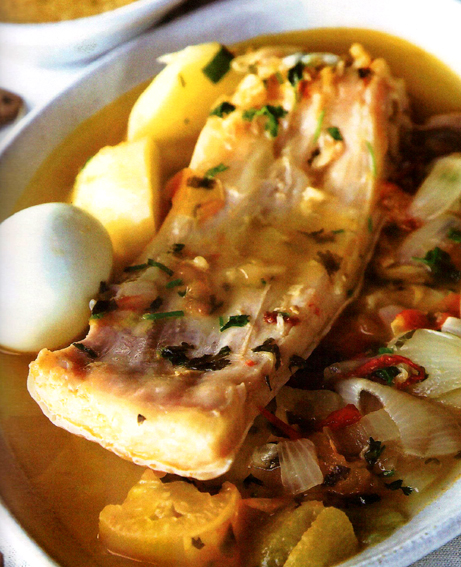
RECIPE - Stewed Tambaqui Ribs (Caldeirada de Costela de Tambaqui)

Yesterday Flavors of Brazil suggested that farming the colossal Brazilian freshwater fish known as tambaqui could create an international market for this species and expecially for its ribs, which are the size and shape of pork baby back ribs - and just a wee bit healthier, being full of beneficial omega-3 oils rather than saturated pork fat.

In the meantime, you'll just have to come to Brazil for a dish of fish ribs - which isn't necessarily a bad thing at all. Here's a typical Brazilian presentation for these ribs - a variation on a traditional way of cooking any number of fish here in Brazil - stewed with tomatoes and onions, potatoes and hard boiled eggs. It's related to the peixadas of northeastern Brazil and more distantly to Bahian moquecas. Obviously, this is a recipe for reading, not making, for most readers of the blog since tambaqui ribs aren't available in your fish market and there is really no other substitute that's acceptable. But in anticipation of that day when tambaqui ribs will be available internationally, here it is.
_________________________________________________
RECIPE - Stewed Tambaqui Ribs (Caldeirada de Costela de Tambaqui)
Serves 2

2 racks of tambaqui ribs (3 or 4 ribs per rack)
Juice of 3 limes
2 Tbsp vinegar
4 cups water
1/2 Tbsp salt
2 Tbsp tomato paste
2 cloves garlic, crushed
1 Tbsp cilantro, finely chopped
1 medium onion, quartered
2 medium tomatoes, quartered and seeded
1 Tbsp annatto paste or powder (sweet paprika can be substituted)
2 cooked and peeled hard boiled eggs
2 medium boiling potatoes, cooked and quartered
2 Tbsp extra-virgin olive oil
----------------------------------------------------------------------
Wash the ribs in plenty of running water. Combine the lime juice and vinegar and rub into both side of the ribs. Let stand for five minutes, then dry the ribs thoroughly with paper towels.

In a large saucepan, combine the water, salt, tomato paste, garlic, cilantro, quartered onion and tomatoes, and the annatto. Stir with a wooden spoon to mix thoroughly and dissolve the tomato paste. Bring to a boil over medium heat, reduce heat to a slow boil and add the ribs, making sure they're covered with liquid. Cook for ten minutes, then add the cooked eggs and potatoes. Cook for five more minutes, then remove from heat.

In each of two deep serving plates, add one rib, one whole egg, and one quartered potato. Using a slotted spoon, remove solid ingredients from saucepan and distribute over the ribs. With a ladle pour just enough of the cooking liquid over to fill the serving plate. Drizzle with olive oil and serve immediately, accompanied with slices of French or Italian bread.

Recipe translated and adapted from Cozinha Regional Brasileira by Abril Editora.

Tuesday, July 12, 2011

FISH OF BRAZIL - Tambaqui

With the oversized tambaqui as the topic at hand, we're back in the freshwater environment of the Amazonian rain forest, where everything seems to come in only one size - XXXL. The Amazonian basin is Brazil's Texas - everything is bigger there. Good news when you're talking about fresh water or medicinal plants, and distinctly bad news when you're talking about mosquitos (humungous), spiders (humungouser) or cockroaches (humungousest).

The tambaqui must feel very much at home in this habitat. Even its scientific name (Colossoma macropomum) speaks to its dimensions. (As an aside, our Latin here at Flavors of Brazil isn't all that good, but wouldn't macropomum  mean "Big Apple?" Maybe the tambaqui is a exiled New Yorker at heart). The species averages about 3 feet in length (1 meter) and adult specimens can weigh upwards of 65 lbs (30 kgs).

The tambaqui is perfectly suited to its habitat in the Amazon, which alternates between flood season and dry season on a yearly basis. During the flood season, the waters of the rivers overflow their banks and invade the surrounding forests, flooding them for miles around. When this happens, tambaqui literally swim into the forest and gorge themselves on fruits and seeds that fall into the water. When the waters recede, leaving only muddy pools of water, the tambaqui live off the fat that they built up during the time of plenty and calmly await the return of the next flood stage. It is this ability to live for long periods of time in stagnant, low-oxygen water that makes tambaqui an excellent species for aquaculture, and fish-farming tambaqui is a growing industry in the Amazon region.

Culinarily, the tambaqui is highly valued by local dwellers, who love its rich white flesh, full of healthy fish oils. In recent times, however, the tambaqui has also begun to be coveted by inventive chefs in Brazil's metropolitan cities, and a market has developed for tambaqui far from its jungle homeland. One thing that makes tambaqui intriguing for chefs and diners alike is its unique skeletal structure, with large bony ribs, which offers the possibility of creating dishes for racks of tambaqui ribs. Who's ever heard of fish ribs? Well, now, readers of Flavors of Brazil just have. Tambaqui ribs. They're wonderful.

Since the species is suitable for closed-container fish farming, an environmentally sustainable practice, we think that the tambaqui could have a great future in markets outside Brazil. Imagine Buffalo Tambaqui Ribs in place of Buffalo Wings, or BBQ Tambaqui Ribs cooked in a smoker. All it would take is someone with vision and  a knowledge of fish farming (perhaps a catfish farmer) and tambaqui ribs could become the talk of the town. It would be a great future for a species that's been around since the Miocene Era.

Flavors of Brazil will offer up a recipe for tambaqui fish ribs in tomorrow's post.